
Why Heat Dissipation Matters as Much as Power in Portable Jammers ?
When people compare portable signal jammers, wattage is usually one of the first specifications they notice. Heat dissipation rarely receives the same attention. Yet a compact electronic device can have considerable thermal challenges, the effectiveness of heat dissipation directly influences the maximum range at which a jammer device can disrupt signals.
The reason is simple: generating heat and getting rid of it are two different problems. Inside a portable enclosure, circuit boards, power components and batteries occupy limited space. Heat doesn't disappear simply because a device is small, and the way it is managed can affect component lifespan, battery condition and operating condition. Just like with cell phones, the better a jammer's heat dissipation, the greater the distance over which it can jam signals.
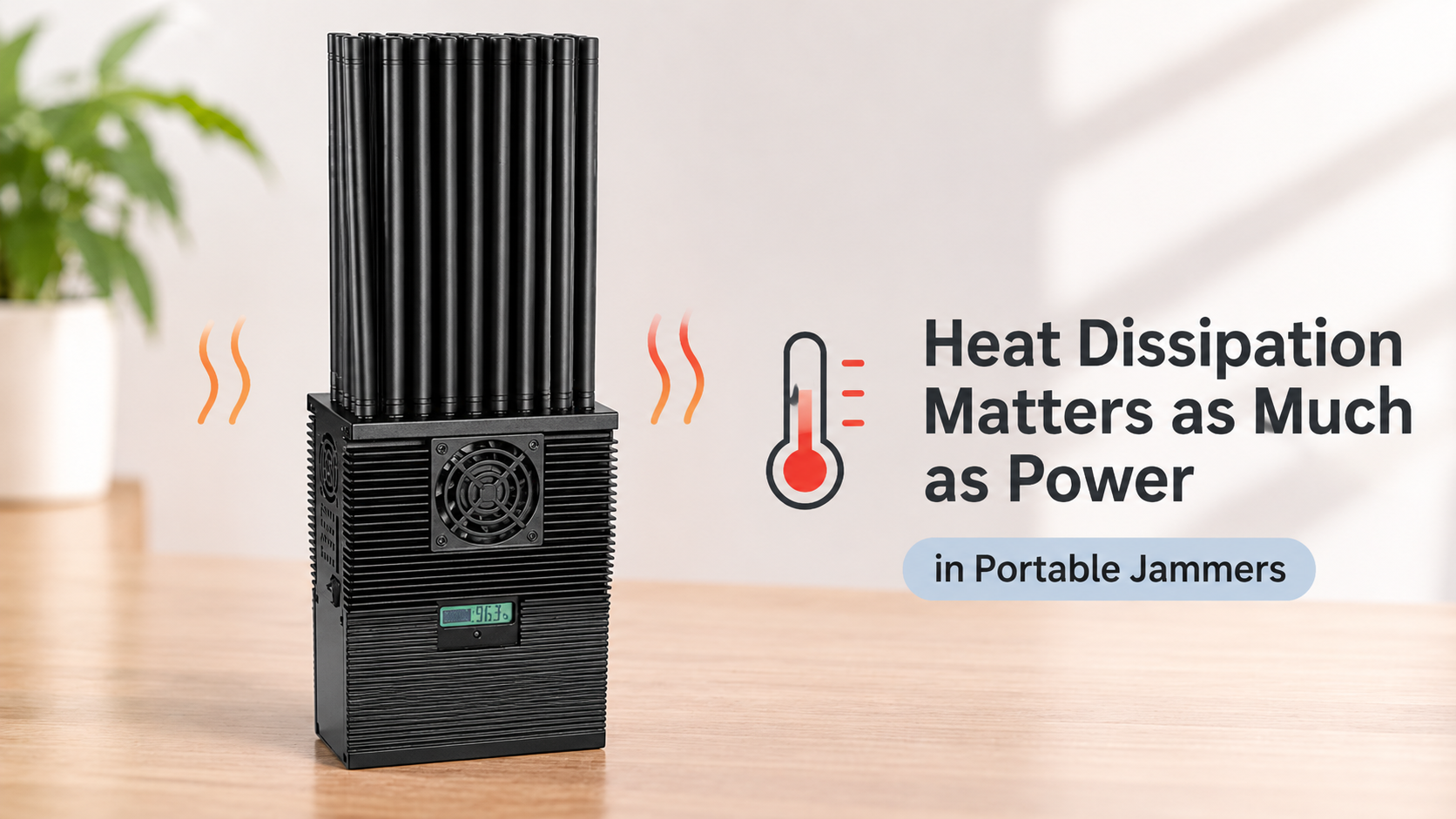
Why Heat Is a Real Challenge for handheld signal blockers ?
The smaller an electronic enclosure becomes, the less space engineers have to accommodate components, ventilation and thermal structures. This is particularly relevant to portable electronic equipment, where compact dimensions are often part of the product's design. That's "Why Do Smaller Signal Jammers Cost More When the Power Is the Same?"
Power transistors, voltage regulators and other electronic components generate heat as they operate. When several heat-producing components are located close together, their temperatures may influence one another. The enclosure, surrounding air and internal layout all affect how that heat is transferred away.
This is why heat dissipation in portable phone jammers is not merely a matter of adding ventilation holes. It involves the entire physical arrangement of the electronics and the thermal limitations of the components.
More Wattage Doesn't Automatically Mean Better Engineering
A power figure can be useful, but it doesn't reveal everything about a device. It cannot, on its own, describe component temperatures, thermal protection, battery condition or the engineering compromises inside a compact enclosure.
Consider two portable electronic devices with similar power consumption. One may use a different circuit layout, enclosure material or component arrangement from the other. As a result, their thermal characteristics may differ, even though their headline specifications look similar. Devices with good heat dissipation capabilities will undoubtedly have a greater range for signal interference.
Specifications are useful for comparison, but they rarely tell the complete story.
A 20W portable signal jammer may not necessarily perform better than a 10W model with a more effective cooling system, even when both are designed for portable use.
What Excessive Heat Can Do to Electronic Components ?
Temperature affects electronic components in different ways. The consequences depend on the component type, the amount of thermal stress and how long the component is exposed to elevated temperatures.
- Circuit components: Prolonged excessive temperatures can accelerate the aging of certain semiconductor components and capacitors.
- Rechargeable batteries: Heat can contribute to battery degradation and, under abnormal conditions, create safety risks.
- Thermal protection: Some electronic equipment incorporates temperature sensors or protective circuits that limit operation or trigger a shutdown.
- Enclosure temperature: The outer housing does not necessarily reflect the temperature of the internal components.
A device that feels warm is not automatically defective. Many electronic products produce heat during normal operation. The important distinction is whether the temperature remains within the limits specified by the manufacturer.
A Common Example: Electronics Left in a Hot Car
A familiar example is a portable electronic device left inside a parked car on a summer afternoon. The temperature inside a vehicle can rise substantially above the outdoor temperature, particularly when the car is exposed to direct sunlight.
Even electronics that are designed for portable use may have specified temperature limits for storage, operation and charging. These limits are not interchangeable.
The same principle applies to compact RF equipment, including portable mobile phone blockers. Environmental temperature, enclosure conditions and battery specifications all matter when it comes to safe handling and storage.
This is one reason why portable electronic device temperature limits are worth checking before relying on a product's physical size or advertised specifications.
What Buyers Often Overlook When Comparing Portable cell phone Jammers ?
Product pages often emphasize dimensions, wattage, battery capacity and the number of supported signal categories. Those specifications may be useful, but thermal and safety information is also worth reviewing.
Before purchasing portable electronic equipment, check whether the manufacturer provides:
- Documented operating and storage temperature ranges
- Battery charging and storage precautions
- Over-temperature protection information
- Ventilation or placement instructions
- Technical documentation and safety guidance
These details help establish what the device is designed for and what limitations apply. They also provide a more reliable basis for comparison than marketing figures alone.
Power, Heat and the Design of Portable Electronics
Unlike desktop jamming devices, portable signal jammers are designed with compact dimensions and mobility in mind. Their design involves more than simply fitting components into a small enclosure. Power consumption, battery specifications, component placement, thermal conditions and overall dimensions must all be carefully balanced to achieve a practical and functional design.
Heat dissipation deserves attention alongside power because power is not equivalent to jam distance.
