
How to Reduce GSM Jammer Range with Shielding?
The operating range of a GSM jammer depends on output power, antenna design, frequency band, room layout, and surrounding materials. RF shielding can reduce signal penetration, but it cannot guarantee a fixed coverage boundary.
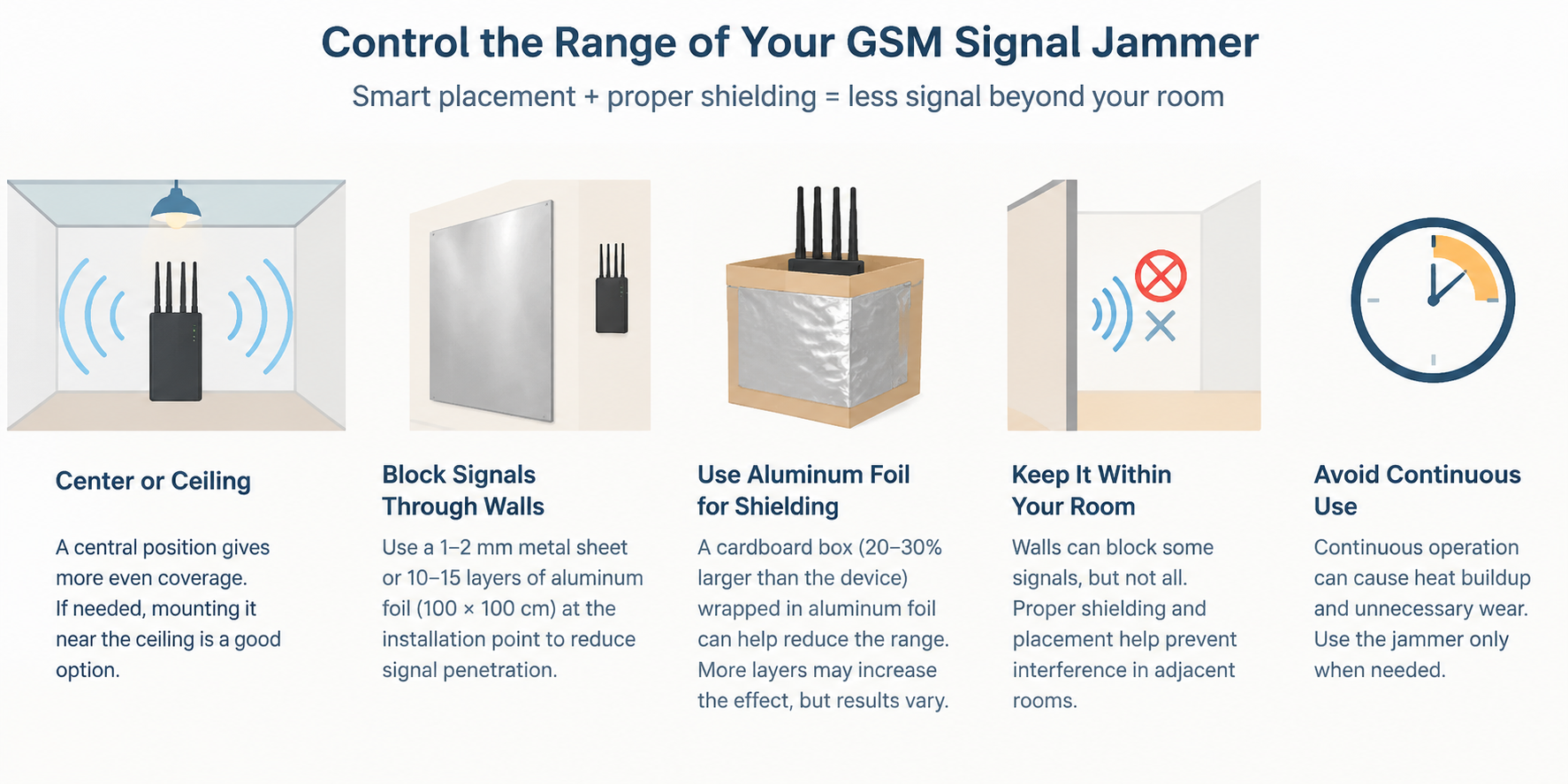
Can Aluminum Foil Reduce Signal Blocker Range?
Aluminum foil is conductive and can attenuate radio-frequency (RF) signals when used as part of a suitable shield. Its effectiveness depends on coverage, gaps, frequency, and the construction of the shield.
One proposed method uses a cardboard box approximately 20–30% larger than the jammer, wrapped in ordinary household aluminum foil. The number of layers may affect attenuation, but adding more foil does not guarantee a predictable reduction in range.
Do not wrap individual antennas or cover device components with foil. This may affect antenna performance, restrict cooling, or damage the jammer. Avoid enclosing an operating device unless the manufacturer confirms that the enclosure is suitable.
How Do Walls Affect GSM Jammer Coverage?
Walls can attenuate RF signals, but the amount depends on their material, thickness, and the frequency involved. Some signals may still pass into adjacent rooms.
The original shielding approach suggests placing a 1–2 mm metal sheet at the wall-mounted device's location or covering a 100 × 100 cm area with 10–15 layers of aluminum foil. These are proposed dimensions, not guaranteed shielding specifications. Actual attenuation depends on material conductivity, coverage, seams, and gaps.
Where Should You Place a GSM phone Jammer?
A jammer with an approximately omnidirectional antenna pattern distributes RF energy in multiple directions. Positioning it near the center of a room may provide more even coverage. If this is impractical, the original recommendation is to consider a position near the ceiling at the room's center, provided the device supports that installation.
Wall placement may allow some RF energy to reach the space beyond the wall. Metal barriers can reduce transmission, but their effectiveness varies. Neither foil layers nor a metal sheet guarantees that interference will remain within one room.
Why Avoid Continuous Operation?
Continuous operation can increase heat buildup and unnecessary component wear, especially when ventilation is restricted. Follow the manufacturer's cooling requirements and recommended duty cycle. If intermittent operation is supported, switch the device off when it is not needed.
Key Factors Affecting jammer device Range
- Output power: Influences the potential coverage area.
- Antenna design: Determines how RF energy is distributed.
- Frequency band: Affects how signals interact with walls and shielding materials.
- Room layout: Walls, furniture, and other obstacles influence propagation.
- RF shielding: Conductive barriers may attenuate signals, but results depend on their design and installation.
