
Why Car Key Jammers Don't Work With Every Vehicle ?
Most remote control jammers on the market focus on three familiar frequency bands: 315 MHz, 433.92 MHz and 868 MHz. These cover many conventional car remote controls, but they do not represent every frequency or wireless technology used in modern vehicles.
Some automotive key systems operate at more specific frequencies, such as 314.85 MHz. Others combine low-frequency communication at 125 kHz with a separate UHF channel. Newer digital keys can also use Bluetooth, NFC and Ultra-Wideband (UWB).
This explains why a 315/433/868 MHz car remote blocker cannot automatically work with every vehicle.
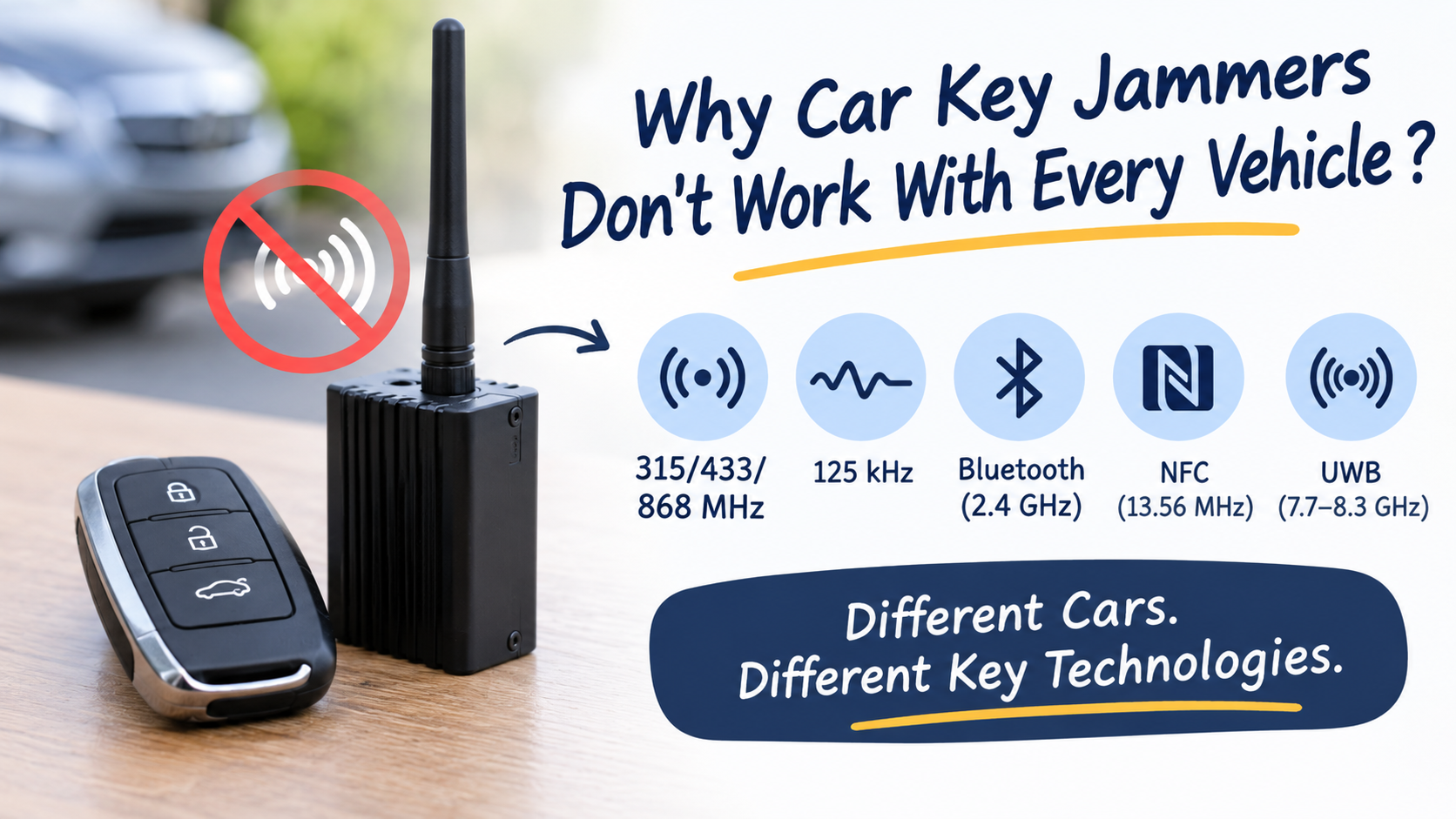
Car Key Remote Frequencies: More Than 315 MHz and 433 MHz
The frequency used by a car key remote depends on the vehicle's technical configuration and target market. Common examples include:
| Frequency | Typical automotive application |
|---|---|
| 315 MHz | Conventional remote key systems, particularly in North America and Japan |
| 314.85 MHz | Used in certain vehicle key-fob configurations |
| 433.92 MHz | Common automotive remote-control frequency in Europe and other markets |
| 868 MHz | Used by certain European remote-control systems |
| 125 kHz | Low-frequency communication in passive keyless entry systems |
| 2.4 GHz | Bluetooth-based digital car keys |
| 13.56 MHz | NFC-based vehicle access |
| 7.7–8.3 GHz | UWB digital key applications |
One important distinction: 125 kHz, Bluetooth, NFC and UWB are not simply additional conventional car remote-control frequencies. They belong to different communication technologies and serve different functions.
For example, a traditional key fob may transmit at 315 MHz, while a passive entry system uses a separate 125 kHz signal from the vehicle to communicate with the key.
125 kHz: A Frequency Often Overlooked in Car Key Systems
Many passive keyless entry systems use 125 kHz low-frequency communication.
When the driver approaches the vehicle or touches the door handle, the vehicle can send a low-frequency signal to activate and locate the key. The key then responds through a separate radio channel, often in the UHF range.
For example, one automotive key specification documents three regional RF configurations:
- US version: 315 MHz
- Japan/Korea version: 314.85 MHz
- European version: 433.92 MHz
The same system also describes a separate LF communication channel for passive key operation.
This is why looking only at the frequency printed on a car key specification may not reveal every wireless channel used by the vehicle.
Bluetooth, NFC and UWB: New Technologies Behind Digital Car Keys
Not all modern car keys rely on conventional RF remote controls. Smartphone-based digital keys introduce several additional wireless technologies.
Bluetooth Low Energy (BLE) – 2.4 GHz
BLE allows a compatible smartphone to communicate with the vehicle. Depending on the system, it can support digital key recognition, passive access and other vehicle functions.
NFC – 13.56 MHz
NFC is designed for close-range communication. Some vehicles allow drivers to unlock or access the car by placing a compatible smartphone or NFC key card near a designated reader.
Ultra-Wideband (UWB) – 7.7–8.3 GHz
UWB is used in advanced digital key systems for precise distance measurement. Rather than relying only on signal strength, it can measure signal travel time to help determine the location of an authorised digital key.
Some automotive digital key designs combine BLE, NFC and UWB in one system, with each technology handling a different part of the access process.
Why Most Car Lock Jammers Have Limited Frequency Coverage ?
The majority of conventional car remote blockers are designed around selected RF frequency bands, particularly 315 MHz, 433 MHz and 868 MHz.
This creates a straightforward limitation: a vehicle using a frequency outside the advertised range is not covered by that frequency specification.
There is also a difference between conventional remote keys and digital key systems:
- A traditional remote key may use 315 MHz or 433.92 MHz.
- A passive entry system may combine 125 kHz and a separate UHF channel.
- A smartphone-based digital key may use BLE, NFC or UWB.
- Some vehicles combine several of these technologies in one access system.
Therefore, a multi-band 315-433-868 MHz jammer is not necessarily a universal car key jammer. The number of advertised RF bands does not tell you whether the device supports every type of automotive key technology.
Check the Actual Key Specifications, Not Just the Car Brand
Two vehicles from the same manufacturer may use different key systems. Regional versions, production years and equipment configurations can all make a difference.
The original key fob's FCC ID, certification information, part number or manufacturer documentation can help identify its actual RF specifications.
It is also worth checking whether the vehicle uses a conventional remote key, passive keyless entry or a smartphone-based digital key.
A general statement such as "compatible with BMW," "compatible with Toyota" or "supports 315 MHz" is not enough to establish compatibility with every version of that vehicle.
Not Every Car Uses the Same Key Technology
315 MHz, 433.92 MHz and 868 MHz remain important frequencies in conventional automotive remote controls, but they are not the complete picture.
Other RF configurations exist, while 125 kHz, BLE, NFC and UWB are also part of modern vehicle access systems.
For anyone comparing car key jammers, car remote jammers or multi-frequency jammers, the distinction is important: a device covering several popular RF bands should not be mistaken for one that supports every vehicle.
The actual key frequency and wireless technology determine the scope of compatibility.
