
Why Do Smaller Signal Jammers Cost More When the Power Is the Same?
A mini jammer can cost twice as much as a much larger model with similar advertised output power. At first, that may seem difficult to explain.
If one jammer costs $500 and another costs $1,000 or more, why does the smaller RF jammer cost so much more when both are advertised at around 20 W ?
The answer is simple: the price of a jammer is not determined by size or wattage alone. You can also check our Common-Misconceptions About Cell Phone Jammers.
A compact high-power jammer has to fit RF circuits, power components, heat management, shielding and control electronics into a much smaller space. That makes the design more demanding—and often more expensive.
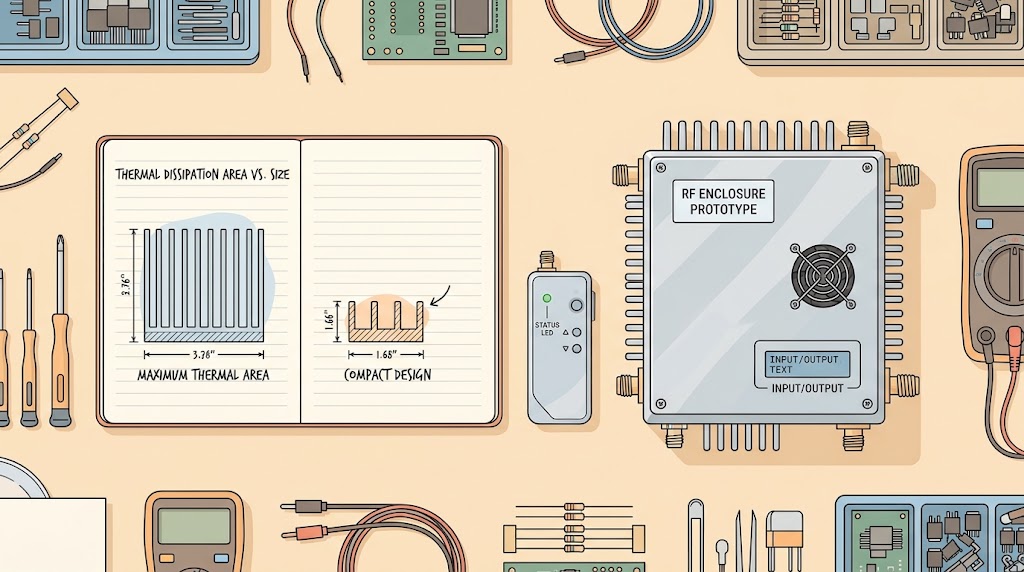
Same Output Power, Different Design
Two signal blockers can have the same advertised output power without being equivalent products.
The wattage does not tell you:
- how efficiently the jammer converts electrical power into RF output
- how heat is managed
- how the RF circuits are arranged
- how much internal shielding is used
- how compact the PCB design is
- how the device handles continuous operation
A large jamming device has more room for components, cooling structures and physical separation.
A compact jammer has to solve the same problems with much less space.
That difference can have a direct impact on the jammer price.
Why Heat Matters in a Compact Jammer ?
One of the biggest challenges in a high-power RF jammer is heat.
Electrical power does not simply disappear after reaching the RF output. Part of the input energy becomes heat, which must be moved away from sensitive components.
A larger enclosure makes this easier because there is more room for heat-spreading structures and physical separation.
A compact jammer has much less room.
This creates a basic engineering problem:
Similar power + less space = higher thermal density.
For a manufacturer, maintaining reliable operation in a smaller enclosure can require better thermal paths, carefully selected components and a more tightly controlled internal layout.
The result is higher development cost even though the finished product is physically smaller.
Miniaturization Can Increase the Cost of an RF Jammer
Smaller does not automatically mean cheaper.
In a specialized jammer, reducing the enclosure size can require:
- more compact PCB layouts
- tighter component placement
- shorter internal connections
- more careful RF isolation
- improved heat management
- more precise mechanical integration
The manufacturer is not simply using less material.
The manufacturer is trying to fit the same functional system into a smaller volume without creating new thermal, electrical or mechanical problems.
That is why a compact signal jammer can cost substantially more than a larger model with similar specifications.
Compact RF Design Requires More Care
RF circuits are sensitive to their physical environment.
The position of components, internal connections and shielding structures can affect how different sections of the device interact.
In a large jammer, designers have more physical space to separate different circuits.
In a compact jammer, there are fewer options.
Power electronics, RF sections, control boards and heat-generating components may all need to occupy the same limited area. The enclosure therefore becomes part of the engineering problem rather than simply a box around the electronics.
This is one reason compact RF equipment can carry a higher price.
Shielding Is More Difficult When Everything Is Packed Together
A signal jammer contains multiple electronic sections that must operate within the same enclosure.
Good electromagnetic design is not simply a matter of adding more metal.
The manufacturer also has to consider:
- component placement
- internal separation
- cable routing
- connector locations
- shielding between circuit sections
- electromagnetic compatibility
A larger enclosure provides more room to address these issues.
A smaller jammer has less physical space available, so the internal design has to be more carefully planned.
Why Can a Small Jammer Cost Twice as Much?
The bill of materials is only part of the final jammer cost.
The manufacturer also has to account for engineering, prototyping, testing and production.
For a compact high-power jammer, development may involve:
- RF circuit design
- compact PCB development
- thermal management
- enclosure design
- shielding and EMC considerations
- component selection
- mechanical integration
- testing and reliability checks
These development costs can be significant, particularly when the product is manufactured in relatively small quantities.
A larger jammer may therefore cost less even if it contains more physical material.
The difference is not necessarily the amount of plastic, metal or PCB inside the enclosure.
It can be the engineering required per unit of available space.
Size, Power and Price Should Be Compared Together
When comparing signal jammers, looking at output power alone can be misleading.
For example, two jammer models may both advertise 20 W, but one may use a much larger enclosure while the other is designed as a compact unit.
The relevant specifications should be considered together:
Output power + frequency coverage + size + thermal design + construction + operating requirements
This gives a much clearer picture of what you are actually comparing.
A smaller suppressor is not automatically more powerful.
A larger Jamming equipment is not automatically less sophisticated.
And a higher-priced jammer is not automatically a better product.
The key is understanding what is behind the specifications.
Why Compact High-Power Jammers Can Be More Expensive ?
The simplest way to put it is:
You are not paying for how much space the disruptor occupies. You are paying for how much engineering is required to make the system work reliably in that space.
A large enclosure gives designers more room for heat management, component separation and mechanical integration.
A compact high-power Silencer takes that space away.
That can increase design complexity, manufacturing requirements and development costs.
So when you compare a $500 jammer with a $1,000 compact jammer, do not look at price, size or wattage in isolation. Look at how those specifications work together.
For buyers researching a signal jammer, RF jammer or compact jammer, this is one of the most important points to remember: smaller equipment can require more engineering, not less.
