
Do 5G Jammers Heat Up More Easily Than GSM Jammers?
A cell phone jammer may feel barely warm when first switched on, yet become noticeably hotter after several hours. Sometimes the cooling fan keeps running, even when nothing else seems to have changed. It is natural to wonder whether 5G cell jammers run hotter than GSM blockers, or whether something else is responsible.
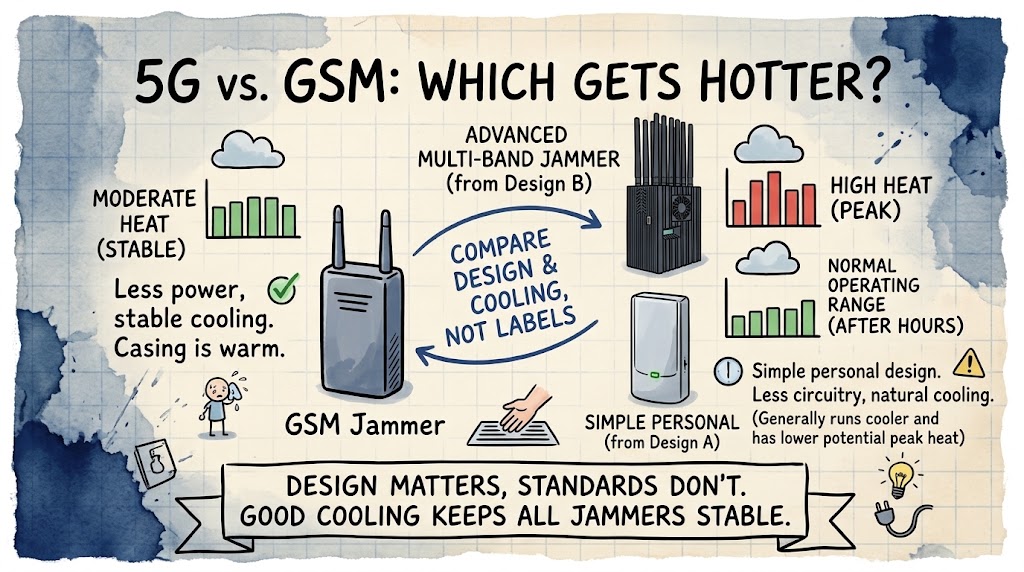
The answer is not as simple as comparing 5G with GSM. Power consumption, heat dissipation, and cooling design usually tell you much more about a device's operating temperature than its supported cellular standards.
Why Do Some Cell Phone Jammers Get Hot After Hours of Use?
Heat builds up when electronic components produce it faster than the cooling system can remove it. During continuous operation, even a device that feels only slightly warm at first can reach a higher, more stable temperature later.
This is why Cellular jammers that get hot after several hours should not be judged by how they feel during the first few minutes. Power supplies, internal amplifiers, ventilation, and room temperature all affect how much heat accumulates.
Two jammer devices with similar applications can behave quite differently. One may release heat efficiently through its housing and cooling system, while another retains more heat because its internal layout or airflow is less effective.
More frequency bands do not automatically mean more heat. Additional circuitry can increase power consumption, but the overall design determines how much heat is produced and how effectively it escapes.
Are 5G Jammers Hotter Than GSM Jammers?
Not necessarily. A 5G jamming device does not automatically run hotter simply because it supports newer cellular technology.
The key difference is often the balance between electrical power consumption and thermal efficiency. A device that consumes more power may produce more waste heat, while differences in component efficiency and cooling can lead to different temperatures even among products with similar specifications.
That is why comparing 5G jammer vs. GSM jammer operating temperature requires more than looking at the product name. Manufacturer specifications for power consumption, operating temperature, cooling requirements, and continuous operation provide a more useful basis for comparison.
Without comparable measurements, there is no reliable way to say that all 5G jammers run hotter than all GSM 3G 4G jammers.
What Does It Mean When a Jammer's Cooling Fan Runs Constantly?
A cooling fan that runs continuously is not necessarily a sign of a problem. Some designs use continuous airflow, while others adjust fan operation according to internal temperature.
What matters is whether the behaviour is normal for that particular model. If a jammer's cooling fan suddenly becomes louder or runs differently than usual, especially alongside excessive heat or unexpected shutdowns, it is worth checking the operating conditions.
Restricted ventilation, dust buildup, a faulty fan, or a warmer room can all affect heat removal. The fan is only one part of the process: heat must first move away from internal components before airflow can carry it out of the enclosure.
Keep ventilation openings clear and follow the manufacturer's maintenance instructions. If the unit becomes unusually hot, smells of overheated plastic, or repeatedly shuts down, switch it off and follow the manufacturer's safety guidance.
Can a Cool Jammer Housing Hide Excessive Internal Heat?
Yes. The temperature of the outer casing does not always reflect the temperature of the components inside.
Some housings transfer heat readily to the surface, so they may feel warm during normal operation. Others retain more heat internally, leaving the exterior comparatively cool. A cool casing does not necessarily mean a jammer is running efficiently, just as a warm casing does not automatically indicate poor quality.
The manufacturer's operating-temperature limits and thermal-protection specifications are more reliable indicators than touch alone. If temperature readings are needed, use an appropriate measurement method and compare the results with the manufacturer's stated limits.
How Room Temperature Affects Jammers During Continuous Operation?
The surrounding environment is easy to overlook. Yet a jammer operating in a hot room has less opportunity to release heat than the same device in cooler air.
Blocked air outlets, enclosed spaces, and poor ventilation can make the problem worse. Over time, these conditions may contribute to heat buildup in cell phone jammers during continuous operation, even when the equipment itself has not changed.
Always follow the manufacturer's requirements for ambient temperature, ventilation, and operating duration. Do not cover ventilation openings or modify the enclosure to improve cooling. Click here to learn more: When and Under What Conditions Does a Cell phone Jammer Work Best ?
What Should You Compare Before Judging a Jammer's Temperature?
| Factor | Why it matters |
|---|---|
| Power consumption | Higher electrical consumption can mean more waste heat. |
| Thermal efficiency | Component efficiency affects how much energy is lost as heat. |
| Cooling design | Airflow, heat sinks, and enclosure design influence heat removal. |
| Continuous operation | Heat may accumulate over longer operating periods. |
| Ambient temperature | Warm surroundings make cooling less effective. |
| Operating limits | Manufacturer specifications help establish acceptable conditions. |
The Bottom Line
5G signal blockers are not automatically hotter than GSM jammers. Their operating temperatures depend on power consumption, component efficiency, cooling design, and the conditions in which they run.
If a cell phone jammer becomes hotter after several hours, the useful questions are whether heat is accumulating, whether ventilation is unobstructed, and whether the device remains within its specified operating limits. The GSM or 5G label alone cannot answer those questions.
