
Does a Signal Jammer with More Frequency Bands Run Hotter?
A jammer device with eight frequency bands may look more capable than a four-band model. A higher-power model may also seem like the obvious choice. But there is another question worth asking before comparing specifications: how much heat does the device generate when it is doing its job? In our previous article, we discussed the critical temperature at which a jammer starts to overheat.
The answer becomes more interesting when the comparison is fair. What happens when two signal jammers deliver the same total RF output power but support different numbers of frequency bands? And if two devices use the same type of cooling, does the higher-power model naturally run hotter?
These are two different questions. The first is mainly about circuit efficiency and how the available power is distributed. The second is about the relationship between output power, electrical consumption and heat dissipation.
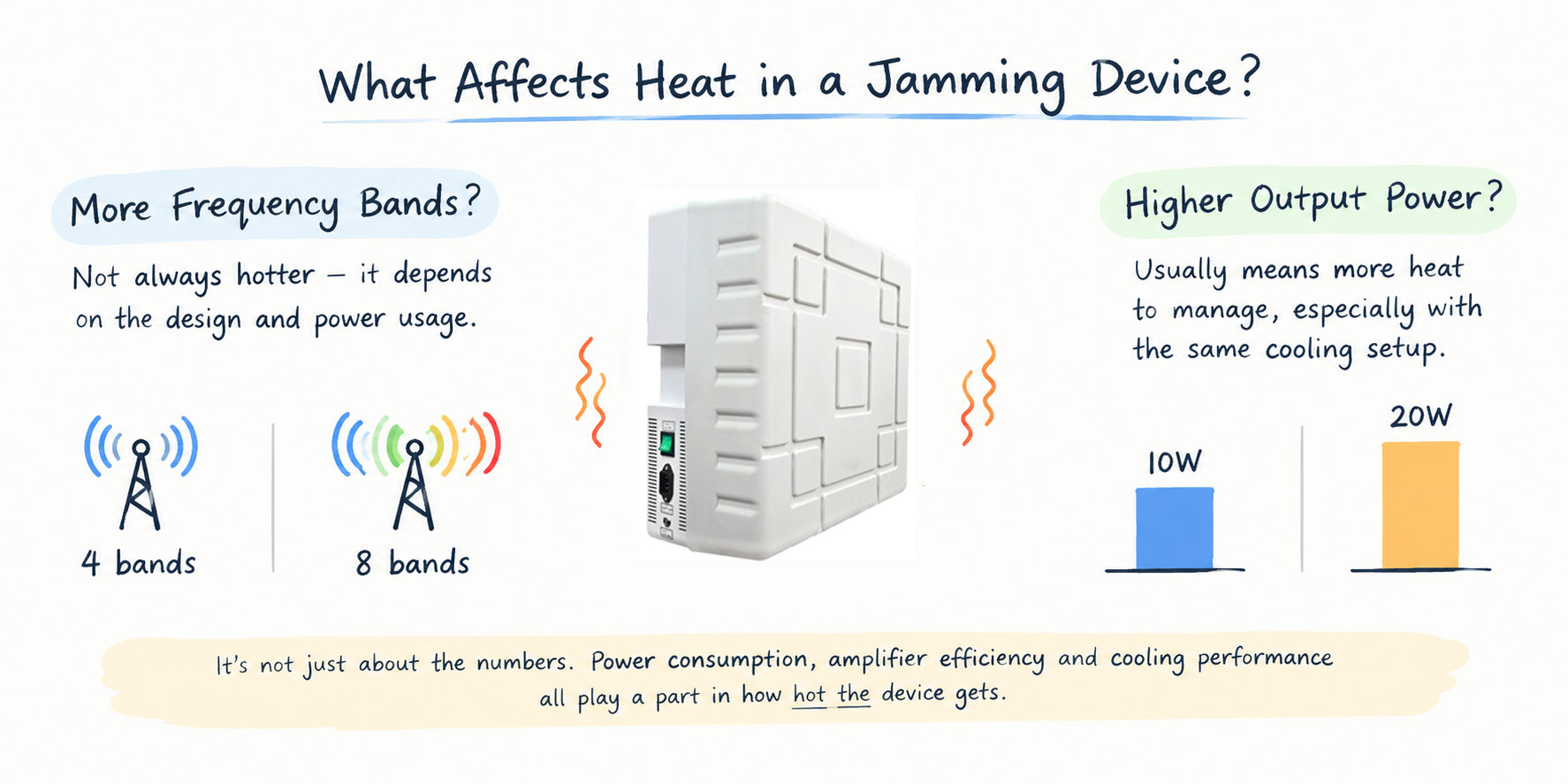
1. Same Total Output Power, More Frequency Bands: Does Heat Increase?
Imagine two signal blockers with the following specifications:
- Model A: Four frequency bands, 20 W total RF output power.
- Model B: Eight frequency bands, 20 W total RF output power.
At first glance, both devices deliver the same total output. It would be easy to assume that they should also generate roughly the same amount of heat.
However, equal total RF output power does not necessarily mean equal electrical consumption.
The reason lies inside the device. Depending on its architecture, a multi-band signal jammer may use separate RF amplifiers and supporting circuits for different frequency ranges. Those components consume energy, and not all of that energy becomes useful RF output. The remaining losses contribute to heat.
If the eight-band model requires more electrical input to deliver the same 20 W of RF output, it will generally generate more heat.
But there is an important detail here: adding frequency bands does not automatically increase heat generation. Some designs share circuitry, while others use more efficient amplifiers or power supplies. The actual result depends on how the manufacturer has designed the electronics.
A practical example: Same 20 W output, different electrical consumption
Consider the following hypothetical comparison. The figures illustrate the principle; they are not measurements of specific products.
| Specification | Four-band model | Eight-band model |
|---|---|---|
| Total RF output | 20 W | 20 W |
| Electrical input power | 40 W | 50 W |
| Approximate power converted into heat | 20 W | 30 W |
For simplicity, assume that RF input power is negligible and that the figures refer to the same overall device boundary.
Both models deliver 20 W of RF output, but the second consumes an additional 10 W of electrical power. Under these assumptions, that extra energy appears as additional heat.
This is the detail that a product specification listing only frequency bands and output wattage will not reveal.
When comparing multi-band frequency jammers heat generation, electrical input power can tell you more than frequency-band count alone. If the input-power figures are unavailable, the number of bands is only a rough clue, not a reliable way to rank devices by temperature.
2. Why Can More Frequency Bands Create Extra Heat?
The number of frequency bands matters because each supported band can introduce additional design requirements.
Depending on the architecture, the device may need additional amplifiers, filters, matching networks, switching components or power-regulation circuitry. These components do not all produce the same amount of heat, but their combined losses can affect the thermal load.
There is also a less obvious factor: the efficiency of an RF amplifier can vary across its operating frequency range. Two amplifiers delivering the same output power at different frequencies may not consume exactly the same amount of electrical power.
That means even a device with a fixed total output rating can have different thermal behaviour depending on its circuit design and operating conditions.
For example, a four-band device with relatively inefficient amplifiers could generate more heat than an eight-band device built around a more efficient architecture. The larger band count does not automatically make the latter hotter.
Now consider the second comparison.
Two signal jammers use the same general cooling method. Both have similar enclosure designs and operate under comparable ambient temperatures. The main difference is their rated RF output power.
Model C: 10 W RF output.
Model D: 20 W RF output.
A practical example: 10 W versus 20 W RF output
Suppose both devices have an illustrative amplifier efficiency of 40%, measured as RF output divided by DC input power. For this simplified example, assume that the remaining DC input power is dissipated as heat within the amplifier.| Specification | 10 W model | 20 W model |
|---|---|---|
| RF output power | 10 W | 20 W |
| DC input power | 25 W | 50 W |
| Approximate amplifier heat dissipation | 15 W | 30 W |
The higher-power amplifier delivers twice the RF output and consumes twice the DC input power. Under these assumptions, it also dissipates twice as much heat.
Real products may have different efficiency curves, power-supply losses and thermal designs, so their results will not always follow this exact ratio. Nevertheless, the example illustrates the general relationship.
With comparable efficiency and cooling capacity, higher RF output power usually creates a greater heat-dissipation burden.
The cooling method alone does not change that energy balance. Two devices may both use fans, for example, but that does not mean their fans, heat sinks or internal airflow paths can remove the same amount of heat.
4. Same Cooling Method Does Not Mean Same Cooling Performance
This is where product comparisons can become misleading.
A fan-cooled signal jammer and another fan-cooled signal jammer share the same basic cooling method. Yet one may have a larger heat sink, better contact between the amplifier and the heat sink, or a more effective airflow path.
The same distinction applies to passively cooled devices. Two models may both rely on metal housings to release heat, but differences in surface area, material, internal mounting and thermal resistance can change how effectively heat escapes.
Consider a higher-power device designed with a larger heat sink. It may generate more total heat than a lower-power model while maintaining a similar external temperature. The additional heat is being removed more effectively.
Conversely, a lower-power device with limited heat transfer may develop a hot spot even though its total heat generation is relatively modest.
This is why signal jammer cooling efficiency and signal jammer heat dissipation are useful comparison topics in their own right.
The important distinction is between heat generated inside the device and temperature reached by a particular component or surface. They are related, but they are not interchangeable measurements.
5. Why Does a Signal Jammer Get Hotter During Extended Operation?
A device's temperature immediately after startup tells you very little about its long-term thermal behaviour.
When a signal jammer begins operating, its internal components start generating heat. At first, the device may remove that heat faster than the temperature rises. As the components warm up, the rate of heat removal increases with the temperature difference between the device and its surroundings.
Eventually, the device may reach a relatively stable operating temperature, provided the heat generated and the heat removed approach a balance.
If the cooling system cannot remove heat as quickly as the electronics generate it, the temperature will continue to rise until a new balance is reached—or until the device reaches a thermal protection limit.
This explains why signal jammer temperature during continuous operation is a more meaningful consideration than a brief startup observation.
For example, two devices may feel similarly warm after five minutes. After a longer period, the higher-power model may reach a higher temperature because it generates more heat than its cooling system can remove under those conditions.
The reverse is also possible if the higher-power model has substantially better cooling.
For this reason, thermal comparisons should be made under comparable operating durations, ambient temperatures and workloads. A short test and an extended operating test do not necessarily reveal the same behaviour.
6. Can a Cooler Signal Jammer Be More Powerful?
Yes. A cooler-running device is not necessarily less powerful, and a hotter device is not automatically poorly designed.
A more efficient amplifier can deliver the same RF output while consuming less electrical power. A well-designed enclosure can also transfer heat away from critical components more effectively.
For instance, one device might deliver 20 W of RF output while dissipating 15 W of heat in its amplifier. Another might deliver the same output but dissipate 25 W because of lower efficiency. If their cooling systems are comparable, the second device has a greater thermal burden.
However, the outer casing may not tell the whole story. Heat can be concentrated around one amplifier, power supply or other internal component. A casing that feels relatively cool does not guarantee that every internal component is operating at a low temperature.
Likewise, a warm metal housing can indicate that heat is being transferred away from internal components rather than trapped inside.
Temperature alone is not a reliable way to rank signal jammer power, quality or efficiency. Electrical consumption, actual output specifications and thermal-performance data provide a more useful basis for comparison.
7. What Should You Check When Comparing Signal Jammer Specifications?
If heat generation matters when evaluating a signal jammer, look beyond the number of frequency bands and the advertised wattage.
Total RF output power
Check whether the manufacturer specifies combined output power or power per band. These figures describe different things, and confusing them can lead to an inaccurate comparison.
Electrical input power
This helps show how much energy the complete device consumes. When two products have the same total RF output, a higher electrical input generally indicates greater overall losses, assuming comparable measurement boundaries and operating conditions.
Amplifier efficiency
Efficiency helps explain why two devices with similar output ratings may generate different amounts of heat. It is also important to know which efficiency metric is being quoted, because amplifier efficiency and power-added efficiency are not identical.
Cooling capacity
Look at the complete thermal design rather than simply checking whether a fan is present. Heat sinks, component mounting, airflow and the path from the amplifier to the surrounding air all matter.
Continuous operating limits
Check the manufacturer's specified operating-temperature limits and any restrictions on continuous use. A product's maximum output rating alone does not establish how it will perform thermally over an extended period.
These details are especially useful when comparing high-power signal jammer heat dissipation or trying to understand why two multi-band models with similar specifications run at different temperatures.
Final Takeaway: Compare the Energy Balance, Not Just the Numbers
The two comparisons lead to different but related conclusions.
When total RF output power remains the same, a signal jammer with more frequency bands may generate more heat if its additional circuitry increases electrical consumption. However, band count alone cannot establish which device will run hotter.
When the cooling method and other important conditions are comparable, a higher-power signal jammer will generally generate more heat because producing more RF output requires more energy and involves additional losses. The actual temperature still depends on efficiency and cooling capacity.
In both cases, the most useful question is not simply how many bands the device supports or how many watts it advertises. It is how much electrical power the device consumes, how much becomes useful RF output, and how effectively the remaining heat is removed.
That is the difference between comparing specifications on paper and understanding the thermal behaviour those specifications can produce.
