
Portable vs. Desktop Signal Jammers: Which Has a Longer Range at the Same Power?
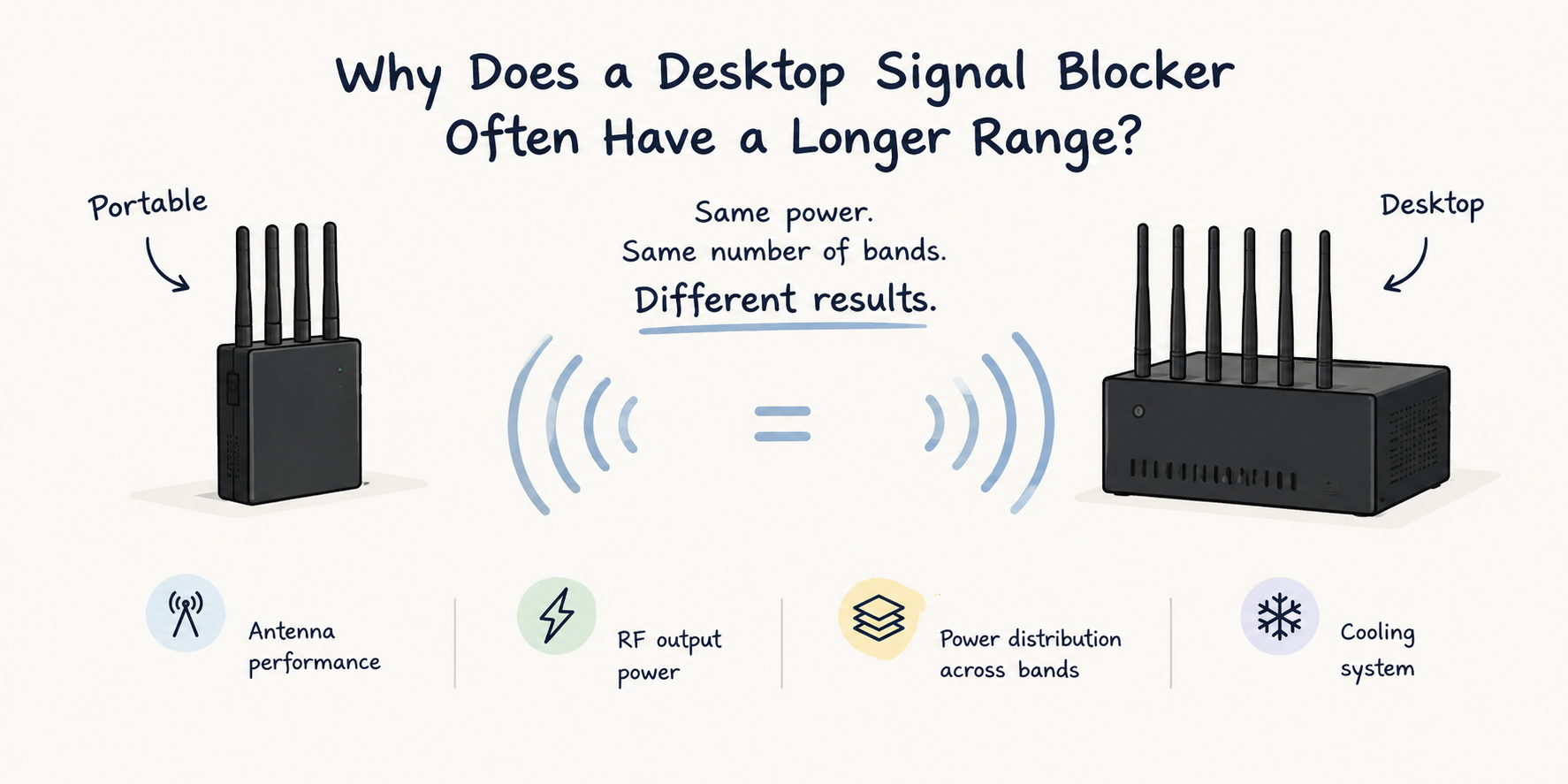
When comparing portable and desktop jamming devices, many buyers focus on two specifications: output power and the number of frequency bands. If both devices have the same figures, it seems reasonable to expect similar performance.
In practice, however, desktop models can often achieve a longer interference range.
The reason is not simply that desktop devices are larger. The difference often comes down to antenna design, RF power delivery, and how effectively the entire system maintains its intended performance.
1. The Same Rated Power Does Not Tell the Whole Story
Suppose a portable cell blocker and a desktop jammer both advertise the same total output power and support the same four frequency bands. On paper, they appear comparable. Why Do Smaller Signal Jammers Cost More When the Power Is the Same?
But rated power alone does not reveal how much RF power reaches each antenna, how efficiently the antennas radiate it, or how that energy is distributed in different directions.
Internal RF losses can also vary between designs. As a result, two devices with identical headline specifications may not produce identical RF performance.
This is an important distinction when comparing signal blocker range at the same power. The wattage printed on a product page is a useful starting point, but it is not a complete measure of the system's radiated performance.
2. Why Antenna Design Can Give Desktop Models an Advantage
A portable Silence has to fit its electronics and antenna system into a compact enclosure. That creates practical design constraints, particularly when several frequency bands must be supported in one device.
A desktop model may have more room for a different antenna arrangement and associated components. Depending on the design, this flexibility can help improve antenna efficiency or produce a radiation pattern better suited to its intended use.
The key point is that antenna performance matters more than antenna size alone. A larger antenna is not automatically more efficient, and a compact antenna is not necessarily inferior. As we mentioned earlier: Why High-Gain Antennas Are Not Suitable for Every Jammer Frequency Band ?
What matters is how well the antenna system is designed for the frequencies involved and how it performs as part of the complete device.
This is one reason why comparing a portable jammer vs. a desktop jammer based only on advertised wattage can lead to misleading conclusions.
3. Does the Number of Frequency Bands Affect Range?
The number of supported bands is another specification that deserves closer attention.
Two jammers may support the same four bands but distribute their total output power differently. Their individual transmitters, filters, RF components, and antenna systems may also differ.
Consequently, matching the band count does not guarantee matching performance on every band.
It is also important to distinguish between total output power and power allocated to an individual band. A total power rating does not, by itself, show how much power is available on each supported frequency range.
The number of bands tells you how many frequency ranges the device covers, not whether its RF performance is equivalent to another model.
For buyers comparing multiband signal jammers, this is a more useful detail than simply counting the bands listed in the specifications.
4. Can Better Cooling Make a Difference?
Desktop jammers often have more room for heat sinks, fans, and other thermal-management components. Portable models must accommodate similar engineering challenges within tighter limits on size and weight.
This difference can matter during extended operation.
If a device's temperature rises enough to affect its operating performance, it may not maintain the same output throughout its operating period. A well-designed cooling system can help prevent this problem.
However, cooling should not be treated as a direct measure of range. If two devices maintain the same actual RF output and have comparable antenna performance, better cooling alone does not make one reach farther.
Its main benefit is helping the equipment maintain its intended performance under the conditions for which it was designed.
5. Why Can a Portable Model Still Compete?
Despite these potential advantages, a desktop jammer is not automatically the better-performing device.
A portable model with an efficient antenna system and low internal RF losses may outperform a desktop model with a less effective design. The difference depends on the actual hardware, not the product category.
The surrounding environment also matters. Walls, building materials, obstructions, and reflections can change how RF energy propagates. A result obtained in one setting may not be representative of performance in another.
For this reason, a meaningful technical comparison requires equivalent measurement conditions and reliable specifications rather than assumptions based on enclosure size.
Portable vs. Desktop Signal Jammer: What Really Matters?
When comparing two models with the same advertised power and number of frequency bands, these are the main specifications worth examining:
| Factor | Why it matters |
|---|---|
| Actual RF output power | Shows whether the devices deliver comparable output under the stated conditions. |
| Power distribution by band | Reveals differences that total wattage can conceal. |
| Antenna efficiency | Influences how effectively supplied RF power is radiated. |
| Antenna radiation pattern | Determines how energy is distributed in different directions. |
| Internal RF losses | Affect the power delivered to the antenna. |
| Thermal performance | Helps establish whether the specified output can be maintained during operation. |
| Test conditions | Determines whether the reported results can be compared fairly. |
These factors help explain why two devices with similar headline specifications may deliver different results.
The Final Verdict
Desktop phone jammers can often achieve a longer interference range than portable models, even when their advertised output power and number of frequency bands are the same. Greater design flexibility may allow some desktop models to use more suitable antenna configurations, manage RF losses differently, or maintain their intended performance more effectively.
However, the advantage is not guaranteed by the enclosure itself. A desktop model with an inefficient RF system can perform worse than a well-designed portable alternative.
