
Low-Power Bluetooth Jammers: Why Are Some Devices Harder to Disrupt?
Why might a low-power 2.4GHz Jammer affect one device but have little noticeable effect on another? The difference is not always obvious. Two Bluetooth products can operate in the same frequency band yet respond differently to radio-frequency interference.
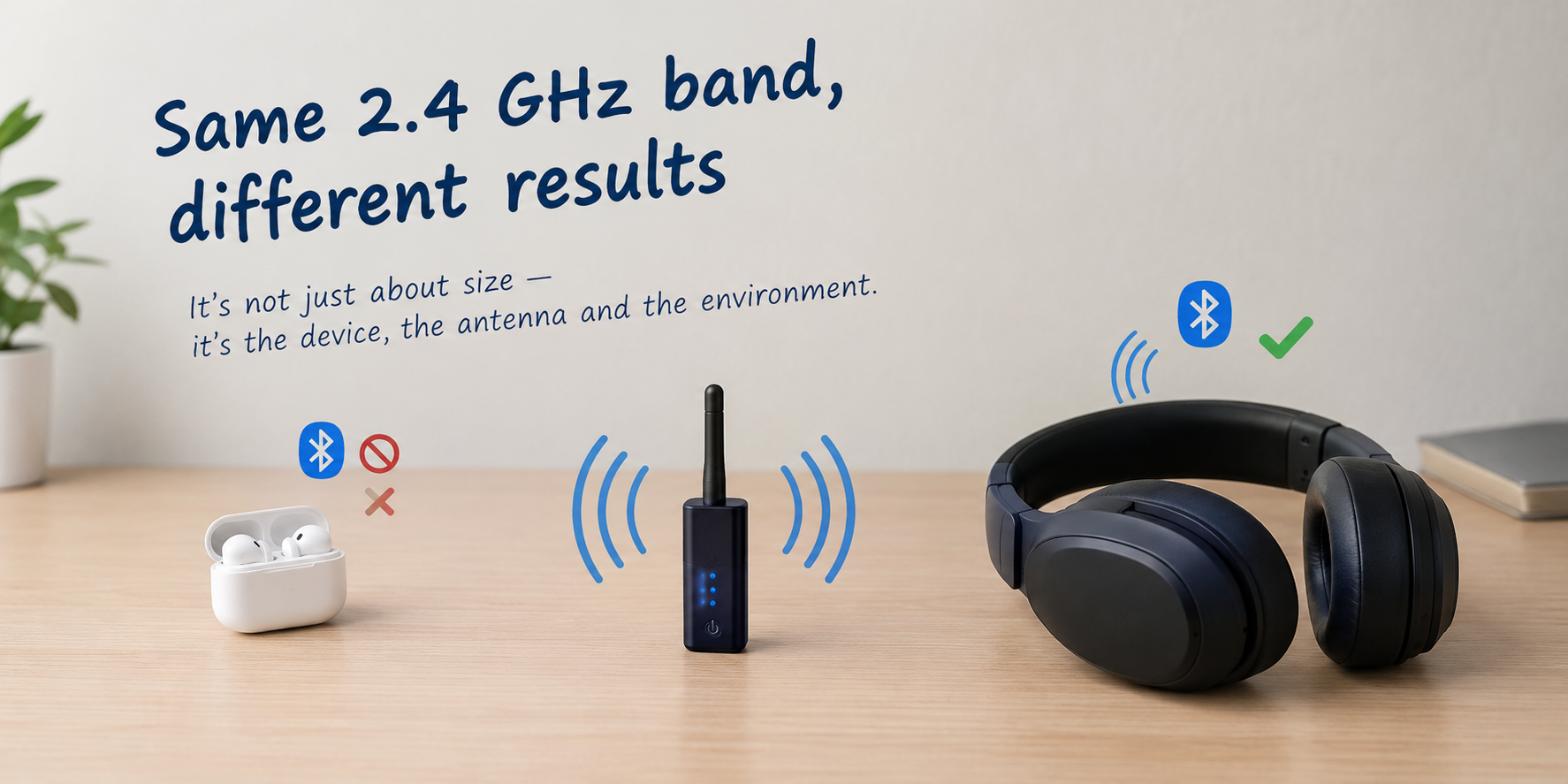
The size of a device can influence its wireless design, but it does not tell the whole story. A device's resistance to Bluetooth interference depends on its antenna, receiver performance, signal strength, and operating environment—not simply its physical dimensions.
Why Can Small Bluetooth Devices Be More Sensitive to Interference?
Compact Bluetooth devices have limited space for antennas and radio components. Battery-powered products must also balance wireless performance with energy consumption. In a previous article, we wrote that Bluetooth jammers can easily interfere with Xiaomi's latest AI glasses.
These design constraints can influence how effectively a device transmits and receives signals. If the desired Bluetooth signal reaching the receiver is already weak, additional interference may cause connection problems more easily.
This can apply to different types of compact Bluetooth equipment, including small audio accessories, wireless input devices, and other battery-powered electronics.
However, a smaller device is not automatically more vulnerable to a low-power Bluetooth Silencer. Some compact products have efficient antennas and well-designed receivers that maintain reliable connections under challenging conditions.
Why Might a Larger Bluetooth Device Be Less Affected?
Larger equipment may have more room for antennas and radio components. Depending on its design, it may also have different transmission characteristics and better reception under certain conditions.
These differences can help explain why one device continues working while another experiences interruptions.
But size alone does not establish whether a device can withstand interference. A large product may still have a sensitive receiver or unfavorable antenna placement. A compact device may perform better than expected because of its wireless design.
The important distinction is between physical size and actual radio performance. They are related in some designs, but they are not interchangeable.
Does a Low-Power Bluetooth blocker Affect Every Device in the Same Way?
No. Different Bluetooth devices can respond differently to the same interference source.
Bluetooth operates in the 2.4 GHz band, which is also used by many Wi-Fi devices. Depending on the frequencies and signals involved, interference in this band may affect Bluetooth communications.
Bluetooth uses frequency hopping to help maintain communication in a busy radio environment. However, this feature cannot guarantee uninterrupted operation under every interference condition.
A low-power source of radio-frequency interference may cause noticeable problems for one device while another continues operating normally. The outcome depends on the desired signal reaching each receiver, the receiver's characteristics, antenna performance, and the surrounding radio environment.
This is why the effect of a low-power 2.4 GHz jammer cannot be predicted from device size alone.
What Determines Bluetooth Interference Range?
The term Bluetooth jammer range can be misleading when treated as a fixed distance.
A device does not necessarily lose its Bluetooth connection at the same distance from an interference source in every environment. Walls, furniture, device placement, antenna characteristics, and the strength of the desired signal can all influence the result.
The receiver matters just as much. Two devices in the same room may experience different connection quality because their wireless hardware and reception conditions differ.
Consequently, there is no universal distance at which a low-power wifi Bluetooth jammer will affect every compact device but leave larger equipment unaffected.
Normal Bluetooth range and resistance to interference are different properties. A device that maintains a connection over a long distance under normal conditions is not necessarily more resistant to unwanted radio signals.
Does Higher Bluetooth Transmit Power Mean Better Interference Resistance?
Not necessarily. Transmit power describes the strength of a device's outgoing radio signal, while receiver sensitivity describes its ability to detect incoming signals.
These are separate aspects of wireless performance.
A device with higher transmit power may provide a stronger signal to the other end of a connection, but that does not automatically make its own receiver more resistant to interference. Antenna design, receiver performance, and the quality of the incoming signal remain important.
For this reason, neither advertised transmit power nor physical size is sufficient to determine how a Bluetooth product will respond to interference.
The Bottom Line: Bluetooth Interference Depends on the Device, Not Just Its Size
A low-power source of radio-frequency interference may affect some Bluetooth devices while having little noticeable effect on others. Compact devices may face design constraints, but larger products are not automatically better protected.
The same principle applies across different categories of Bluetooth equipment. There is no universal rule that small devices are always easier to disrupt or that large devices are effectively immune to low-power interference.
