
Why Does the Same 5G Jammer Reach Further in the US Than in Europe?
When people compare portable cellular jammer device across different continents, a strange pattern keeps popping up: the exact same pocket-sized device often kills phone signals over a much wider area in the US than it does in places like France or Germany.
Tech forums love to argue about why. The biggest theory floating around: Is it because American 5G sits on lower frequencies—like that 617–652 MHz chunk—giving the signal an automatic reach advantage?
The short answer is yes, frequency helps, but it’s only half the story. To really see why a jammer feels stronger stateside, you have to look at how American cell towers are spaced out, how buildings are laid out, and how the gear itself is built under the hood.
1. The 617–652 MHz Low-Band Effect
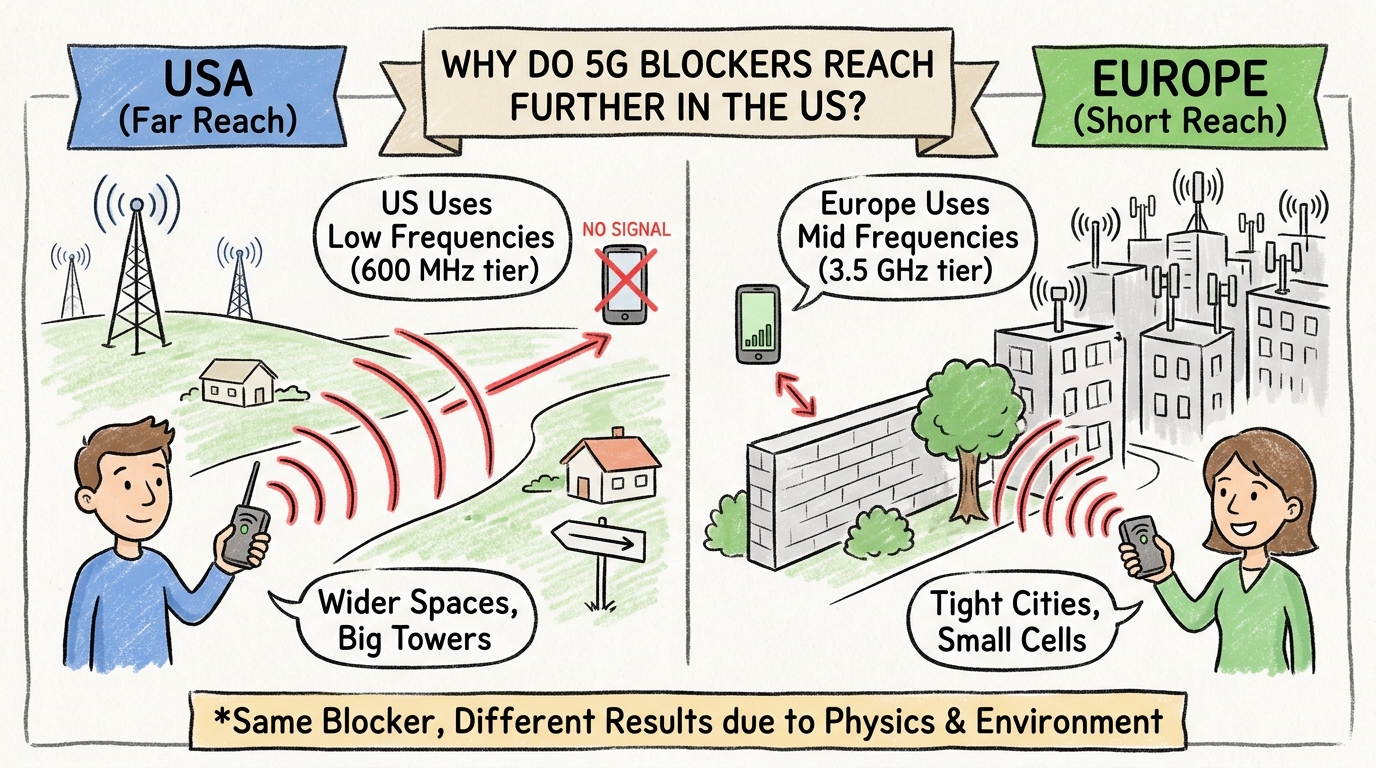
To tackle the frequency question head-on: yes, dropping down into the 600 MHz neighborhood (like T-Mobile’s n71 band in the US) changes the rules of the game.
Physics is stubborn here. Lower frequencies mean longer waves. Longer waves travel further and punch through obstacles way better than high-pitched, short waves.
- The US Lower-Frequency Edge: Operating down in the 600 MHz range means the signal doesn't die out as fast in the open air. It bends around corners and slides through walls with minimal loss.
- The European Reality: While Europe has some low spectrum, their 5G heavily relies on mid-band frequencies—especially n78 (3.4–3.8 GHz). Those higher frequencies drop off a cliff over distance and get chewed up instantly by concrete, double-glazed windows, and trees. Because European phones are mostly locked onto higher, shorter-range frequencies, it takes a lot more raw force to disrupt them from afar.
So, if a device targets those lower US frequencies, the natural physics of the wave give it a head start.
2. Wide Open Space vs. Urban Clutter
Waves don't travel in a vacuum; they crash into whatever the local infrastructure throws at them.
- American Sprawl and Big Towers: US network design is built around macro-cells—massive towers spaced miles apart designed to cover huge chunks of suburbia and highway. Phones in the US are basically built to listen for distant, high-power transmitters miles away. When you introduce a rogue signal into that kind of sparse setup, the interference bleeds out for blocks over open corridors.
- European Density: European cities are tighter, older, and strictly regulated. Carriers rely on small-cell densification—tons of little micro-antennas tucked tightly together on rooftops and street corners. Because European towers are neighbors with your phone, local signal paths are short and tightly boxed in. Natural city layouts act like physical baffles, trapping and choking out stray radio waves before they can travel far.
3. The Hardware Secret: Regional Tuning
There’s another reason people rarely talk about: Jammers manufacturers rarely ship an identical circuit board worldwide. Devices built for different markets get tweaked inside.
- Antenna Resonance: Internal antennas are physically sized to match local carrier bands. A device aimed at the broad, lower US allocations has internal coils and patches tuned for peak efficiency at those specific long wavelengths.
- Filtering and Suppression: Strict local filtering rules in Europe often force manufacturers to choke out stray frequencies to stop cell signal Jammer from bleeding into neighboring bands. That tight internal cleanup can accidentally clip the outer edges of a device's effective range compared to less restricted builds.
The Bottom Line
Does the 617–652 MHz range matter? Partially. Lower frequencies naturally travel further and make target networks softer from a distance.
But the real reason for the trans-Atlantic gap is a mix of raw low-band physics, wide-open American tower spacing, and how the hardware is tuned. It’s less about one magic number and more about the entire environment working together.
