
Why Do Mobile Phone Jammers Struggle Through Walls?
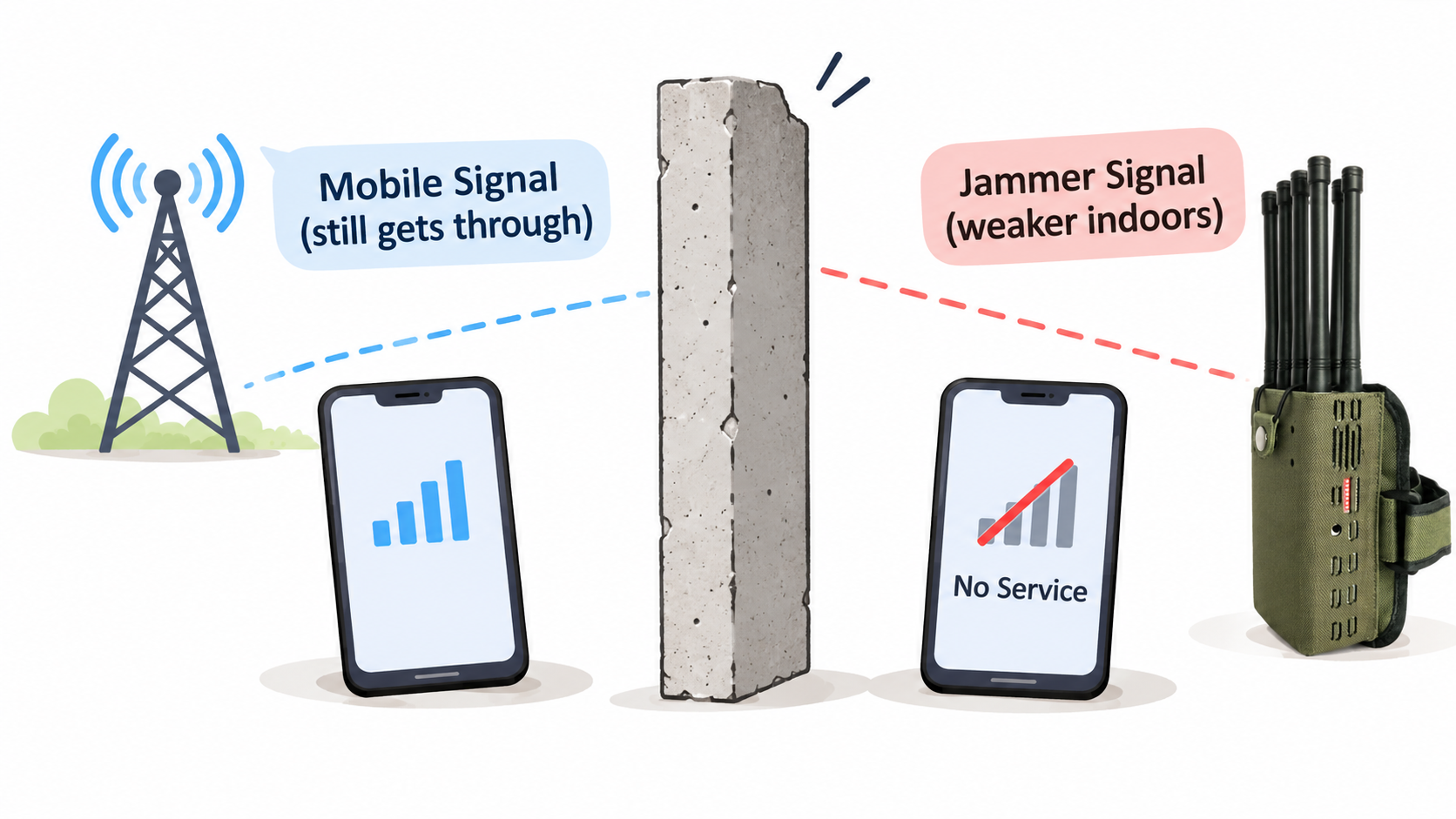
You may have noticed something odd: a cell phone can still show network reception inside a room, even with several walls between it and the outside. But the effect of a cell phone signal jammer may become much less noticeable in the same room.
At first, this seems contradictory. If the phone signal can pass through the wall, shouldn't a blocker signal be able to do the same?
Not necessarily. The important difference is what happens when each signal reaches the phone.
A Phone Can Work With a Weak Signal
A mobile phone does not need to receive a particularly strong signal to stay connected. Its receiver is designed to pick out and process the network signal even when reception is poor.
That is why a phone may still display signal bars in a basement, behind a concrete wall or inside a building with difficult reception. The connection might be slow or unstable, but the phone can still recognize the network.
In other words, a weak signal is not the same as no usable signal.
Why Do mobile phone silencers Behave Differently Indoors?
Jammers have a different task. Their signals must interfere with the network signals that phones are trying to receive.
Imagine two signals reaching the same phone: one carries network information, while the other acts as interference. The phone's response depends not simply on whether both signals are present, but on their relative strength at the receiver.
If the phone can still distinguish the network signal, it may remain connected. The mere presence of interference does not automatically mean that reception will disappear.
This is why phone jammers can behave differently indoors, even when mobile phones still have network reception.
How Do Concrete Walls Affect Mobile Phone Signals and Jammers?
Concrete walls, brickwork, reinforced structures and other building materials can all weaken radio signals. However, the amount of signal loss varies with the material and the building itself.
There is another detail worth considering: the network signal and the interference signal do not necessarily reach the phone with the same original strength or along the same path.
After passing through walls, the network signal may still be strong enough for the phone to recognize, while the interference may no longer have the same relative influence.
This helps explain a common question: why do mobile network blockers lose effectiveness through walls while phones still show signal bars?
It is not because walls only block jammers. They can weaken both. The difference is how much usable network information remains at the phone and how the two signals compare when they arrive.
Does Having Phone Reception Mean Jammers Cannot Work Indoors?
Likewise, a phone losing reception does not automatically tell you what caused the loss. Building materials, network conditions and the surrounding radio environment can all affect reception.
The two situations should not be treated as direct opposites.
Mobile phone signal penetration through walls and the indoor performance of jammers are not the same measurement. A phone may remain connected with a weak signal, while interference depends on the relationship between competing signals at the receiver.
