
Why GPS Jammer Range Depends on More Than Power: Hidden GNSS Signal Factors
When people search for GPS jammer range, the first thing they usually want to know is simple:
“Will it work 10 meters away? 100 meters? Or farther?”
However, this question misses the most important part of GNSS technology.
The effective range of a GPS jammer is not only a matter of power. It is a competition between the satellite signal arriving from space, the local environment, and the receiver trying to calculate its position. As we discussed in our previous article, "Why More Power Doesn't Always Mean More Range in Signal Jammers ?"...
A higher output does not always mean a better result.
The surrounding signal environment often decides what actually happens.
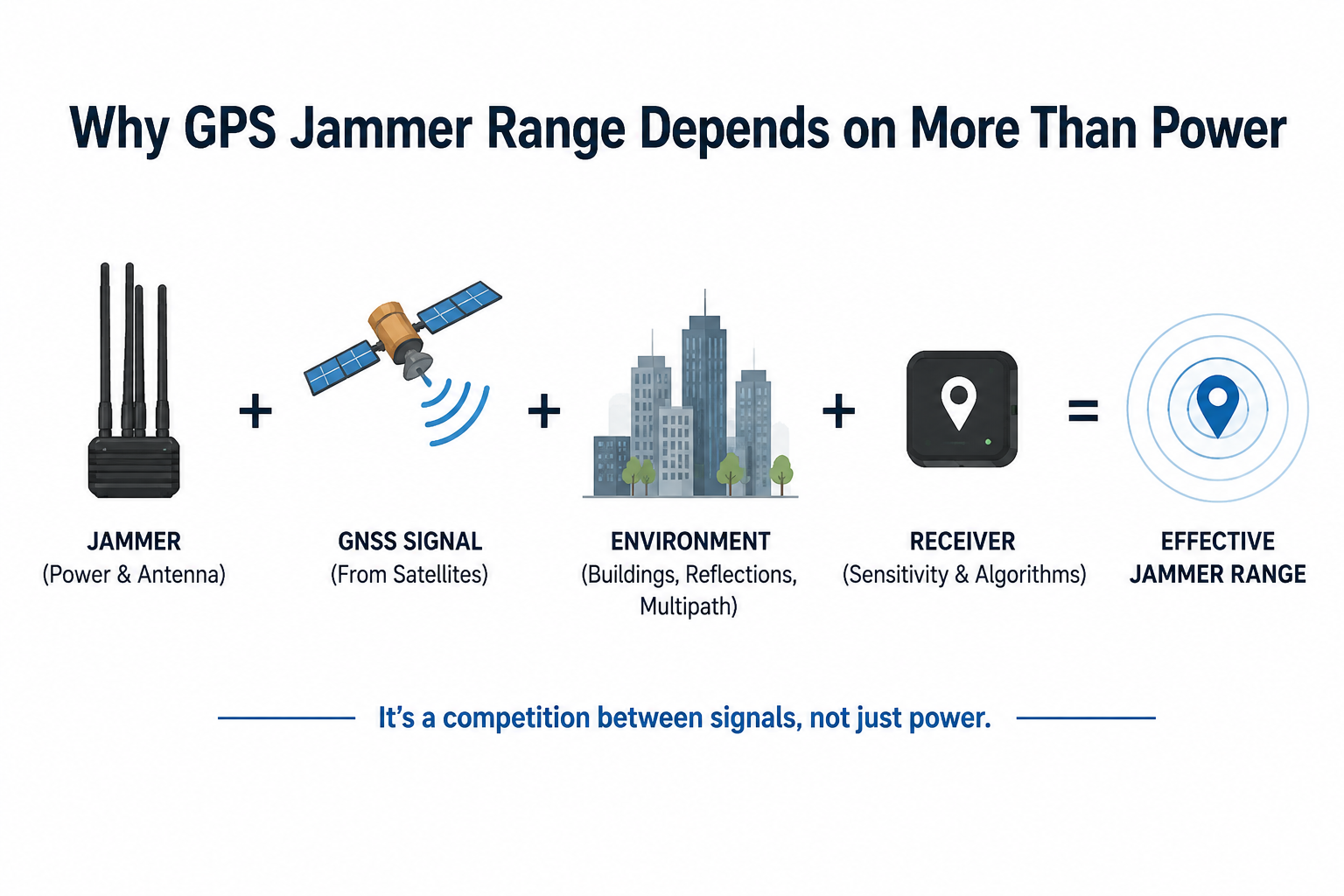
A GPS Signal Arriving on Earth Is Already Extremely Weak
GPS satellites are thousands of kilometers above the Earth.
By the time their signals reach a receiver, they are already very weak and close to the natural background noise level.
This is why a small change in the environment can have a surprising impact.
For example:
A delivery vehicle driving on an open highway usually has a clear view of satellites.
But when the same vehicle enters an area surrounded by tall buildings, the GPS signal can become unstable because signals are reflected by glass and concrete.
The difference is not the GPS receiver.
The difference is the environment.
Why the Same GPS Jammer Can Perform Differently in Different Places
One of the biggest misunderstandings about GPS interference distance is assuming it is a fixed number.
In reality, location changes everything.
Imagine two scenarios:
Open Road
A receiver has a clear view of the sky.
Satellite signals arrive more directly, and the positioning system has better conditions.
Dense Urban Area
Buildings create signal reflections.
The receiver may receive multiple versions of the same satellite signal with small delays.
This phenomenon is known as multipath interference.
The result?
The GPS environment becomes much more complicated.
Antenna Design Can Matter More Than Extra Power
Many discussions about Anti-Tracking GPS Jammer range factors focus only on power.
But radio systems do not work like a flashlight where more brightness always means a longer distance.
The antenna design plays an important role.
A well-designed antenna can influence how radio energy interacts with the surrounding space.
This is why two devices with similar power levels may not behave exactly the same in real conditions.
The antenna is not just an accessory.
It is part of the entire signal system.
The GPS Receiver Also Changes the Result
Another factor often ignored is the receiver itself.
Modern GNSS receivers are much more advanced than older navigation modules.
A smartphone, a vehicle navigation system, and an industrial tracking device may process satellite signals differently.
For example:
A basic receiver may depend heavily on direct satellite signal.
A newer system may combine GNSS with:
- inertial sensors
- digital maps
- additional positioning information
The same environment can produce different results because the receivers are not equally sensitive.
This is why GNSS receiver sensitivity is a key factor when discussing GPS signal performance.
A Real Example: Why Distance Numbers Can Be Misleading
Imagine a GPS system operating in two locations.
Location A:
- open outdoor area
- strong satellite visibility
- fewer obstacles
Location B:
- surrounded by buildings
- reflected signals
- weaker satellite reception
Even with the same equipment, the surrounding conditions are completely different.
A distance number written on a specification sheet cannot describe every possible situation.
The real-world result depends on how the GPS signal reaches the receiver at that moment.
The Future of GPS Signal Technology Is About Signal Conditions
The future discussion around GPS jammer technology will not only focus on:
“How far can it reach?”
A more meaningful question is:
“How does the receiver behave in a specific signal environment?”
As GNSS systems become more advanced, factors such as:
- satellite signal strength
- antenna design
- receiver algorithms
- urban interference
will become increasingly important.
The biggest misunderstanding about GPS signal interference is thinking it is only a power competition.
In reality, it is a competition between signals.
