
The Next Generation of Drone Jammers Will Be Measured by What They Don't Disrupt
For years, the counter-drone industry has celebrated the same numbers.
Longer range.
Higher output power.
More frequency bands.
Those specifications looked impressive when drones operated above empty fields or military training grounds.
Cities are different.
A smart city doesn't simply contain wireless networks.
It depends on them.
Every traffic intersection, office tower, logistics hub and public transport system is quietly exchanging radio signals every second. The invisible air above a city has become as busy as the streets below it.
In that environment, every transmission has a cost.
The question is no longer whether a drone jammer can stop a drone.
The real question is how much of the surrounding city it disturbs while doing it.
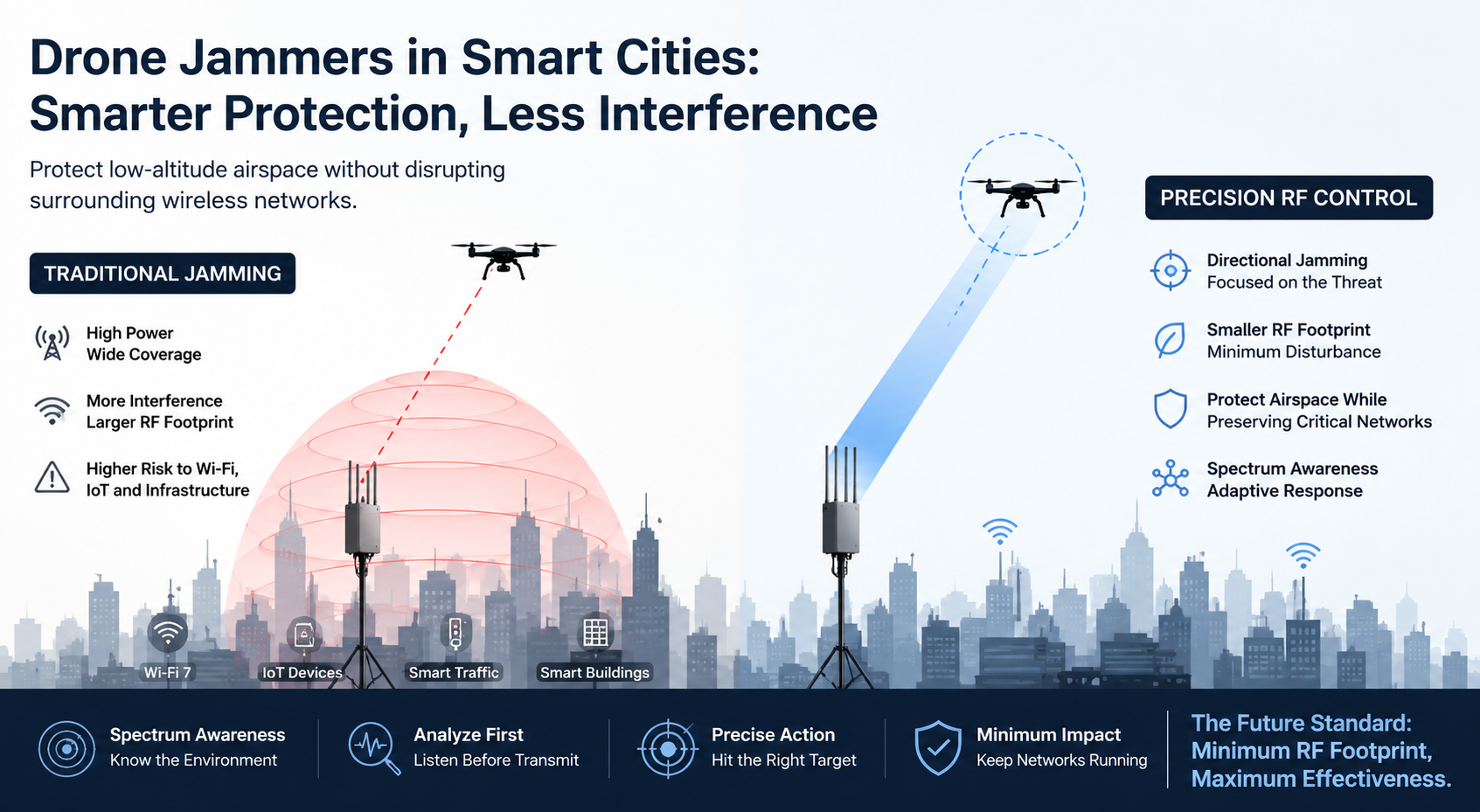
Radio silence has become one of the rarest resources in a city
Nobody notices radio silence because it has no physical shape.
You can't photograph it.
You can't paint it on a map.
Yet cities are consuming it faster every year.
Wi-Fi 7 access points negotiate channels hundreds of times every hour.
Building automation systems continuously exchange telemetry.
Parking sensors report occupancy.
Environmental stations upload measurements.
Private 5G networks synchronize industrial equipment.
Autonomous delivery robots request route updates.
Each device occupies only a tiny fraction of the spectrum.
Together, they create an environment of permanent RF coexistence.
A drone jammer enters that environment as another transmitter competing for the same invisible resource.
Not road space.
Not airspace.
Radio space.
Perhaps we've been measuring drone jammers the wrong way
Manufacturers usually compare output power.
20 watts.
50 watts.
100 watts.
Those numbers are easy to print on a specification sheet.
They're much harder to translate into real urban performance.
Imagine two counter-drone systems.
One creates a one-kilometre interference zone.
The other creates only a 250-metre controlled RF footprint.
If both stop the same drone, which one is actually better?
Engineers may increasingly choose the second.
Not because it's weaker.
Because it wastes less spectrum.
The future benchmark may not be maximum coverage.
It may be minimum unnecessary interference.
Cities aren't running out of bandwidth
They're running out of quiet spectrum.
Every year, another wireless technology joins the conversation.
Wi-Fi 7.
Thread.
Matter.
Bluetooth LE.
Ultra-Wideband.
Private 5G.
Industrial IoT.
Vehicle-to-Infrastructure communication.
Individually, none of them creates a problem.
Collectively, they produce something new:
Urban RF congestion.
The challenge is no longer avoiding interference.
It's learning how thousands of systems can coexist without constantly disrupting one another.
Counter-drone technology now belongs to that same ecosystem.
The smartest jammer may spend most of its time doing nothing
Traditional jammers transmit first.
Future systems may do the opposite.
Before emitting a single watt, they may build a live picture of the surrounding spectrum.
Which frequencies are occupied?
Which signals belong to infrastructure?
Which belong to a drone?
Where is the control link actually coming from?
How narrow can the beam become?
This is no longer conventional jamming.
It's spectrum-aware decision making.
Transmission becomes the final step, not the first.
Every unnecessary transmission leaves an RF footprint
Urban planners already talk about carbon footprints.
Network engineers increasingly measure energy footprints.
Counter-drone systems may soon be evaluated in a similar way.
Not by how much power they generate.
But by how much spectrum they temporarily consume.
A jammer that occupies 200 MHz for three seconds creates a very different RF footprint from one that occupies 20 MHz for half a second.
Today's datasheets rarely mention that difference.
Tomorrow's procurement teams probably will.
Precision is becoming a software problem
Better antennas still matter.
More efficient amplifiers still matter.
But the biggest improvements may come from software.
Artificial intelligence can already classify wireless signals, distinguish drone communication from background traffic and estimate signal direction in real time.
The jammer becomes only one part of a larger RF decision engine.
Instead of asking:
"How much power should we transmit?"
The software asks something much more valuable:
"Do we actually need to transmit at all?"
Counter-drone technology is quietly changing its philosophy
The first generation of drone jammers tried to dominate the spectrum.
The next generation may try to disturb it as little as possible.
That isn't simply better engineering.
It's a different way of thinking.
Because in a smart city, the most valuable wireless resource isn't bandwidth.
It isn't transmission power.
It isn't even coverage.
It's the ability to protect one piece of airspace without everyone else noticing that anything happened.
Perhaps that's where the future of drone jammers really begins—not with stronger signals, but with smaller, smarter and almost invisible RF footprints.
