
Offline AI Is Changing Exam Security: Why Cell Phone Jammers Alone Are No Longer Enough
Last spring, a university in Europe quietly updated its examination policy.
Students were still required to switch off their phones. Smartwatches were still prohibited. Wireless earphones were still treated as unauthorized devices.
One sentence, however, attracted much less attention.
The policy no longer focused only on internet access.
It referred to AI-assisted devices, regardless of whether they were connected to a network.
That small change says a lot about where academic integrity is heading.
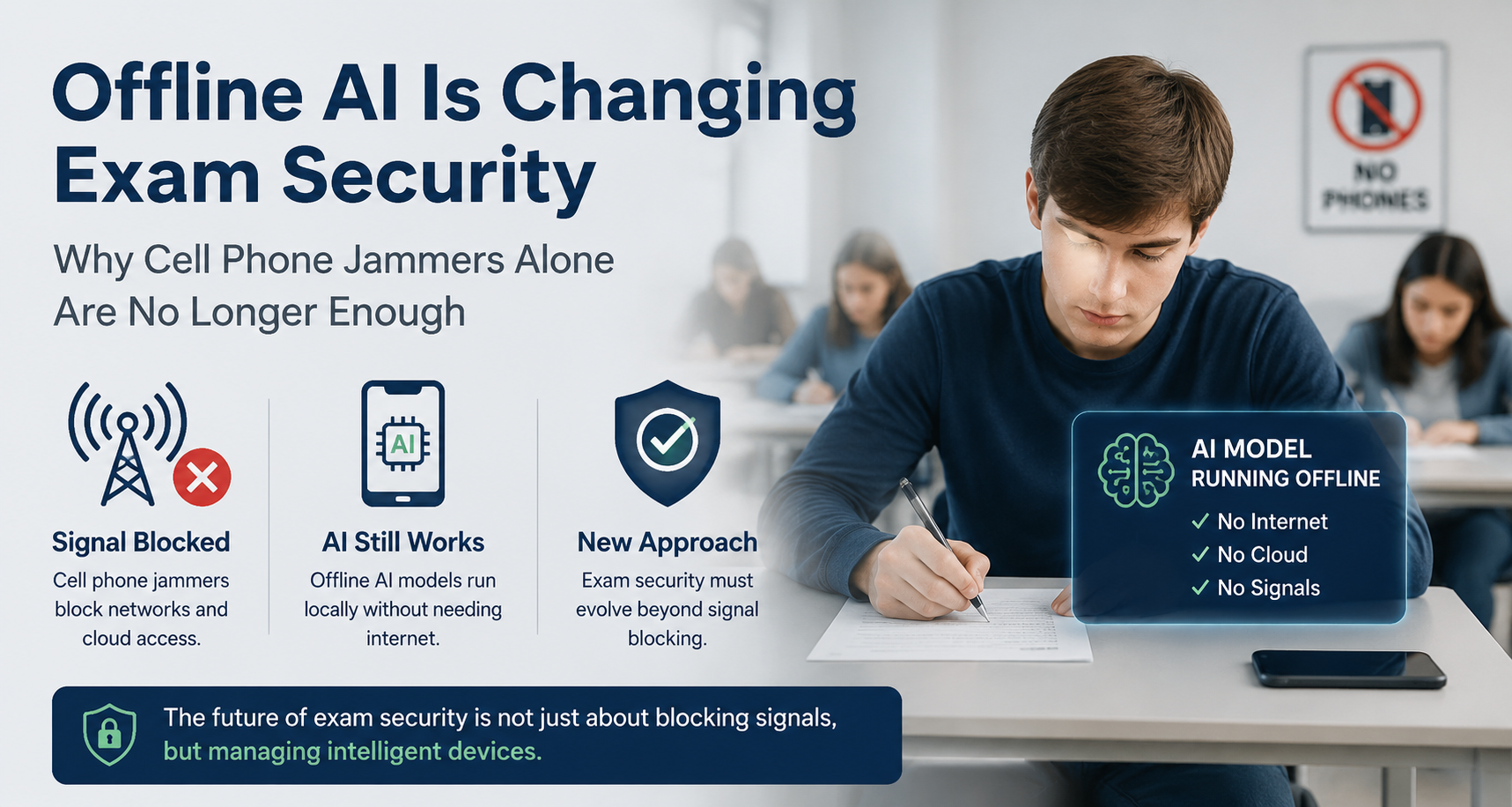
The Question Has Changed
For years, preventing digital cheating was relatively straightforward.
Limit internet access.
Collect smartphones.
Disable WiFi.
Some institutions even considered using 5G cell phone jammers or other forms of wireless signal isolation to eliminate mobile communication during high-stakes examinations.
The assumption behind these measures was simple.
If a student couldn't reach the internet, they couldn't receive outside help.
That assumption is becoming increasingly fragile.
Intelligence Has Started Moving Onto the Device
Only a few years ago, large language models depended almost entirely on cloud computing.
A question travelled across the network.
The answer came back a few seconds later.
Today, the situation looks very different.
Smaller AI models are beginning to run directly on laptops, tablets and smartphones.
The hardware inside modern devices is evolving remarkably fast. Dedicated AI processors, larger memory and increasingly efficient inference engines allow some language models to generate text without sending a single request to an external server.
From an examination perspective, that's a fundamental shift.
A device can remain completely offline while still acting as an intelligent assistant.
A Signal Jammer Can Interrupt Communication
It Cannot Interrupt Computation
This distinction is becoming increasingly important.
A mobile cell jammer can prevent a smartphone from communicating with mobile networks.
It can interrupt cloud-based AI services.
It can stop live searches, online translation, remote collaboration and synchronized note-taking.
But none of these measures affect calculations performed entirely inside the device.
If an AI model has already been installed, network isolation changes very little.
The phone simply stops asking the internet for help because it no longer needs to.
Why Two Students Might Face Completely Different Restrictions ?
Imagine two candidates sitting in the same examination room.
The first relies on an online chatbot.
The second prepared days earlier by downloading an offline language model.
Once wireless communication disappears, their situations immediately become different.
The first loses access to almost everything.
The second may lose almost nothing.
Both still hold identical smartphones.
The difference lies entirely in the software they installed before entering the classroom.
Examination Security Is Quietly Becoming Device Security
This explains why many universities are gradually shifting their attention.
Five years ago, the discussion centred around communication.
Today, it increasingly centres around computation.
Instead of asking:
"Can this device connect to the internet?"
Institutions are beginning to ask:
"What can this device already do without the internet?"
Those are two completely different security models.
RF Isolation Still Has an Important Role
None of this makes exam signal isolation obsolete.
Far from it.
Many AI features still rely heavily on remote infrastructure.
Among them are:
- cloud-based image generation;
- real-time web retrieval;
- collaborative AI workspaces;
- synchronized cloud notes;
- online document analysis;
- remote AI assistants.
Removing wireless connectivity immediately limits these functions.
In practice, RF isolation for examination rooms remains highly effective against an entire category of digital cheating.
It simply isn't the complete answer anymore.
Hardware Is Becoming Less Predictable
Modern smartphones rarely behave like fixed-function devices.
A software update can introduce new AI capabilities overnight.
A locally installed application can completely change how the phone behaves during an exam.
The hardware may remain identical while its practical capabilities evolve every few weeks.
This is one reason why discussions around dynamic RF control, education signal shielding and controlled wireless environments continue to attract attention among security professionals.
The challenge is no longer static.
Exam Invigilators Are Facing a Different Problem
Traditional supervision relied on visible behaviour.
Looking down repeatedly.
Whispering.
Receiving messages.
Using hidden earphones.
AI changes that picture.
A student reading an answer generated locally on the device may appear no different from someone reviewing personal notes.
There may be no network traffic.
No incoming notifications.
No suspicious communication.
The device itself becomes the source of information.
That makes detection considerably more complicated than simply monitoring wireless activity.
The Conversation Around Cell Phone Jammers Is Evolving
Interestingly, discussions about cell phone jammers are no longer driven solely by telecommunications.
Education has become part of the conversation.
Not because signal blocking solves every problem, but because it still defines the boundary between cloud intelligence and local intelligence.
That boundary matters.
Once communication disappears, whatever remains available on the device becomes much easier to identify and regulate.
Tomorrow's Examination Rooms May Look Different
Future examination environments will probably combine several independent layers.
Restricted wireless communication.
Managed examination devices.
Offline operating modes.
Secure testing software.
AI-aware assessment design.
Notice that wireless control is still there.
It simply becomes one layer instead of the entire strategy.
The Bigger Question Isn't About Phones
It's About Intelligence
For decades, schools tried to control information entering the examination room.
Today, information can already be inside the student's pocket before the exam even begins.
That changes the purpose of technologies such as mobile signal blockers and exam RF isolation systems.
Instead of preventing information from arriving, they increasingly prevent intelligent devices from expanding their capabilities through external communication.
The real discussion is therefore no longer whether students should have internet access.
It is whether examination rules designed for connected devices are still suitable in an era where advanced AI can work perfectly well without ever connecting to anything at all.
