
Autonomous Cars Depend on More Than GPS — So Is GPS Jamming Slowly Losing Its Spotlight?
Not long ago, GPS was often treated as the weak link in vehicle navigation.
If satellite signals disappeared, the assumption was simple: the car would lose its position and confusion would follow.
That idea made sense fifteen years ago.
Today, it feels increasingly outdated.
Modern vehicles don't navigate the world through GPS alone. In fact, some engineers have started describing autonomous driving systems (Taking Huawei and Tesla as examples) less as "navigation systems" and more as machines that constantly compare competing versions of reality.
And that's why an interesting question deserves more attention:
As cars rely on sensor fusion rather than a single positioning source, are traditional GPS jammers gradually becoming less important?
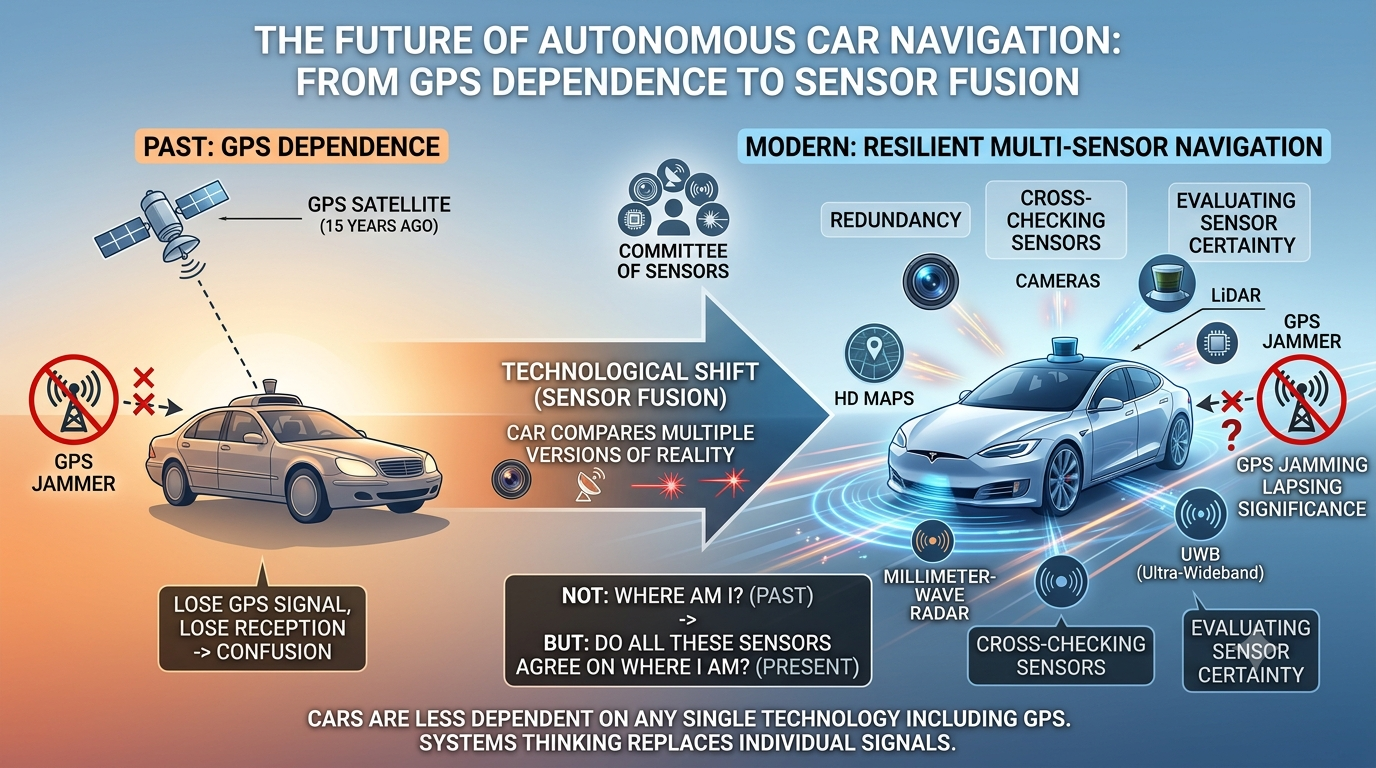
Cars No Longer Ask One Sensor for Directions
People often picture GPS as the brain of a vehicle.
In reality, GPS has become more like a member of a committee.
A modern intelligent vehicle may process information from:
- Cameras;
- LiDAR sensors;
- Millimeter-wave radar;
- IMU systems;
- HD maps;
- GNSS receivers;
- UWB positioning technologies.
No single sensor is considered infallible. Just as we wrote in our previous article "How Wireless Disruptions Shape the Future of Self-driving car ?"
Instead, every piece of information is constantly checked against the others.
This philosophy changes everything.
The car isn't asking:
"Where am I?"
It's asking:
"Do all these sensors agree on where I am?"
Those are two very different questions.
Losing GPS Doesn't Automatically Mean Losing Navigation
Years ago, a navigation system without GPS had very few alternatives.
Today, many advanced vehicles can continue estimating their position even when satellite reception becomes unreliable.
An IMU tracks acceleration and movement.
Wheel speed sensors measure distance.
Cameras compare the surroundings with HD maps.
LiDAR builds three-dimensional models of the environment.
Radar works in situations where visibility becomes poor.
None of these systems is perfect.
But together, they create redundancy.
That's why GPS interference no longer carries the same weight it once did.
The vehicle doesn't immediately become blind.
It simply starts relying more heavily on other information.
Engineers Worry Less About Missing Data Than Contradictory Data
Surprisingly, the bigger challenge isn't losing GPS.
It's what happens when every sensor tells a slightly different story.
Imagine driving through heavy rain.
The camera struggles to recognize lane markings.
LiDAR performance becomes less precise.
Radar reflections become noisier.
GPS accuracy drops because of nearby buildings.
Individually, these problems are manageable.
Combined, they create something much more difficult: uncertainty.
Modern autonomous systems aren't designed to deal with perfect information.
They're designed to deal with imperfect information.
And sometimes that is far more complicated.
Because the question is no longer:
"Where is the car?"
Instead, it becomes:
"Which sensor should the car believe?"
GPS Jammers Aren't Disappearing — Their Role Is Changing
Traditional GPS jammers, GPS blockers and anti-tracking devices aren't suddenly becoming obsolete.
GPS remains essential for:
- Route planning;
- Timing synchronization;
- Initial positioning;
- Map matching;
- Backup navigation.
But the discussion around vehicle security is slowly moving elsewhere.
Search interest is increasingly expanding toward topics such as:
- Sensor fusion navigation;
- GNSS spoofing detection;
- Autonomous vehicle redundancy;
- Multi-sensor localization systems;
- Automotive UWB positioning;
- Resilient navigation technologies.
In other words, engineers are beginning to think less about individual signals and more about entire systems.
UWB and IMU Might Become More Important Than People Realize
GPS receives most of the attention because everyone understands satellites.
But some technologies work quietly in the background.
Ultra-Wideband is already appearing in smartphones and digital car keys.
IMUs have existed for decades but are becoming increasingly important in autonomous driving.
High-definition maps contain millions of reference points.
Together, these systems allow vehicles to maintain awareness even when one source temporarily becomes unreliable.
The future of navigation may not belong to one technology.
It may belong to cooperation between technologies.
The Real Story Isn't About GPS
People often ask whether self-driving cars will eventually stop relying on GPS.
Perhaps that's the wrong question.
GPS isn't disappearing.
LiDAR isn't replacing radar.
Cameras aren't competing against UWB.
They're all becoming pieces of something larger.
And perhaps that's the biggest change happening inside modern vehicles.
Cars are no longer trying to find one perfect answer.
They're trying to decide which answer is the most believable.
That's a subtle difference.
But it changes the entire conversation around GPS jamming.
Because in the coming years, the biggest challenge may not be blocking a signal.
It may be understanding how dozens of sensors, maps and algorithms work together when none of them is completely certain.
And maybe that's the strange irony of autonomous driving.
As vehicles become smarter, they also become less dependent on any single technology—including GPS itself.
