
Why Smartphones Keep Sending Background Signals: New Challenges for Cell Phone Jammer Technology
Many people assume that a smartphone becomes inactive when the screen turns off.
It looks quiet. It sits on a table, inside a bag, or next to a laptop without any obvious activity. From a user’s perspective, nothing seems to be happening.
However, modern smartphones are constantly managing wireless connections in the background.
Even when no application is open, a smartphone may still exchange data through cellular networks, WiFi, Bluetooth, and location-based services. These small but continuous wireless activities allow modern devices to provide instant updates, automatic synchronization, and seamless connections.
This hidden layer of connectivity has changed the way experts look at cell phone jammer technology and mobile signal blocking technology.
The challenge today is no longer simply understanding one wireless signal. It is understanding a smartphone that operates as a multi-network device.
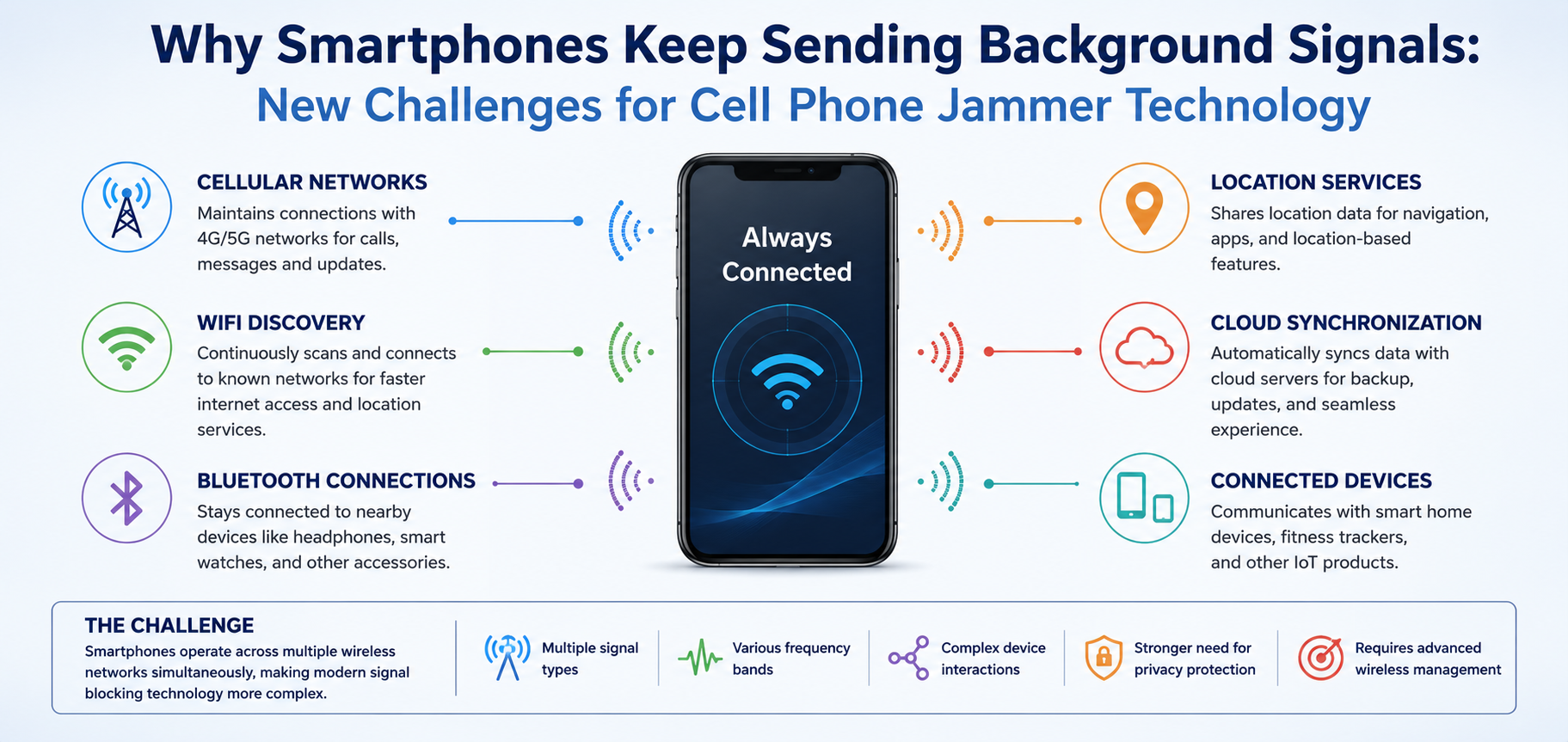
Smartphones Are Not Really “Silent” When They Are Idle
The idea of an idle smartphone is outdated. A modern smartphone is designed to stay connected. Behind the simple interface are many background processes that users rarely notice. For example, a device may:
- Maintain communication with mobile networks
- Synchronize applications with cloud servers
- Search for nearby WiFi connections
- Detect Bluetooth devices
- Exchange location-related information
- Keep connected accessories available
These activities usually involve small amounts of data, but they happen frequently.
This is why smartphone signal activity has become much more complicated compared with older mobile devices.
The smartphone is no longer just a tool that users actively operate. It has become an always-connected wireless platform.
The Hidden Wireless Connections Inside Modern Smartphones
A smartphone today combines several wireless technologies into one compact device.
Cellular Network Connections
Mobile networks are continuously evolving.
With 4G LTE and 5G technologies, smartphones rely on more advanced communication systems to maintain stable connectivity and efficient network management.
The device does not simply connect once and remain unchanged. It continuously manages its relationship with available networks.
This creates a more complex environment for cell signal blocking technology, because different devices may behave differently depending on network conditions, frequency bands, and surrounding environments.
WiFi Discovery and Background Connectivity
Many users think WiFi only becomes active after manually selecting a network.
In reality, smartphones often monitor their surroundings to improve connectivity and user experience.
Background WiFi activity supports functions such as:
- Faster network recognition
- Automatic connection management
- Smart device integration
- Location assistance
This means WiFi-related wireless activity can exist even when users are not actively browsing the internet.
For professionals researching mobile phone jammer technology, this represents an important change: smartphones are no longer dependent on only one wireless connection.
Bluetooth and Nearby Device Communication
Bluetooth has also evolved significantly.
It is no longer limited to wireless headphones. Modern smartphones use Bluetooth for communication with:
- Smart watches
- Fitness devices
- Digital accessories
- Smart home products
Many connected experiences depend on background Bluetooth interaction.
This creates another layer of wireless activity that did not exist in older generations of mobile phones.
Why Modern Smartphones Create New Challenges for Cell Phone Jammer Technology
Traditional discussions about a mobile phone blocker often focus on signal strength, frequency coverage, or transmission distance.
However, modern smartphones have introduced a more complicated question:
How does a device manage multiple wireless connections at the same time?
A current smartphone may rely on:
- Cellular networks
- WiFi signals
- Bluetooth communication
- Location technologies
- Connected smart devices
Because of this, modern cell phone jammer technology is no longer only about one signal type. It requires a broader understanding of the wireless environment.
This is one reason why discussions around smartphone signal blocking have become more focused on wireless behavior rather than only basic signal interruption concepts.
From Mobile Connectivity to Mobile Privacy Protection
The growth of background wireless activity has also changed the conversation around privacy.
In the past, many people thought about privacy mainly in terms of visible digital actions.
Today, privacy discussions include questions such as:
- What wireless connections are active around a device?
- Which applications communicate in the background?
- How many connected systems interact with a smartphone?
- How can sensitive environments better manage wireless activity?
This is why mobile privacy protection has become an increasingly important topic.
The goal is not simply to disconnect technology, but to better understand how connected devices operate.
Why Traditional Signal Blocking Concepts Are Changing
The wireless environment has become much more dynamic.
A smartphone in 2026 is very different from a basic mobile device from previous generations.
It can interact with:
- Multiple network types
- Different frequency ranges
- Various connected devices
- Cloud-based platforms
As smartphone technology continues developing, mobile phone signal blockers and wireless management solutions must consider more than traditional mobile communication patterns.
The future of wireless management will depend on understanding how devices communicate, not only how strong their signals are.
