
6G ISAC: When RF Interference Targets Perception Instead of Communication
For most of the wireless era, communication networks had a simple job.
Move information from one place to another.
Whether it was a Wi-Fi router, a cellular tower, or a satellite link, success was measured by familiar metrics:
- coverage
- throughput
- latency
- reliability
If a signal disappeared, communication stopped.
If the signal remained stable, the system was considered healthy.
This assumption has shaped decades of thinking around wireless security, RF interference, and spectrum management.
But Integrated Sensing and Communication (ISAC), one of the most important research directions behind 6G networks, introduces a very different possibility.
Future wireless infrastructure may not only carry information.
It may also develop an understanding of the physical environment.
And once that happens, the meaning of interference could change completely.
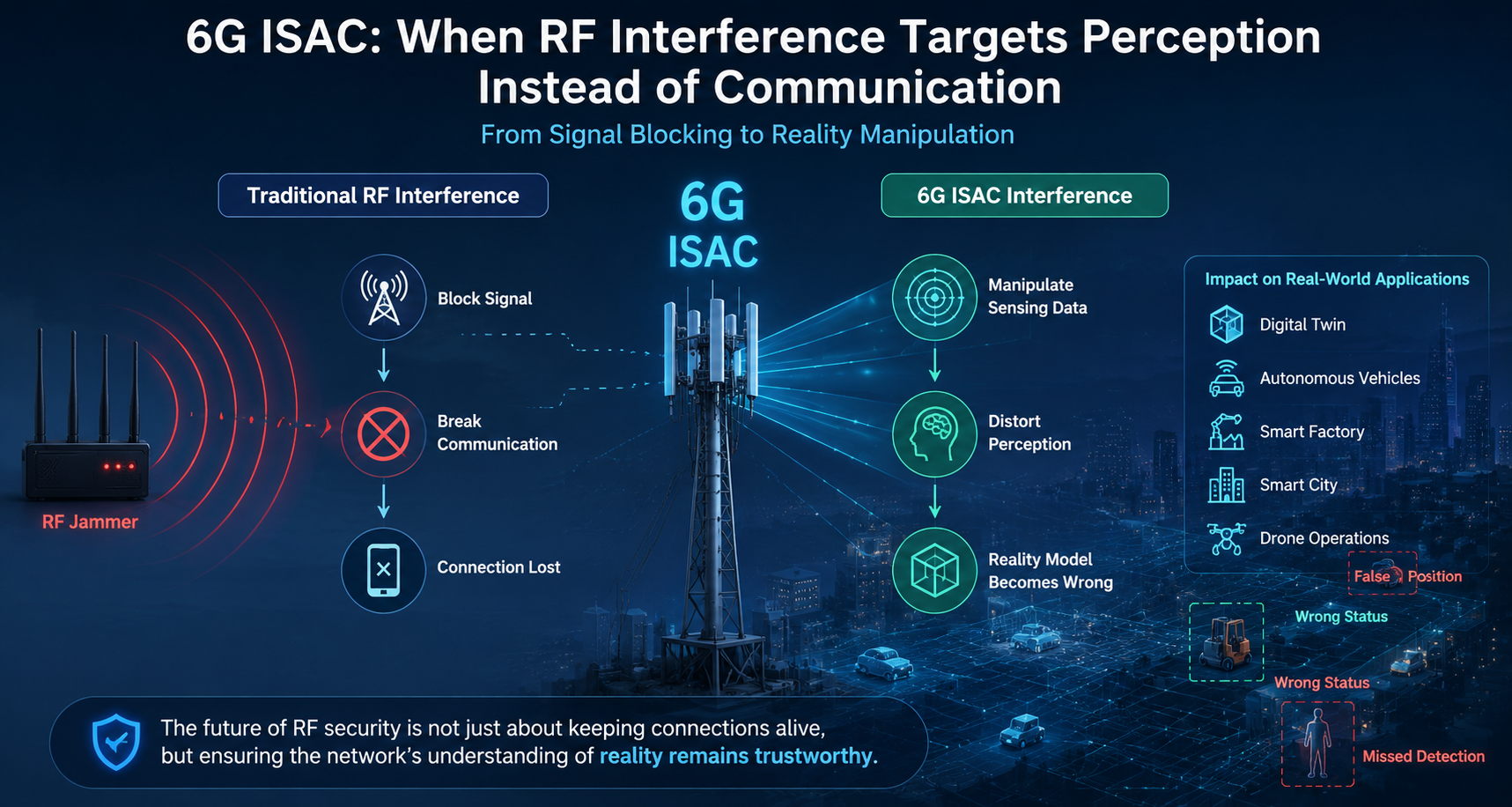
Wireless Networks Are Starting to Build Their Own Version of Reality
A traditional base station answers a simple question:
"How can devices stay connected?"
An ISAC-enabled network may answer several additional questions at the same time:
- Who is moving?
- What has changed in this space?
- Where are objects located?
- How is the environment evolving?
- Which areas are becoming congested?
The radio signal becomes more than a communication channel.
It becomes a sensing tool.
This is a subtle shift, but it may prove more important than higher data rates or lower latency.
For the first time, wireless infrastructure begins creating a model of the world around it.
In effect, the network develops a form of environmental awareness.
A False Reality May Be More Dangerous Than a Lost Connection
Most discussions about RF jammers still focus on disruption.
Can a signal be blocked?
Can a device be disconnected?
Can a communication channel be interrupted?
These questions belong to a world where communication is the primary objective.
ISAC introduces a different concern.
Imagine a digital twin factory operating on future 6G infrastructure.
Autonomous vehicles move between production lines.
Robots coordinate logistics.
Wireless sensing continuously updates the factory's virtual model.
Now imagine the network remains fully connected.
Data continues flowing.
No alarms are triggered.
Yet the digital representation of the facility slowly drifts away from reality.
A vehicle appears several meters from its actual position.
A moving object is interpreted as stationary.
A corridor is identified as empty when it is occupied.
Communication has not failed.
Perception has.
This distinction may become one of the most important RF security challenges of the next decade.
The Rise of Cognitive RF Threats
Most current RF security strategies focus on protecting communications.
Future ISAC environments may require protection of perception itself.
This creates entirely new areas of interest:
- RF cognitive deception
- environmental perception attacks
- digital twin poisoning
- spatial awareness spoofing
- radio environment manipulation
- semantic RF interference
- context-level RF disruption
These concepts are rarely discussed outside advanced research circles.
Yet they address a growing reality.
When networks begin interpreting the physical world, the interpretation itself becomes a target.
Not the signal.
Not the bandwidth.
Not even the protocol.
The network's understanding of reality.
Why Future RF Jammers May Look Very Different ?
Traditional RF jammers rely on a straightforward principle.
Inject enough energy into a radio channel and communication performance degrades.
This model assumes the objective is communication disruption.
Future systems may operate under different assumptions.
In a sensing-driven environment, an attacker may have little interest in blocking connectivity.
The more effective strategy could be influencing how the network interprets radio reflections and environmental changes.
The objective shifts from denial to deception.
Instead of creating silence, the goal becomes creating confusion.
A network that cannot communicate is obviously compromised.
A network that confidently believes incorrect information may be far more dangerous.
Digital Twins Could Become an Unexpected RF Battleground
Much of the discussion around 6G focuses on autonomous vehicles, smart cities, and next-generation mobile services.
Digital twins deserve equal attention.
A digital twin depends on synchronization between the physical world and its virtual counterpart.
ISAC could become one of the primary technologies responsible for maintaining that synchronization.
If environmental sensing becomes inaccurate, delayed, or manipulated, the digital twin itself may gradually diverge from reality.
This possibility introduces new long-tail topics that barely exist today:
- digital twin RF security
- ISAC environment mapping integrity
- wireless reality modeling attacks
- sensing data poisoning in 6G networks
- cognitive infrastructure protection
- spatial intelligence security
As enterprises increasingly rely on real-time digital representations of factories, warehouses, transportation hubs, and smart cities, these concerns may move from academic theory to operational necessity.
The Most Important Question About 6G Is Not Speed
The wireless industry often measures progress through technical specifications.
Faster downloads.
Lower latency.
Higher capacity.
ISAC points toward a different future.
A future where wireless networks do more than transport information.
They observe.
Interpret.
Model.
And increasingly participate in decision-making processes.
That is why the most interesting question surrounding 6G may have little to do with communication performance.
Instead, it may be this:
When wireless infrastructure begins building its own understanding of reality, how do we know that reality has not been manipulated?
The answer may ultimately shape the future of RF security far more than any discussion about frequencies, bandwidth, or signal strength.
