
Why It's Becoming Surprisingly Difficult to Completely Lose Mobile Signal ?
Ten years ago, walking into a parking garage or driving into the countryside almost guaranteed one thing: No Service.
Today, that message appears less often.
Even when the signal drops to one bar—or disappears for a moment—it frequently returns before you have time to wonder what happened.
This isn't because towers suddenly became more powerful.
It's because cellular networks have learned how to recover themselves.
That change matters for far more than everyday smartphone users. It also explains why engineers working with RF systems, wireless testing, and even cell signal jammer detection are paying closer attention to how modern networks behave instead of simply measuring signal strength.
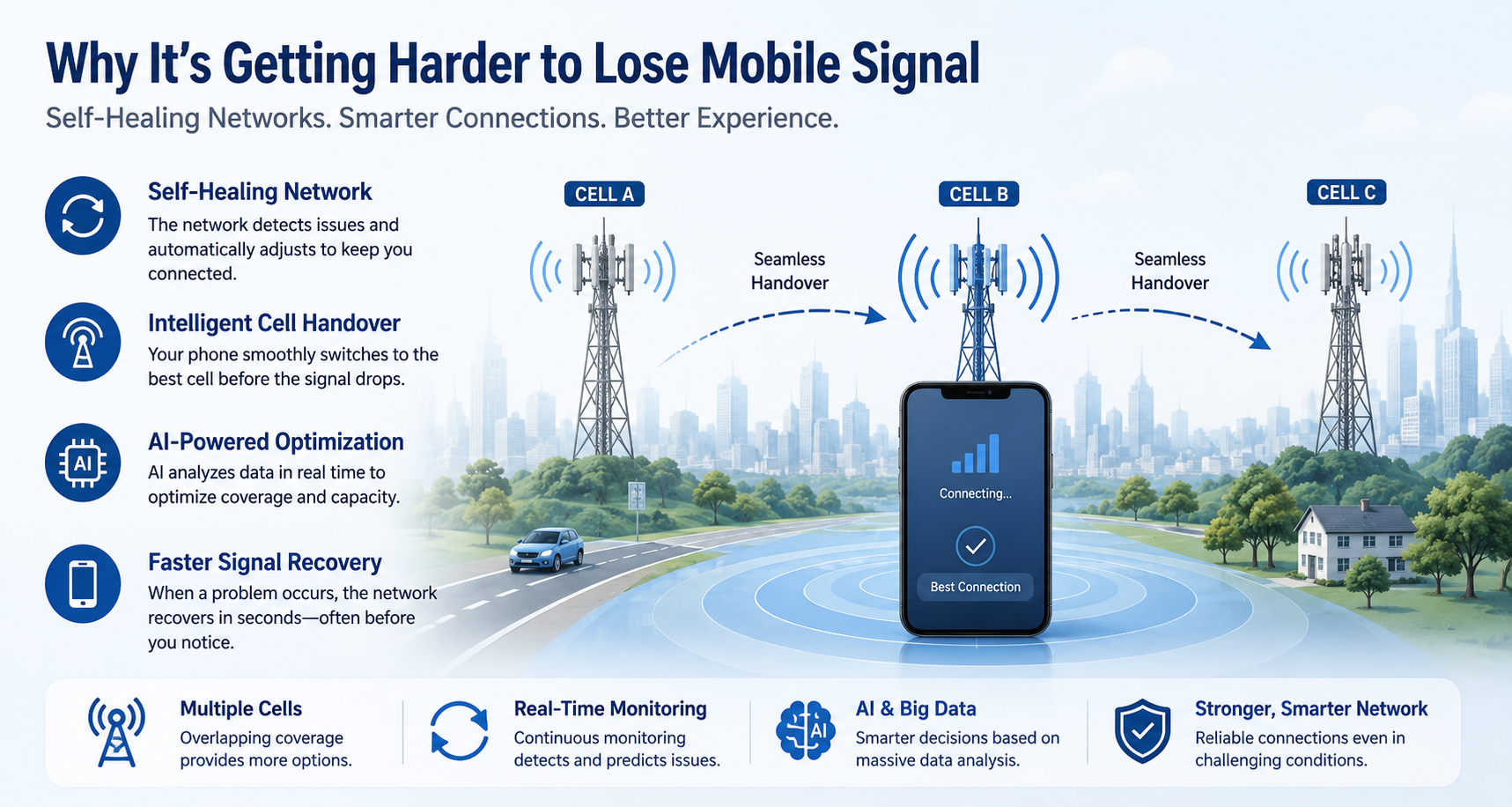
A Weak Signal Doesn't Always Mean a Weak Network
People still assume that signal depends mainly on distance from a cell tower.
In reality, your phone is surrounded by dozens of possible radio paths.
Some are stronger.
Some are cleaner.
Some carry less traffic.
The network constantly compares these options.
While you're reading a webpage or watching a video, your phone is already measuring neighboring cells in the background.
It isn't waiting for the current connection to fail.
It's preparing an alternative before failure even happens.
That's why Mobile Signal Recovery often feels almost invisible.
Cell Handover Has Become Predictive
Years ago, a Cell Handover happened because the current tower became unusable.
Modern networks try to avoid reaching that point.
If algorithms detect that signal quality is slowly degrading—or that another cell can provide a more stable connection—the handover may happen before users notice any interruption.
The decision is no longer based only on signal bars.
It can include:
- radio interference;
- network congestion;
- available spectrum resources;
- user movement;
- neighboring cell load.
In other words, your phone doesn't simply chase the strongest tower anymore.
It follows the smartest path through the network.
Self-Healing Networks Quietly Rewrite the Rules
One failed radio sector used to create complaints within minutes.
Today, operators increasingly deploy Self-Healing Network platforms capable of responding automatically.
Imagine a base station suddenly going offline.
Nearby cells may immediately begin adjusting:
- antenna parameters;
- transmission power;
- scheduling priorities;
- traffic allocation.
To most users, nothing dramatic happens.
The network quietly reorganizes itself.
Engineers sometimes describe this as wireless infrastructure behaving more like cloud computing than traditional telecom hardware.
AI Is Optimizing Coverage Long Before You Notice Problems
Artificial intelligence isn't replacing radio engineers.
It's helping them process an impossible amount of information.
Every day, operators collect enormous volumes of performance data from their Cellular Network.
AI systems can identify patterns that would take humans much longer to discover.
For example:
- Morning commuter routes.
- Weekend shopping districts.
- Concert venues.
- Sporting events.
- Holiday traffic.
Instead of applying fixed parameters across an entire city, networks can increasingly adapt to changing demand.
Coverage becomes something dynamic rather than permanent.
Rural Networks Play a Completely Different Game
Urban users often think their network is simply "better."
The real advantage is density.
A city may have several neighboring cells capable of serving the same location.
If one develops a fault, another is usually available.
In rural regions, a single site may cover several kilometers.
There are fewer backup options.
That's why identical smartphones can show completely different Mobile Signal Recovery behavior depending on geography rather than hardware.
Modern RF Environments Are Harder to Predict
This evolution is creating interesting discussions among RF professionals.
As Network Optimization becomes increasingly automated, radio environments stop behaving like static systems.
Coverage shifts.
Traffic moves.
Neighbor relationships evolve.
Frequency resources are redistributed.
Even engineers evaluating adaptive jammer resistance, cell reselection behavior, or dynamic RF environments increasingly focus on network intelligence rather than raw transmitter power.
The network itself has become part of the equation.
Signal Bars No Longer Tell the Whole Story
Most people still judge connectivity by the icon in the corner of the screen.
Engineers rarely do.
A device showing only one bar may still deliver excellent performance if it's connected to an uncongested cell.
Another phone showing four bars may perform worse because that sector is overloaded.
Modern Cellular Network performance depends on far more than received signal strength.
Capacity, interference, spectrum management, traffic balancing, and automated recovery all influence the experience.
The Future Isn't Stronger Coverage—It's Faster Recovery
The biggest innovation in mobile networks isn't necessarily reaching places that had no signal before.
It's reducing the amount of time users spend disconnected.
Networks are becoming better at recognizing instability, predicting failures, redistributing traffic, and restoring connectivity without waiting for human intervention.
That same trend is reshaping wireless testing, RF planning, and discussions around network-aware signal management.
The smartest network isn't always the one with the strongest signal.
It's the one that quietly repairs itself before anyone notices there was ever a problem.
