
When eSIM Stops Belonging to a Carrier, What Exactly Does a Signal Jammer Target?
A few years ago, identifying a mobile connection was almost effortless.
You looked at the SIM card.
You knew the carrier.
You knew the frequency bands.
Today that shortcut is quietly disappearing.
A growing number of phones can activate different carrier profiles without replacing a SIM, negotiate roaming automatically, and in some cases prepare for satellite connectivity without the user touching a single setting.
Oddly enough, almost nobody is asking what this means for the way wireless signals are actually managed.
The discussion keeps revolving around eSIM itself.
Maybe that's already the wrong question.
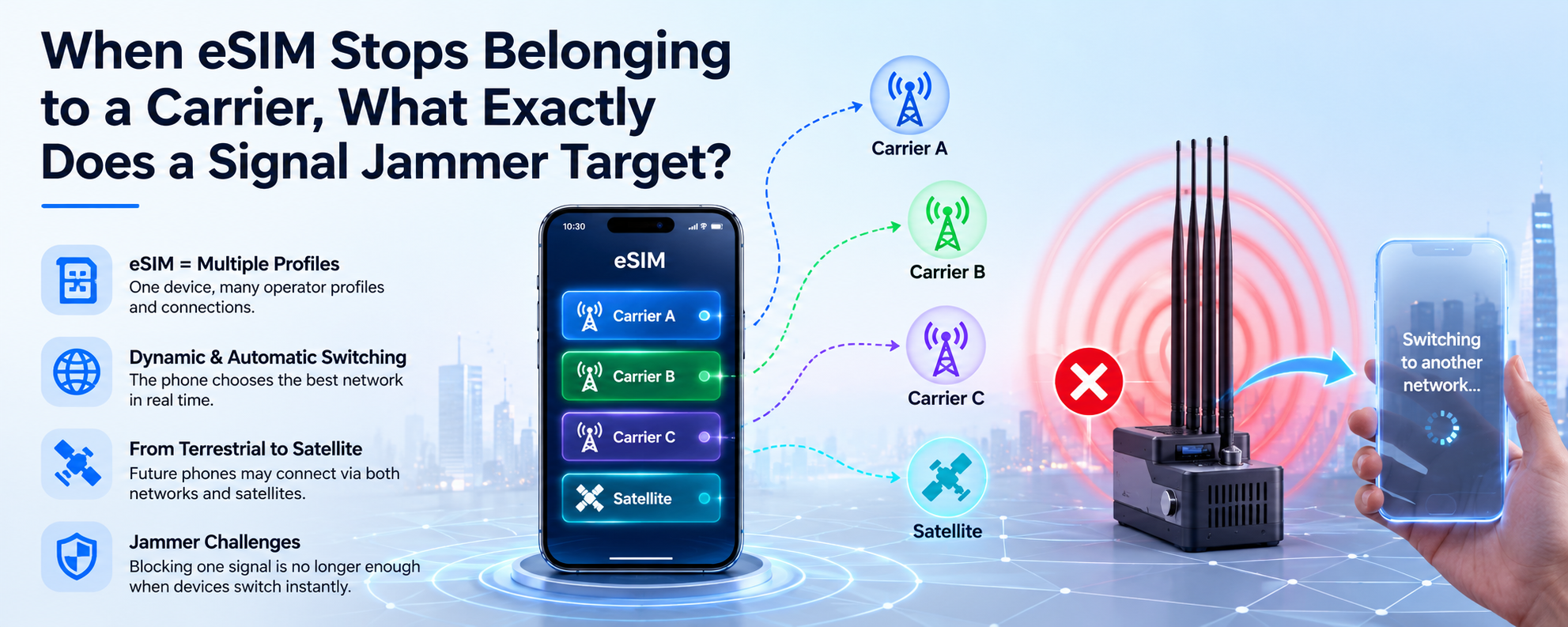
Your Phone Is No Longer Loyal to One Network
A traditional base station answers a simple question:
"How can devices stay connected?"
An ISAC-enabled network may answer several additional questions at the same time:
- Who is moving?
- What has changed in this space?
- Where are objects located?
- How is the environment evolving?
- Which areas are becoming congested?
The radio signal becomes more than a communication channel.
Imagine walking through three different cities in a single day.
Your phone doesn't really care which operator owns the nearest tower.
It simply asks another question.
"Which connection gives me the best chance of staying online?"
That sounds trivial.
It isn't.
Once the device starts making connectivity decisions on its own, the operator becomes only one variable among many.
Coverage.
Latency.
Signal quality.
Network congestion.
Roaming agreements.
Satellite availability.
Private enterprise networks.
They're all becoming part of the same calculation.
The connection is no longer static.
It's negotiable.
Future Mobile Devices May Never Stay on One Network Long Enough
Traditional discussions about Jammers usually assume something fairly stable.
A phone connects.
It stays there.
Interference affects that connection.
But what happens when the phone reacts faster than expected?
Imagine a device that notices deteriorating radio conditions within milliseconds.
Instead of waiting for the user to lose service, it silently shifts traffic somewhere else.
Another carrier.
Another profile.
Another radio technology.
Eventually another satellite.
In that scenario, the conversation changes.
The problem isn't whether one network can be interrupted.
It's whether the device can still discover another route.
The Interesting Part Isn't eSIM
It's Decision-Making.
Engineers often describe future mobile systems as adaptive.
Personally, "adaptive" feels too polite.
Modern smartphones are becoming opportunistic.
They constantly compare options.
They're looking for the cheapest route.
The fastest route.
The cleanest spectrum.
The lowest latency.
The strongest uplink.
The best backup.
Connectivity starts looking less like infrastructure and more like navigation.
Every few seconds the phone quietly asks itself:
"Should I stay where I am?"
That's a completely different philosophy from traditional cellular design.
Wireless Architecture Is Becoming the Real Battlefield
This shift also changes how many engineers are beginning to describe RF resilience.
Instead of thinking about one LTE carrier or one 5G channel, they're examining entire communication paths.
Several research groups now spend more time discussing ideas like:
- adaptive wireless path selection
- carrier profile orchestration
- multi-network failover
- hybrid terrestrial-satellite mobility
- software-defined connectivity
Notice something?
Almost none of these concepts mention a specific operator.
That's probably where the industry is heading.
The Next Generation of Signal Jammer Discussions Could Sound Very Different
People searching online still type phrases like:
- 5G jammer
- LTE jammer
- cell phone jammer
Those terms describe hardware.
Future discussions may describe behavior instead.
Some emerging long-tail topics are surprisingly overlooked:
- adaptive network switching interference
- carrier profile disruption
- eSIM roaming interruption
- autonomous network reselection
- multi-carrier signal blocking
- intelligent failover interference
- hybrid network disruption
- software-defined mobile interference
- satellite fallback interruption
- dynamic connectivity disruption
None of these focus on a particular frequency.
They describe what the device is trying to accomplish.
That difference matters.
Maybe We've Been Looking at the Wrong Layer
The SIM card used to represent identity.
Now it's becoming software.
Tomorrow it may become almost invisible.
If that's true, then mobile communication won't really revolve around carriers anymore.
It will revolve around decisions.
Which network should the phone trust?
When should it switch?
Which radio should it abandon?
Which backup should it activate?
The invisible software making those choices may become far more important than the logo printed on the nearest cell tower.
And once that happens, conversations about signal management—and eventually about signal jammers—may stop focusing on operators altogether.
They'll start focusing on the architecture that quietly decides how every connection is built in the first place.
