
GPS Blocking VS GPS Jamming: Why Your GPS Signal Disappears for Completely Different Reasons
A strange thing happens quite often during GPS jammer testing.
A GPS tracker works perfectly outside.
Then someone moves it near a building, inside a garage, or under a metal roof.
The location suddenly becomes unstable.
The first reaction is usually:
"The GPS positioning jammer is working."
But sometimes that conclusion is completely wrong.
The receiver may not be affected by interference at all.
It may simply have lost sight of the satellites.
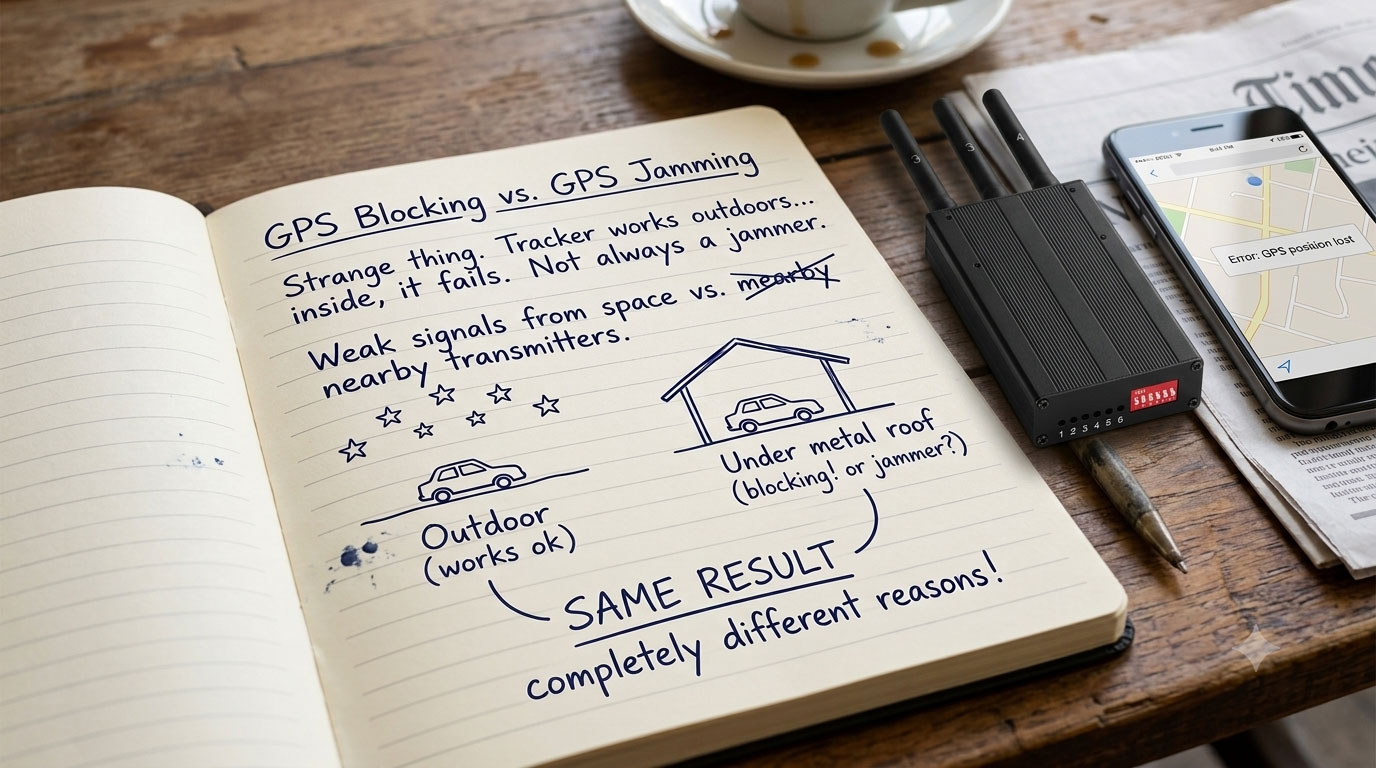
This is one of the biggest misunderstandings when people compare GPS jamming vs GPS blocking.
Both situations can look almost identical:
- GPS location stops updating;
- coordinates become inaccurate;
- tracking software shows an error;
- the device appears offline.
But the reason behind the failure can be completely different.
A GPS Receiver Does Not "Receive GPS Like Mobile Signal"
Many people imagine GPS works like a mobile phone.
A phone connects to a nearby tower.
The signal is relatively strong.
GPS is different.
The receiver is listening to extremely weak signals coming from satellites far above the Earth.
The antenna is not waiting for a nearby transmitter.
It is trying to collect information from multiple satellites at the same time.
That creates an important difference:
A small change in the environment can affect GPS performance.
A receiver that works perfectly in an open field may behave completely differently:
- inside a warehouse;
- between high-rise buildings;
- under a concrete ceiling;
- inside a vehicle with poor antenna placement.
No GPS jammer is required.
Sometimes the satellite signal simply never reaches the receiver properly.
GPS Blocking: When Satellites Become Invisible
GPS blocking is often misunderstood.
It does not mean someone is actively interfering with the signal.
It simply means the receiver cannot get enough useful satellite information.
Common examples:
Underground parking
The receiver has almost no direct view of the sky.
Dense city areas
Buildings block satellite paths and create reflected signals.
Metal structures
Large metal surfaces can weaken or distort satellite reception.
Poor antenna position
A GPS antenna hidden under certain materials may perform far worse than expected.
In these cases, the problem is not:
"Something is attacking the GPS signal."
The problem is:
"The receiver cannot see enough satellites."
GPS Jamming Is a Different Situation
A GPS jammer creates a different type of problem.
The satellite signals may still be physically present.
The receiver can simply no longer separate useful GPS information from the surrounding RF environment.
This is why a GPS jammer test and a normal indoor GPS test should never be compared directly.
One is an active signal interference situation.
The other is an environmental reception problem.
The final result may look the same.
The process is not.
Why Many GPS Jammer Tests Are Misleading ?
A common mistake happens during testing.
Someone turns on a GPS jammer outdoors.
The tracker loses location.
Then they move the same tracker into a building.
The tracker still loses location.
The conclusion:
"Same result, so the GPS jammer must be working."
Not necessarily.
The second test started under completely different conditions.
The receiver may already be struggling because:
- fewer satellites are visible;
- the antenna position changed;
- reflected signals increased;
- the surrounding structure changed.
The GPS receiver is not starting from the same point anymore.
The Hidden Problem: A GPS Tracker May Show the Wrong Location Before Losing Location
Many people only notice one thing:
"Does the GPS position disappear?"
But GPS problems do not always happen that way.
Sometimes the receiver continues reporting coordinates.
The problem is that the position becomes unreliable.
This often happens in urban environments.
The device may think it has a stable location because it receives delayed reflected signals.
The result:
The tracker appears online.
The map shows movement.
But the position is wrong.
This is why professional GPS signal testing looks at accuracy changes, not only complete signal loss.
Why GPS L1, L2, L5 Support Changes the Result ?
Another overlooked factor is frequency support.
Many people search for:
"Does a GPS jammer block GPS?"
But a better question is:
"Which GNSS frequencies does the receiver actually use?"
Modern positioning systems may use:
- GPS L1;
- GPS L2;
- GPS L5;
- Galileo;
- BeiDou;
- GLONASS.
Different devices combine these signals differently.
A navigation module in a vehicle is not necessarily the same as a small tracking device.
Two devices placed in the same environment can produce completely different results.
The Signal Bars of GPS Are Not the Whole Story
GPS testing is different from checking WiFi or mobile signal bars.
A receiver may show:
- a previous location;
- delayed coordinates;
- temporary accuracy;
- unstable positioning.
The screen does not always reveal what is happening between the antenna and the satellites.
That is why judging a GPS jammer only by:
"the location disappeared"
or
"the location is still visible"
can lead to incorrect conclusions.
The Question Most People Ask Is Usually the Wrong One
Many users ask:
"Why didn't my GPS jammer work?"
But the better question is:
"Did the receiver lose the satellite signal, or did the environment prevent reception?"
That difference explains many confusing GPS jammer test results.
A GPS signal can disappear because of active interference.
It can also disappear because the receiver is simply unable to see the sky.
The screen shows the same problem.
The reason behind it can be completely different.
