
Why Does My Phone Still Show My Location After Using a GPS Jammer?
One comment appears again and again after someone tests a Anti GPS Jammer for Tracker.
"The blue dot is still there."
Many people immediately assume one thing:
The jammer isn't working.
That conclusion is often made too quickly.
Because today's smartphone doesn't care where the location comes from.
It only cares that it can calculate one.
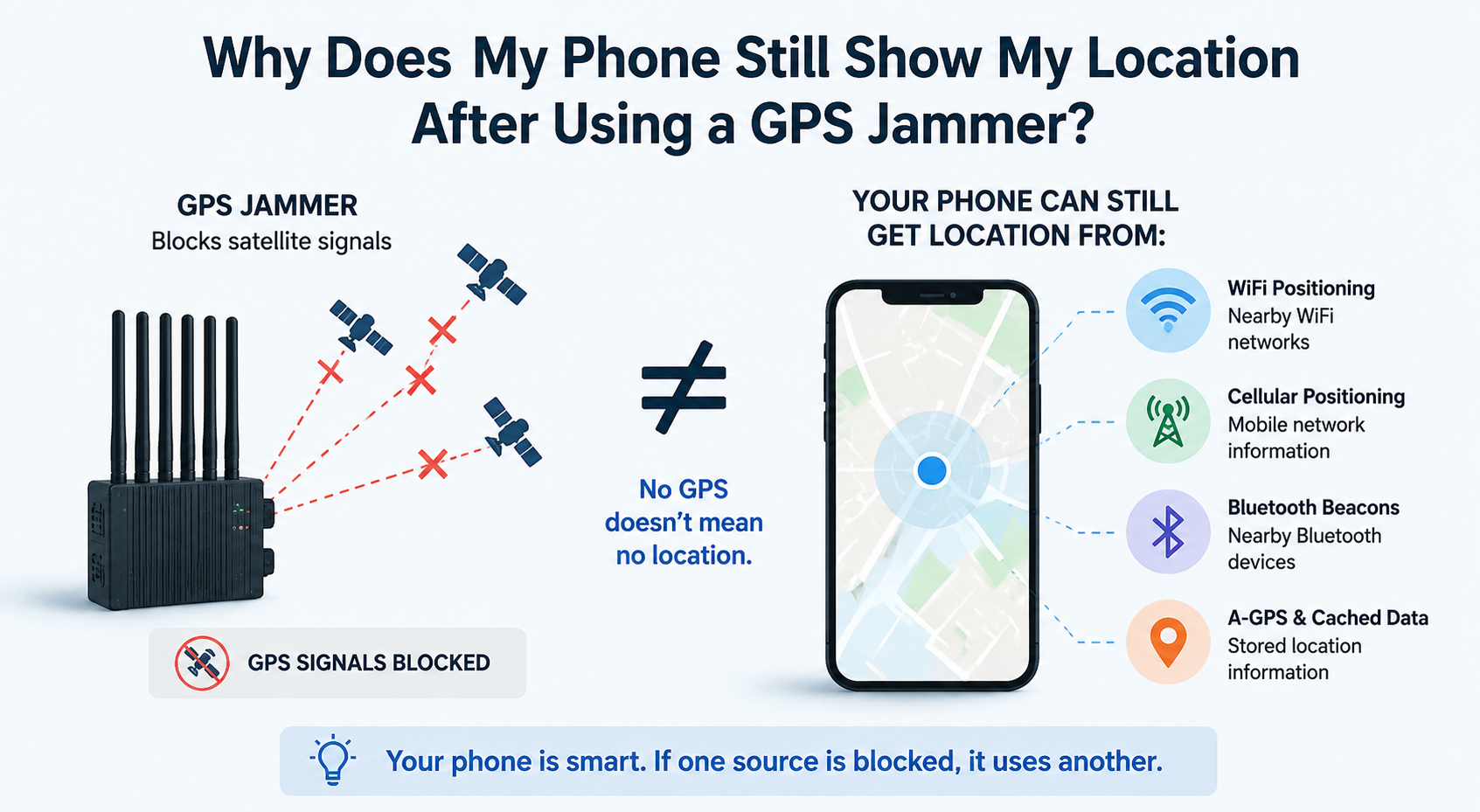
GPS Is Only One Piece of the Puzzle
Open a map application indoors.
Walk through an airport.
Stand inside a shopping mall.
Your phone often knows roughly where you are before it even locks onto a satellite.
That location didn't suddenly appear.
It came from somewhere else.
The Blue Dot Doesn't Tell You Which System Is Working
This is where many tests become misleading.
People see a location on the screen and think:
"GPS is still active."
Not necessarily.
That blue dot doesn't tell you whether it came from:
- satellite signals;
- nearby Wi-Fi fingerprints;
- cellular timing;
- Bluetooth beacons;
- cached positioning data.
It only shows a position.
It doesn't reveal its source.
A Coffee Shop Is a Good Example
Imagine walking into the same coffee shop every morning.
Your phone has visited it dozens of times.
Before GPS has finished searching the sky, the device already recognizes:
- surrounding Wi-Fi networks;
- nearby Bluetooth devices;
- mobile network information.
Within seconds, the map places you almost exactly where you are.
Many people believe GPS never stopped.
In reality, GPS may not have contributed very much at all.
Why Two Phones Can Produce Completely Different Results ?
Place two smartphones on the same table.
Turn on the same GPS jammer.
One phone loses satellite positioning almost immediately.
The other continues showing a stable location.
The difference is often not the jammer.
It is how each manufacturer combines positioning sources.
Some phones rely heavily on satellite signals.
Others switch almost seamlessly between several location technologies.
Modern Phones Prefer Continuity
A smartphone isn't trying to prove that GPS works.
Its goal is much simpler.
Keep the location available.
If one positioning method becomes unreliable, another quietly takes over.
Most users never notice the transition.
Testing a GPS Jammer With Only a Map App Can Be Misleading
Many people open a navigation app for ten seconds and decide whether the jammer works.
That isn't always a reliable test.
The application only displays the final location.
It doesn't explain how that location was produced.
The positioning engine behind the screen may already have changed its strategy several times.
The Better Question
Instead of asking:
"Why can I still see my location?"
Ask something different.
"Where is this location actually coming from?"
That question usually leads to a much more accurate answer.
Final Thoughts
A GPS jammer doesn't operate inside your phone.
It affects satellite reception.
Your smartphone, however, is designed to avoid losing its position whenever possible.
The location on your screen may still exist—not because GPS is still available, but because the device has already found another way to answer the same question.
