
Why Didn't the Drone Return Home After Signal Jamming?
One customer recently sent us an interesting message.
"The first time I interrupted the controller link, the drone flew back automatically."
A few minutes later, he repeated exactly the same test.
Same drone.
Same location.
Same FPV drones radio Jamming device.
This time the aircraft simply hovered.
His conclusion came almost immediately.
"The jammer isn't working anymore."
Maybe.
But probably not.
In reality, one of the biggest mistakes people make when testing drone jammers is assuming that every loss of controller signal should produce exactly the same flight behavior.
Modern drones don't work like that.
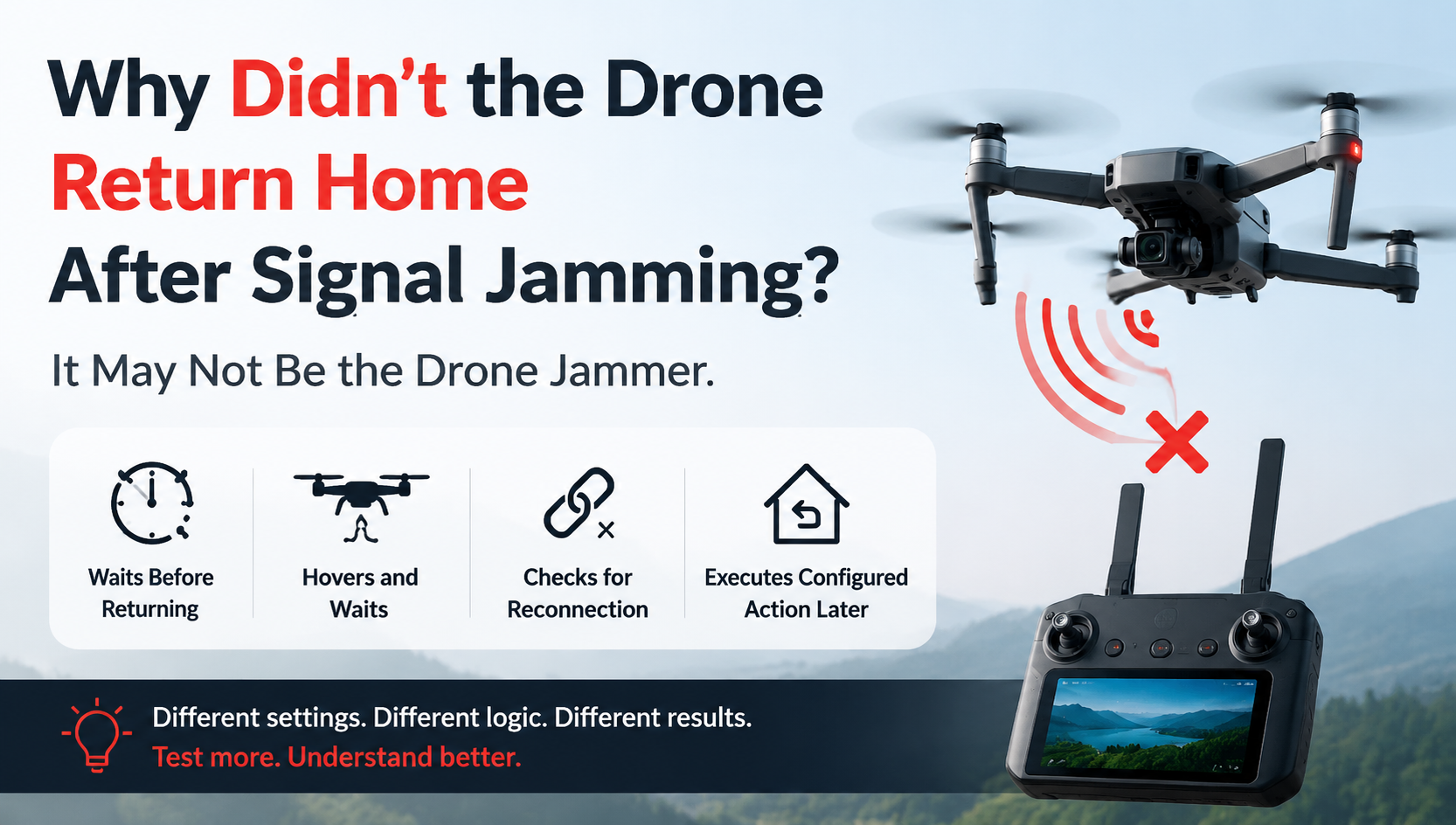
A Drone Doesn't Decide to Return Home the Moment the Signal Disappears
People often imagine a very simple sequence.
Remote signal disappears.
Return Home starts.
Flight finished.
Most aircraft actually pause before making that decision.
Some wait.
Some hold position.
Some check whether the controller reconnects.
Only then do they decide what to do next.
If reconnection happens during that window, Return Home may never begin.
To the person watching, it looks as though the drone jammer suddenly became less effective.
Nothing may have changed except the drone's own decision process.
The First Interruption Can Change the Second Test
This is something that surprises many buyers.
The first signal interruption is a completely new event for the aircraft.
The second one isn't.
Between those two tests the drone has already:
- rebuilt communication;
- updated flight status;
- re-evaluated link quality;
- stored new connection information.
When the second interruption occurs, the aircraft isn't starting from the same conditions anymore.
That's why identical tests often produce different results.
Hovering Isn't Proof That The Drone Is Still Connected
One misunderstanding appears in almost every support conversation.
"If it's hovering, the remote signal must still be there."
Not necessarily.
Hovering is often nothing more than the aircraft waiting for its configured timeout to expire.
Many drones are programmed to wait before executing their fail-safe action.
During that waiting period, they remain stable instead of immediately flying home.
That's exactly what they're designed to do.
The Most Overlooked Setting Isn't Return-To-Home
Most owners spend time adjusting camera settings, obstacle avoidance or flight speed.
Very few ever check one option:
Loss of Signal Action.
That single menu decides what happens after communication is interrupted.
Depending on the aircraft, it may be configured to:
- Hover
- Return Home
- Land immediately
Many buyers assume every drone leaves the factory with Return Home enabled.
That assumption is often wrong.
Why Two Flight Tests Can Look Completely Different ?
Suppose you interrupt the controller signal today.
The aircraft returns home.
You repeat the same test fifteen minutes later.
Now it hovers.
Nothing is broken.
The aircraft may simply be operating under a different combination of:
- GPS quality;
- flight mode;
- controller reconnection timing;
- fail-safe status;
- cached flight information.
Small changes inside the flight controller can completely change what you see outside.
Don't Judge A Drone Jammer By One Flight
Professional testing never relies on one result.
Experienced users compare:
different flight locations.
different battery cycles.
different signal environments.
different aircraft settings.
Only then can they determine whether a drone jammer is behaving consistently.
One flight tells a story.
Several controlled tests reveal the real pattern.
The Wrong Question
Instead of asking:
"Why didn't my drone return home?"
Ask this:
"What decision was the flight controller trying to make before Return Home?"
That single question explains why many people believe their drone jammer stopped working, when in reality the aircraft simply followed a different recovery strategy.
