
Why the Same Phone Jammer Performs Better at 10 AM Than at 9 PM ?
A customer once told me something that sounded impossible:
“The 5G phone network Jammer blocked my phone almost instantly in the morning, but in the evening the phone kept reconnecting. I tested it in the same room, standing in the same spot.”
The device was fine.
The room was the same.
The phone was the same.
What changed was the network outside the building.
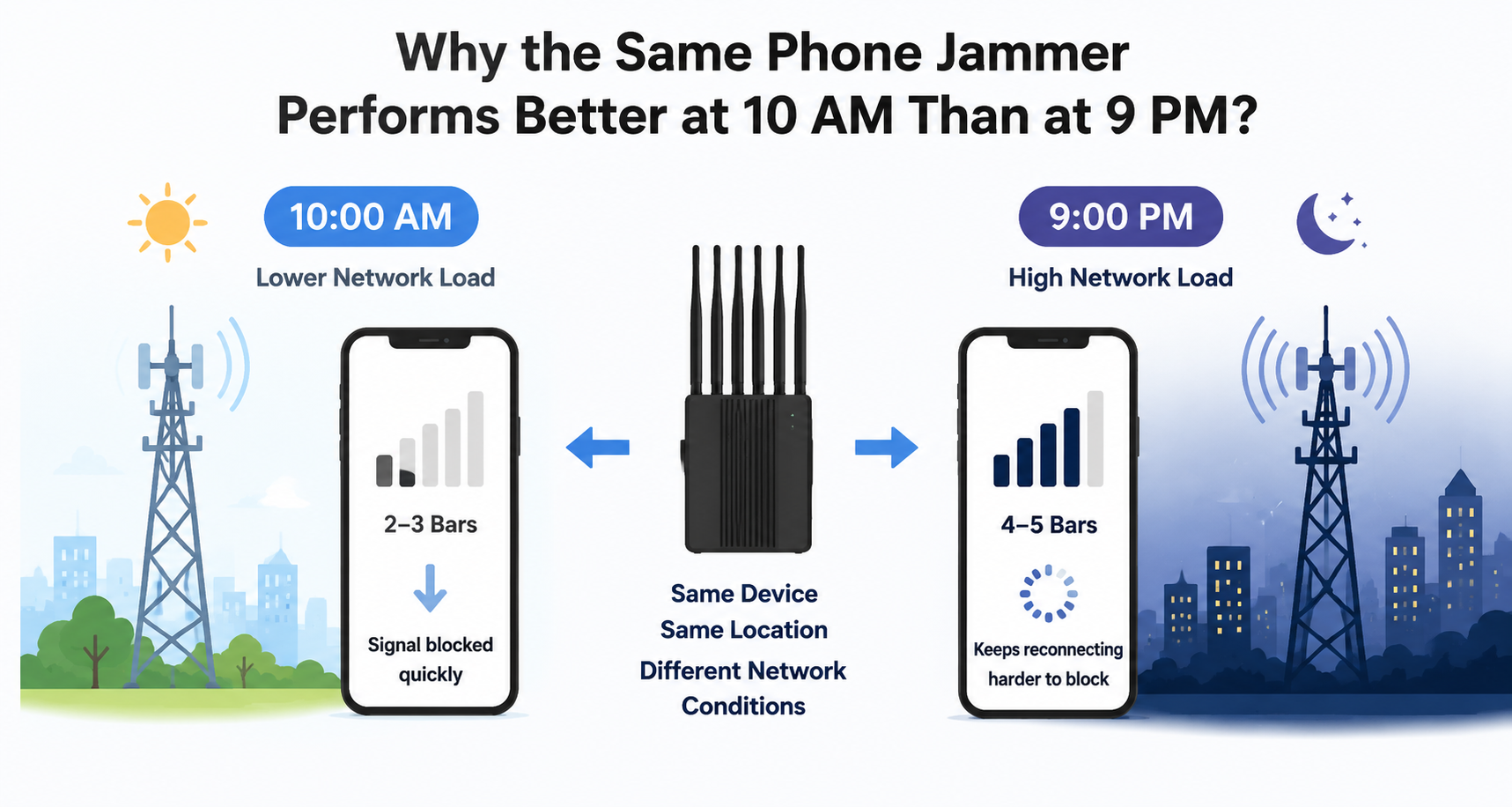
The tower is much busier at night
At 10 AM, the nearest cell tower is usually handling fewer active users. Many people are at work, on Wi‑Fi, or not using their phones heavily.
At 9 PM, the situation is different:
- video streaming;
- social media;
- gaming;
- voice calls;
- smart devices updating in the background.
The tower is serving far more connections, and phones become much more aggressive about holding onto a usable signal.
That is why a same-location mobile phone jammer test can produce different results at different times of day.
What I saw during repeated tests ?
I ran the same test over three days in a small office.
Time |
Phone reaction |
|---|---|
10:00 |
Signal dropped quickly |
15:00 |
Slightly slower |
21:00 |
Several reconnection attempts |
The jammer did not become weaker at night. The phone simply had a stronger incentive to search for and recover a connection.
One detail most people never check
Look at the phone before turning on the jammer.
- Morning: often 2–3 bars
- Evening: sometimes 4–5 bars
The phone is already receiving a stronger or more stable signal from the network, so disrupting that connection becomes noticeably harder.
This is a useful field-testing keyword that almost nobody targets:
phone jammer signal bar difference morning vs evening
People search for “jammer range,” but the number of signal bars at the moment of the test often tells you more than the advertised range.
The elevator test
If you want a quick demonstration, try this:
- Stand near a window at night and check the signal.
- Walk into an elevator or stairwell.
- Watch how fast the phone loses signal.
The phone reacts differently because the signal environment changes, not because the phone changed.
A jammer is affected by the same principle.
A better way to compare results
Do not test once and write down a number.
Use the same phone, same position, and same carrier, but test at:
10:00
14:00
18:00
21:00
Then compare how long the phone takes to reconnect, not just whether it loses signal.
That gives a much more realistic picture of phone jammer reconnection behavior during peak hours.
The takeaway
When someone says:
“My signal blocker worked better this morning than tonight,”
my first question is not:
“Which model are you using?”
It is:
“How many signal bars did the phone have before the test?”
That single detail explains a surprising number of inconsistent results.
And it is the reason why peak-hour mobile network load is often a bigger factor than the jammer’s published specifications.
