
Will Cell Phone Jammers Become Anti-AI Cheating Tools?
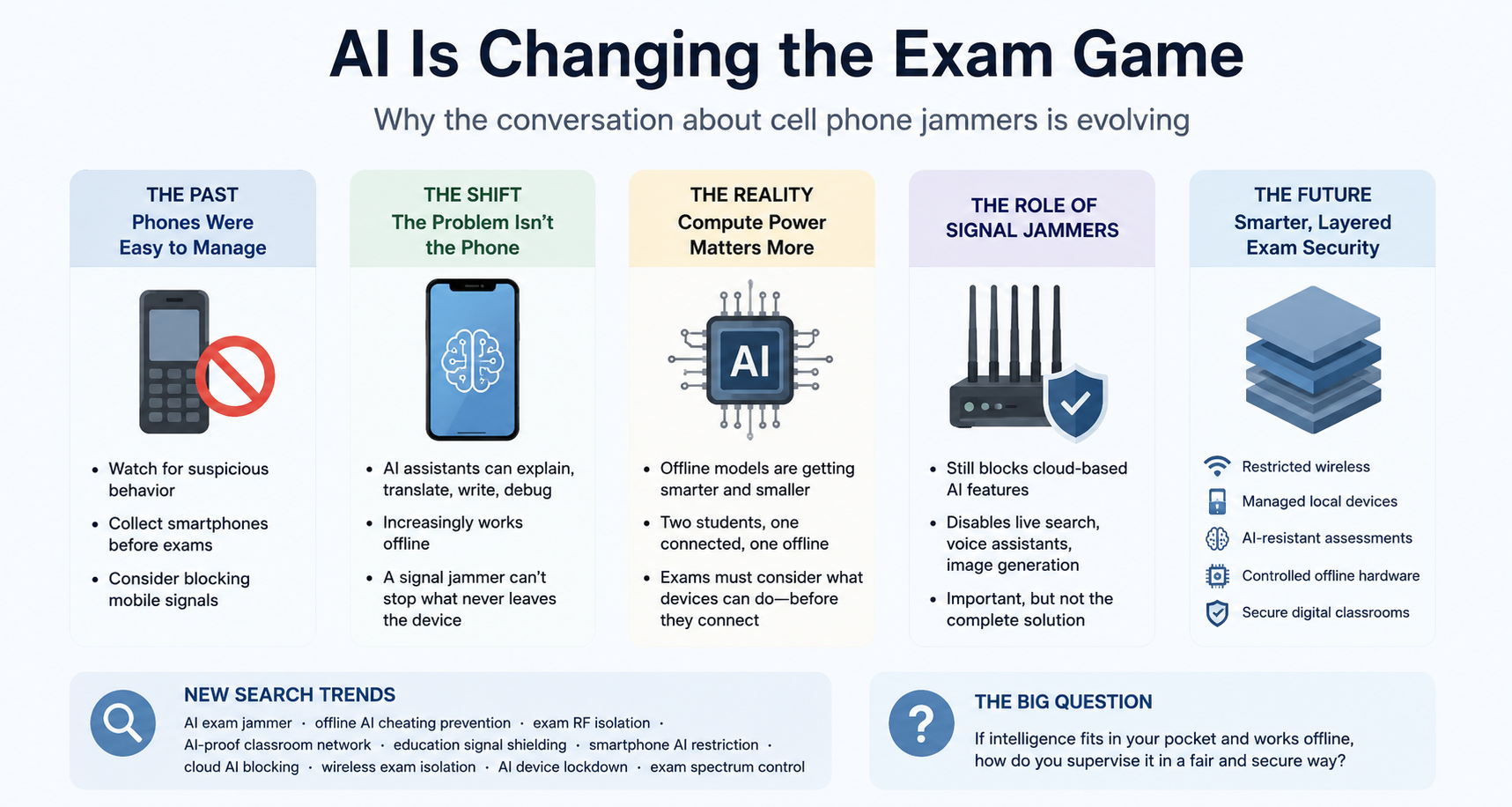
Ten years ago, catching someone cheating with a phone was relatively simple.
You watched for someone looking down too often.
You collected smartphones before the exam.
Some schools even considered blocking mobile signals.
Today, the phone isn't necessarily the problem.
The software inside it is.
That's a much stranger challenge.
A student can carry an AI assistant capable of explaining chemistry, translating Latin or debugging Python. Sometimes it needs the internet. Increasingly, it doesn't.
That changes the conversation around cell phone jammers in ways most people haven't noticed.
Blocking Mobile Data Isn't the Same as Blocking AI
Many discussions still assume one thing:
No internet means no AI.
That assumption is already starting to age.
Several AI models are becoming smaller every year. Smartphones are becoming more powerful at exactly the same time.
Soon, asking an AI for help during an exam may not require WiFi or 5G at all.
The phone never contacts a server.
Nothing travels through the network.
Everything happens locally.
A mobile signal jammer can't interrupt a conversation that never leaves the device.
Schools May Soon Care More About Computing Power Than Connectivity
Imagine two students.
The first opens ChatGPT through a browser.
The second uses an offline language model installed months earlier.
One depends on the network.
The other doesn't.
Only one of them is affected by mobile network blocking.
That's why some educators are beginning to ask a different question.
Maybe exams shouldn't focus on whether students are connected.
Maybe they should focus on what modern devices are capable of before they ever connect.
A Signal Jammer Still Changes the Playing Field
That doesn't mean signal jammers suddenly become irrelevant.
Far from it.
Many AI services still depend on cloud processing.
Voice assistants.
Live searches.
Image generation.
Real-time reasoning.
Cloud synchronization.
Without a network, many of those features disappear immediately.
In practical terms, exam signal isolation still changes what students can realistically do during a timed assessment.
It's simply no longer the complete solution.
The Next Generation of Exam Security Might Look Very Different
Instead of asking
"Should we block phones?"
Schools may eventually ask
"Which device functions should remain available?"
That's a very different discussion.
Future exam environments could combine several layers:
- restricted wireless communication
- managed local devices
- AI-resistant assessment formats
- controlled offline hardware
- secure digital classrooms
Notice something?
Only one of those involves blocking signals.
The New Long-Tail Keywords Aren't About Phones
Search behavior is quietly changing.
People are no longer searching only for:
Powerful 5G cell phone jammer
mobile signal blocker
They're starting to look for much more specific ideas:
- AI exam jammer
- offline AI cheating prevention
- exam RF isolation
- AI-proof classroom network
- education signal shielding
- smartphone AI restriction
- cloud AI blocking
- wireless exam isolation
- AI device lockdown
- exam spectrum control
These phrases don't describe hardware.
They describe problems that schools are trying to solve.
The Real Competition Isn't Between Students and Teachers
It's Between AI and Exam Design
Every generation changes the way people cheat.
Calculators.
Programmable watches.
Messaging apps.
Now it's generative AI.
The interesting part isn't that technology keeps changing.
It's that examinations rarely change at the same speed.
A software-defined jammer might eventually adapt to new wireless environments.
An AI-powered phone will adapt even faster.
That means future discussions may spend less time comparing jammer specifications and more time asking how intelligent devices behave inside controlled environments.
The Question Nobody Asked Five Years Ago
A few years ago, schools mainly wanted students offline.
Five years from now, being offline may not matter very much.
If a phone can analyse, write, translate and explain everything without contacting the outside world, then network denial stops being the centre of the discussion.
The real challenge becomes something much larger.
How do you supervise intelligence when it already fits inside someone's pocket?
That's where conversations about cell phone jammers, AI exam security, dynamic RF control and educational signal isolation are likely to meet—not as competing technologies, but as different pieces of the same problem.
