
Why Silent Mode Isn't Enough: How to Eliminate Phone Interruptions in Meetings
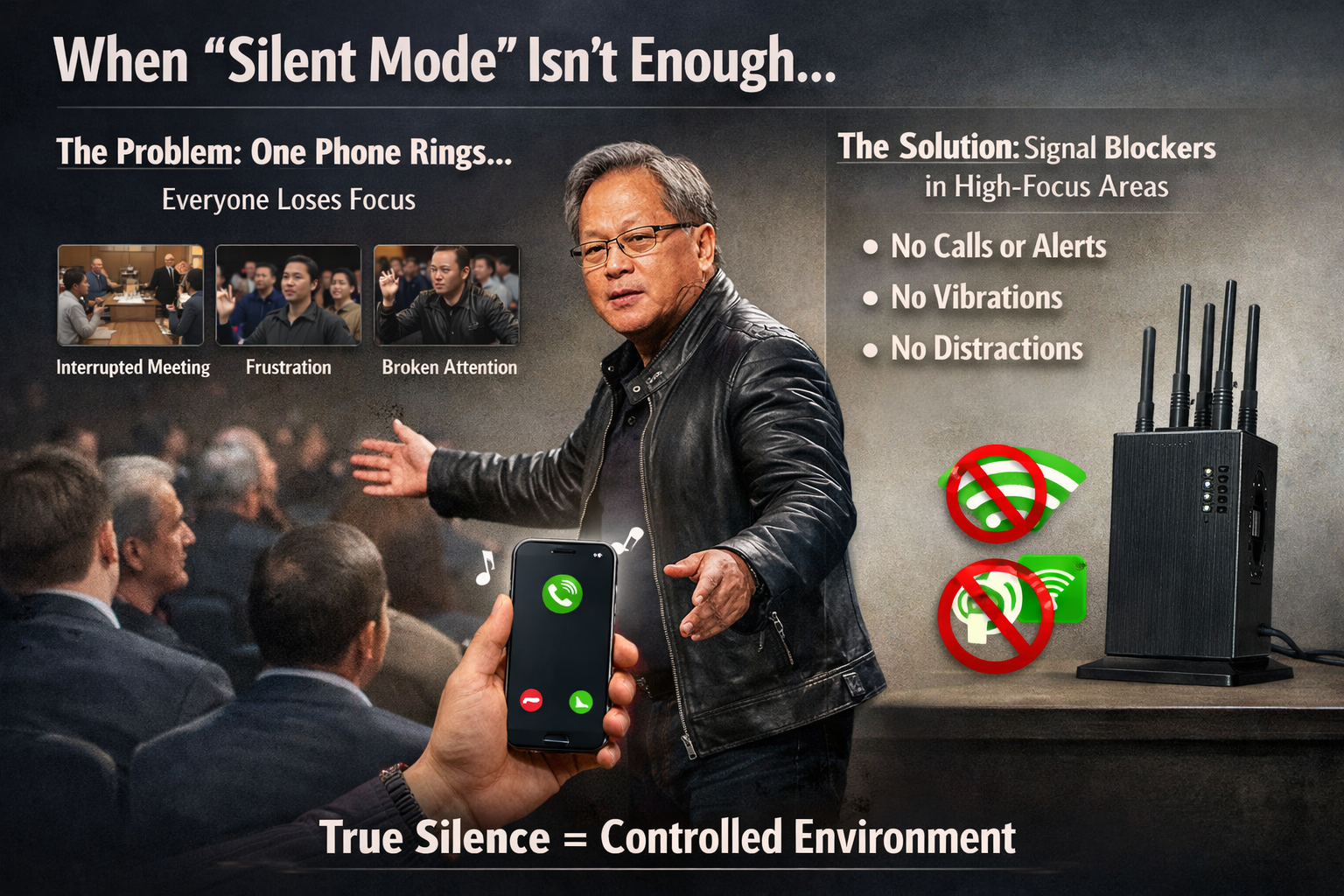
During a recent talk, Jensen Huang suddenly stopped mid-sentence.
A phone was ringing somewhere in the audience.
"Whose phone is that?"
No attempt to ignore it. No polite workaround. Just a direct interruption of the interruption.
After a short pause, he added something telling: at NVIDIA, this wouldn't happen. Meetings have a clear rule—all phones must be fully silent. No vibration. No exceptions.
It sounds strict. But also… necessary.
The Awkward Truth About "Silent Mode"
Everyone knows the rule. And yet, situations like this still happen.
Not because people don't care—but because "silent" doesn't really mean silent anymore.
Phones today are always active:
- Background network connections never stop
- Notifications still trigger screen activity
- Vibration feels "acceptable," until it isn't
- Multiple devices amplify small mistakes
So even in a room where everyone thinks they did the right thing, disruption is still one step away.
In High-Focus Environments, One Mistake Is Enough
In casual settings, a ringtone is just annoying.
In the wrong environment, it's different.
- A strategy meeting
- A confidential discussion
- A training session where attention matters
Here, interruption isn't just noise—it breaks momentum, attention, and sometimes trust.
And the uncomfortable part is this:
👉 The system relies entirely on everyone getting it right, every time.
Which rarely happens.
From "Reminder" to "Control"
This is where a subtle shift is happening.
Instead of repeating the same rule—"Please silence your phone"—some organizations are moving toward something more reliable:
controlling the signal environment itself.
Not louder rules. Not stricter reminders.
Just fewer chances for things to go wrong.
Where Cell Phone Signal Blockers Actually Make Sense ?
This is the point where cell phone signal blockers (jammers) stop sounding extreme—and start sounding practical.
Because they solve a very specific problem:
- 👉 Not bad behavior
- 👉 Not lack of discipline
- 👉 But unavoidable human error in connected environments
In spaces where interruptions carry real consequences, signal blockers are used to:
- Eliminate incoming calls and notifications entirely
- Ensure meetings stay uninterrupted from start to finish
- Create controlled environments for sensitive discussions
- Remove the “weakest link" factor in group settings
No signal means no surprises.
Why This Isn't About Restriction
There's often a misconception here—that blocking signals is about limiting freedom.
In reality, it's closer to setting boundaries for a specific purpose.
Just like:
- Closing a door during a meeting
- Soundproofing a conference room
- Turning off external noise sources
A signal-controlled space is simply the digital version of that idea.
Back to That Moment
Jensen Huang didn't overreact.
He reacted to something preventable.
That's what made it stand out.
Because everyone in the room probably thought:
"This shouldn't have happened."
And they were right.
The Real Question
The next time a phone rings in a room that requires focus, it's easy to ask:
"Who forgot to silence it?"
But a more useful question might be:
"Why are we still relying on that?"
In a world where devices are always connected,
true silence doesn't come from settings anymore—it comes from control.
