
Starlink, GPS Tracking and Privacy: Who Really Knows Where We Are ?
When SpaceX launched the first Starlink satellites, the mission was straightforward: provide fast and reliable internet access to areas where traditional infrastructure is limited or unavailable. A few years later, the Starlink constellation consists of thousands of satellites and continues to expand across the globe.
As internet access reaches places that were once difficult to connect, discussions about privacy are becoming more common. The concern is understandable: if devices, vehicles, and online services are connected almost everywhere, how much control do we still have over our personal data?
For some users, Starlink represents the next stage of global connectivity. For others, it has become part of a broader conversation about digital tracking, location data, and online privacy. Others believe the real privacy concerns are not orbiting above our heads, but sitting in our pockets, vehicles, and homes every day.
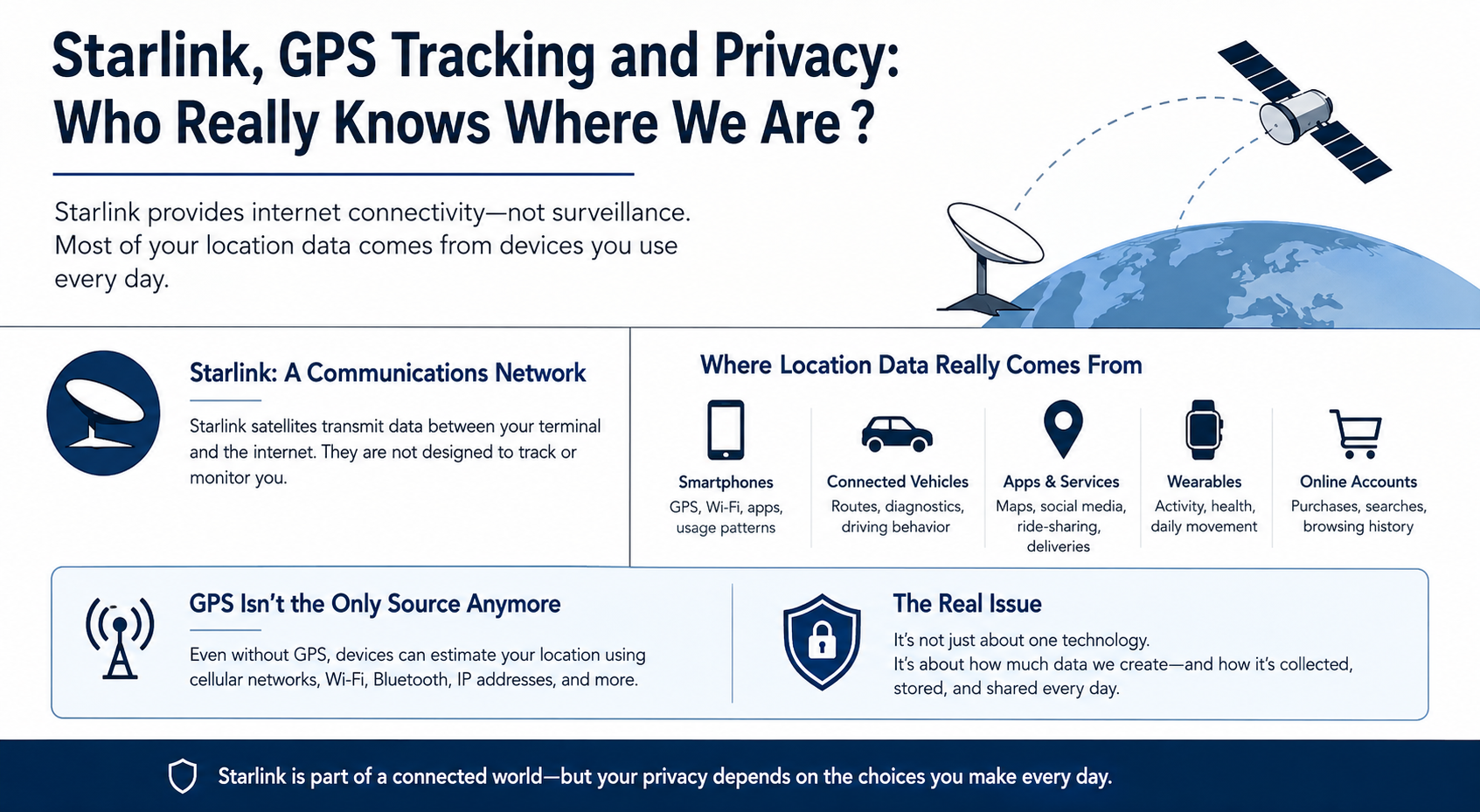
Can Starlink See Where You Are?
A common misconception is that Starlink satellites directly monitor people on the ground or track their movements in real time. As discussed in our previous article, The Evolution of Smart Positioning: From UWB to Satellite Connectivity, this is not how the system works.
Starlink is primarily a communications network. Its purpose is to transmit data between user terminals and the internet. Unlike Earth-observation satellites designed for imaging and surveillance, Starlink satellites are not built to identify or monitor individual users.
Much of the confusion comes from the fact that several technologies are often grouped together in public discussions:
- Satellites
- GPS location services
- Smartphones
- Mobile networks
- Connected applications
Although these technologies frequently work alongside each other, they serve very different functions.
When someone shares a location on WhatsApp, navigates with Google Maps, or uploads a geotagged photo to Instagram, the location data typically comes from the smartphone and its apps—not from the Starlink network itself.
Digital Tracking Existed Long Before Starlink
Location tracking did not begin with Starlink. In reality, location data has been collected and processed for years through devices most people use every day.
Smartphones Collect More Data Than Many Users Realize
Modern smartphones continuously gather information from multiple sources, including:
- GPS coordinates
- Nearby WiFi networks
- Cellular towers
- Browsing history
- App activity and usage patterns
Even when GPS is disabled, many applications can estimate a user's location through alternative methods such as Wi-Fi positioning, mobile network triangulation, and IP address analysis.
This explains why weather apps, ride-sharing platforms, delivery services, and navigation tools often know your location with remarkable accuracy.
Connected Vehicles Generate Massive Amounts of Data
Today's vehicles have become powerful data-collection devices.
Many modern cars routinely record:
- Driving routes
- Travel times
- Navigation history
- Vehicle diagnostics
- Maintenance information
Automakers in both North America and Europe have faced criticism over the amount of data collected through connected vehicle systems. In some cases, drivers are unaware of how much information their vehicles generate and store during everyday use.
GPS Trackers Are Everywhere
Tracking technology is no longer limited to businesses, logistics companies, or government agencies.
Today, consumers can easily purchase:
- GPS trackers for vehicles
- Motorcycle tracking devices
- Pet tracking collars
- Personal GPS trackers
One of the most well-known examples is Apple's AirTag.
Since its release, multiple high-profile incidents have demonstrated how location-tracking devices can be misused. In several reported cases, AirTags were secretly attached to vehicles or personal belongings in order to monitor someone's movements without their knowledge.
These incidents have significantly increased public awareness of location privacy and digital surveillance.
Why Are More People Looking Into GPS Jammers?
As concerns about tracking grow, some people begin searching for ways to protect their privacy.
As awareness of digital tracking grows, some users start looking for ways to reduce their visibility. This is one reason Popular Anti GPS Tracking jammer frequently appear in online discussions about location privacy and vehicle tracking.
The basic idea seems simple: if a device cannot receive GPS signals, it becomes more difficult to determine its location.
However, modern tracking systems are far more sophisticated than they were a decade ago.
GPS Is No Longer the Only Source of Location Data
Fifteen years ago, blocking a GPS signal could significantly reduce tracking capabilities.
Today, smartphones and connected devices can determine location through a combination of:
- Cellular networks
- Wi-Fi access points
- Bluetooth devices
- IP addresses
- Cloud accounts
- App synchronization services
For this reason, cybersecurity experts often emphasize that protecting privacy requires more than simply blocking a single technology. Effective privacy management starts with understanding how personal data is collected, stored, and shared across multiple platforms.
The Real Issue: How Much Data We Leave Behind Every Day
Perhaps the most important question is not whether Starlink can track an individual.
A more relevant question is how many companies already know where we go, what we do, and how we spend our time.
Think about a typical day. Your phone records where you travel, navigation apps remember frequently visited places, banking apps can associate purchases with specific locations, and fitness trackers often log movement throughout the day. None of these systems tells the complete story on its own, but together they can create a remarkably detailed picture of a person's routine.
Banking applications know where we shop.
Smartwatches track our activity levels.
Social media platforms analyze our interests, habits, and interactions.
Individually, these pieces of information may seem insignificant. Combined, they can create a surprisingly detailed profile of a person's daily life.
This growing collection of digital footprints is what fuels many modern privacy concerns.
Starlink did not create this reality. It is simply another component of an increasingly connected world. While public attention often focuses on satellites and new technologies, most location data is generated much closer to home—through smartphones, connected vehicles, apps, and online services that people use every day.
Starlink did not create the modern tracking ecosystem, nor is it the primary source of most location data. In many cases, the devices we carry every day reveal far more information than satellites ever could. For anyone concerned about privacy, understanding how that data is collected is usually more important than focusing on a single technology.
