
WiFi 7 Is Going Mainstream: Are Traditional Wi-Fi Jammers Already Falling Behind?
Just a few years ago, most wireless devices relied on relatively predictable communication methods.
IP cameras connected through home Wi-Fi networks. Bluetooth headphones paired directly with smartphones. GPS trackers depended on a handful of well-known satellite systems.
That environment is changing rapidly.
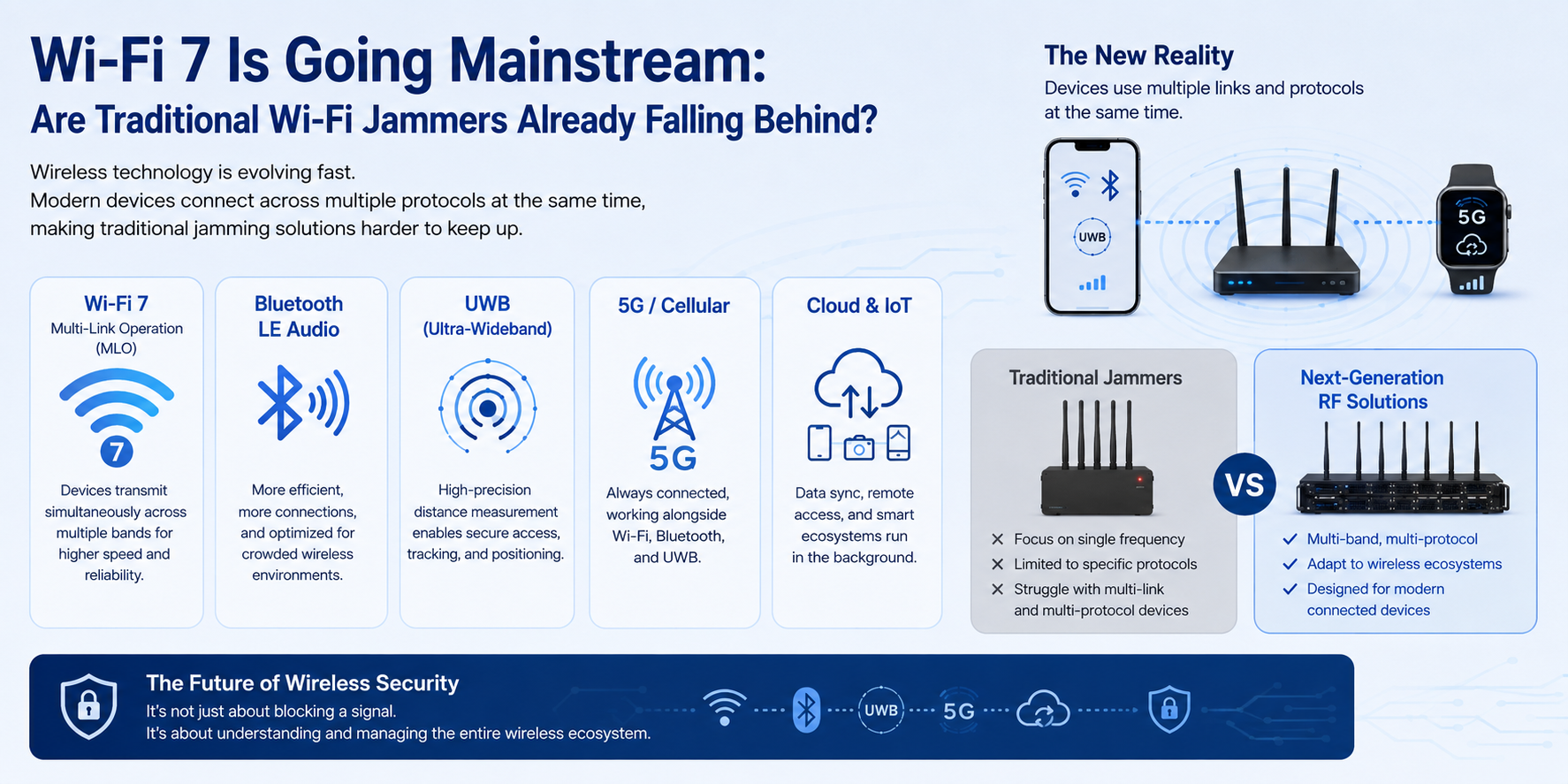
A modern smartphone may now operate across Wi-Fi 7, Bluetooth LE Audio, Ultra-Wideband (UWB), 5G networks, and multiple cloud-based services at the same time. Even when users disable one feature, several other communication channels often remain active in the background.
As wireless technologies continue to evolve, an interesting question is emerging:
Can traditional RF jamming technologies still keep pace with today's multi-protocol devices?
The Challenge Is No Longer Signal Strength
For years, most RF interference solutions focused on clearly defined targets, including:
- High-power 2.4 GHz WiFi Blockers
- Long-range 5 GHz WiFi signal blockers
- Wireless camera jammers
- Portable Bluetooth jammers
These devices were designed for communication systems operating on relatively fixed frequencies.
Wi-Fi 7 changes that equation.
Unlike previous generations, Wi-Fi 7 introduces Multi-Link Operation (MLO), allowing devices to transmit data simultaneously across multiple frequency bands. Rather than relying on a single wireless channel, devices can dynamically switch and combine available links to optimize performance.
For RF engineers and wireless security professionals, analyzing traffic patterns becomes significantly more complex when communications are spread across multiple channels at once.
Bluetooth LE Audio Is More Than an Audio Upgrade
Many consumers view Bluetooth LE Audio as simply a better version of Bluetooth sound transmission.
In reality, the technology introduces a fundamentally different communication framework.
LE Audio is designed to improve power efficiency, support new audio-sharing features, and optimize device connectivity in crowded wireless environments.
As a result, many RF systems originally developed to interfere with classic Bluetooth connections were never specifically engineered with LE Audio profiles in mind.
That doesn't mean older equipment suddenly stops working.
It simply highlights a broader trend: wireless protocols are evolving faster than many legacy RF solutions currently deployed in the field.
Why UWB Is Attracting Growing Attention ?
When discussions turn to signal interference technologies, most people focus on:
- GPS
- Wi-Fi
- Bluetooth
- Cellular networks
Ultra-Wideband often receives far less attention.
Yet UWB has quietly become one of the fastest-growing wireless technologies in modern electronics.
Today, UWB is already integrated into:
- Digital vehicle key systems
- Indoor positioning platforms
- Asset tracking solutions
- Premium smartphones
- Smart home ecosystems
Unlike Wi-Fi, UWB is not primarily designed for data transmission.
Its key advantage is highly accurate distance measurement and spatial awareness.
This precision is exactly why electronic security specialists have started paying closer attention to the technology.
Search demand is gradually emerging for topics such as:
- UWB signal blocker for digital car keys
- Anti-UWB tracking devices
- Ultra-Wideband privacy protection
- UWB location tracking countermeasures
A few years ago, these terms barely appeared in search engine data. Today, they are becoming increasingly relevant as UWB adoption expands.
Future RF Jammers Will Need to Target Entire Ecosystems
One of the biggest misconceptions about wireless systems is the belief that a device depends on a single communication protocol.
Modern connected devices rarely operate that way.
Consider a typical smart tracker.
It may:
- Broadcast identification data through Bluetooth
- Relay information through nearby smartphones
- Synchronize data to cloud servers
- Supplement positioning information through multiple location sources
Disrupting one communication layer does not necessarily disable the entire system.
This reality is driving interest in broader RF protection technologies such as:
- Wi-Fi 7 and Bluetooth LE Audio jammers
- How GPS Jammers Can Help Protect Your Location Privacy ?
- RF blockers for next-generation IoT devices
- Wireless signal control solutions for connected environments
While these search terms remain relatively niche today, they reflect the direction in which the industry is moving.
The Real Shift Isn't Wi-Fi 7 Itself
The most significant change is not that Wi-Fi 7, Bluetooth LE Audio, or UWB are replacing older technologies.
The real transformation is happening at the device level.
For decades, wireless products typically relied on one dominant communication protocol.
Today's devices combine multiple radio technologies that work together simultaneously.
A smartphone may use Wi-Fi, Bluetooth, UWB, cellular connectivity, cloud synchronization, and location services all at the same time.
As this trend accelerates, conversations around RF jamming, wireless signal detection, anti-tracking technology, and digital privacy are becoming far more complex than simply blocking a frequency band.
The future of wireless security will likely depend less on targeting individual signals and more on understanding how interconnected communication ecosystems operate as a whole.
