
Why a Signal Jammer Can Disconnect Phones with Just 3–6 dB More Power ?
I recently came across an idea that completely changed how I think about signal jammers and cell phone signal blocking.
The common assumption is simple:
A jammer just needs to transmit more power than the base station — the stronger the signal, the better the disruption.
But in practice, it's not always that straightforward.
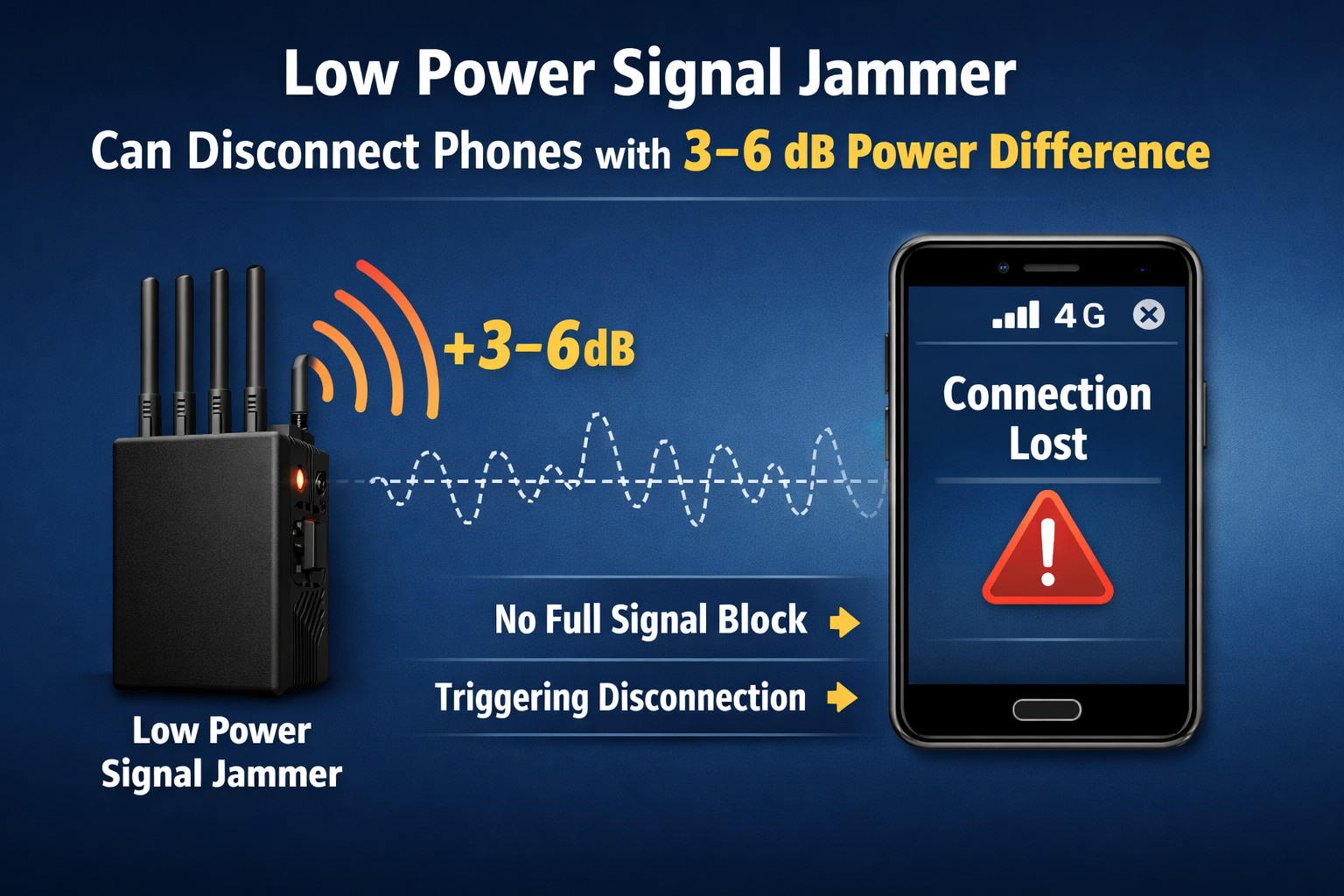
An Observation That Doesn't Fit the “High Power” Theory
In an area with stable 4G coverage, something unusual happened:
- The connection suddenly dropped
- Then quickly reconnected
- Yet the signal never fully disappeared
This wasn't typical RF interference or full-spectrum blocking.
The network wasn't overwhelmed — just briefly interrupted.
That raised a question:
Is high power really the only way a signal jammer works?
A Smarter Approach: Triggering Instead of Overpowering
What I found points to a more subtle mechanism used in some advanced signal jamming technologies.
Instead of brute-force interference, the system may mimic legitimate network signaling — essentially sending instructions that appear valid to the device.
In simple terms, it's like telling the phone:
→ “Disconnect from the network”
And the phone complies — as if the command came from the network itself.
Why Only 3–6 dB Can Be Enough ?
Here's the key insight:
The interfering signal doesn't need to be dramatically stronger — just slightly dominant, typically around +3 to +6 dB.
That small difference is often enough for the device to “trust” the stronger signal source.
Compared to traditional high-power mobile signal Blocker, this approach offers:
- Lower energy consumption
- More targeted signal disruption
- Efficient performance without full-band interference
From Power-Based Jamming to Protocol-Level Disruption
If this model is accurate, it marks a shift in how signal blocking devices operate:
Traditional jammers:
→ Rely on brute-force RF power to overwhelm signal
Modern approaches:
→ Exploit how communication protocols (like 3GPP standards) actually work
In other words:
It's no longer just about transmitting stronger noise —
it's about sending the right signal.
A Simple Way to Understand It
Think of it like this:
- A traditional signal jammer is like someone shouting so loudly that no one else can be heard
- A smarter system is like someone calmly announcing, “The event is over” — and everyone leaves
What This Means Going Forward ?
If low-power signal jamming based on protocol behavior becomes more common, it raises some important questions:
- Will future RF jammers focus less on power and more on precision?
- Are current mobile networks vulnerable to this kind of targeted signaling?
- Should these weaknesses be addressed at the protocol level?
Final Thoughts
A signal jammer doesn't always need to overpower everything.
In some cases, it just needs to interact with the system in a smarter way —
and the device disconnects on its own.
