
Why Do Drone Jammer Guns Sometimes Appear More Effective?
Drone blocker guns often look more powerful than compact units or anti-drone devices fitted with multiple antennas. Their rifle-like design makes them visually distinctive, but does that mean they actually perform better?
Not necessarily. The difference is often related to antenna design, radiation patterns and the conditions under which performance is measured. Two devices with similar advertised RF output power can have different technical characteristics and coverage patterns.
Understanding these differences is more useful than judging anti-drone jammers by their appearance alone.
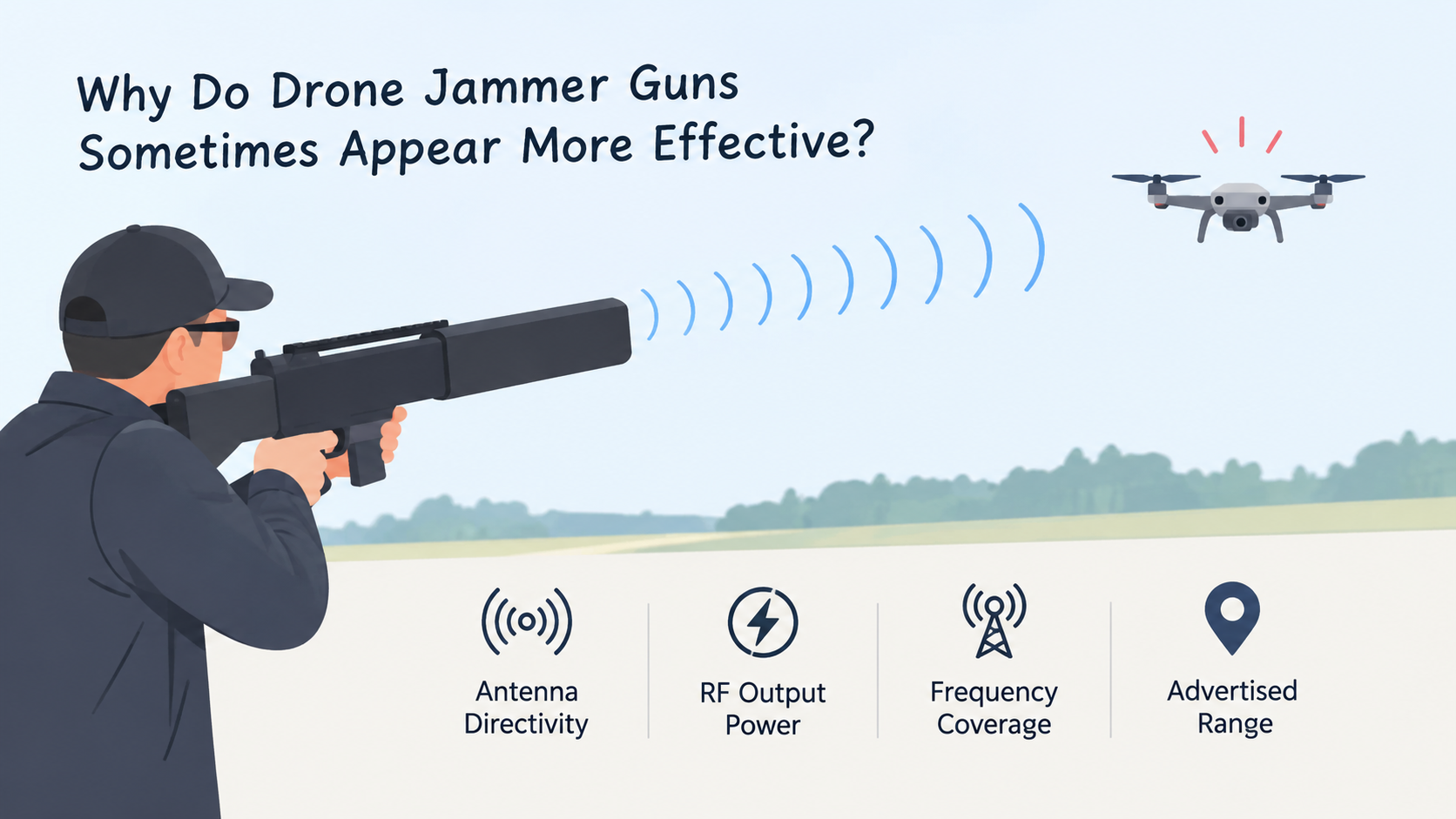
How Does Antenna Directionality Affect Performance?
One important difference between drone jammer guns and other designs is how their antennas distribute radio-frequency energy.
Directional antennas concentrate more of their radiation within a particular angular region. Omnidirectional antennas are designed to distribute radiation more broadly around the device, although their actual patterns depend on the antenna design and installation.
This distinction affects the distribution of energy rather than automatically increasing the transmitter's output power.
As a result, two anti-drone jammers with similar output-power specifications may have different radiation patterns. A directional model may appear more effective in a particular direction, while a multi-antenna unit may be designed for broader coverage or different frequency bands.
When comparing directional RF drone jammers, antenna characteristics are therefore just as important to consider as the headline specifications.
Why the Shape of Drone Jammer Guns Can Be Misleading ?
The rifle-like shape is one of the most recognizable features of these devices. However, the enclosure alone does not reveal how the radio-frequency system is designed.
Gun-shaped drone jammers may use directional antenna configurations, but their external appearance does not establish antenna gain, supported frequency bands, RF output power or overall performance.
By comparison, box-shaped anti-drone jammers may incorporate several antennas to support different frequency bands or coverage requirements. Depending on their design, these devices may be intended for applications that differ from those of directional models.
This is why the number of visible antennas or the shape of the housing should not be treated as a reliable measure of effectiveness.
A meaningful comparison requires technical specifications and clearly documented test results.
Why Advertised Range Can Be Misleading ?
Range is often one of the first figures people notice when comparing drone jammer guns. However, a range claim is difficult to assess without knowing how it was measured.
Radio propagation is affected by environmental conditions, physical obstructions, reflections and antenna characteristics. Results recorded in an open test area may differ from those obtained in a built-up environment.
The type of effect being measured also matters. Disruption of a control link, loss of a video feed and interference with satellite-navigation signals are different outcomes. A range figure associated with one function should not automatically be applied to the others.
For example, specifications claiming 500 metres or 1 kilometre provide limited grounds for comparison if the manufacturer does not explain the test conditions and the effect being measured.
Clear testing information is more useful than a headline figure without context.
Do All Drones Respond to Interference in the Same Way?
No. Drone models can differ in their communication links, video-transmission systems, navigation technologies and failsafe procedures.
These differences can affect how an aircraft responds when a radio link is disrupted. One function may be affected while another continues to operate.
When reviewing claims about anti-drone jammers, it is useful to distinguish between four outcomes:
- Control-link disruption: Communication between the remote controller and the aircraft is affected.
- Video-link disruption: The live video feed becomes unavailable or degraded.
- Navigation interference: Positioning information may be affected.
- Failsafe activation: The aircraft responds according to its configured safety procedures.
These outcomes are not interchangeable. A drone that loses its video feed has not necessarily lost its control link, and the aircraft's subsequent behaviour depends on its design and configuration.
For this reason, advertised performance should always be considered in the context of the specific function being evaluated.
RF Output Power Is Only One Part of the Picture
When comparing drone jammer guns, it is tempting to focus on the highest advertised power rating. However, output power alone does not describe the complete radio-frequency system.
RF output power
This specification describes the transmitter's output under the stated measurement conditions. It does not independently establish the resulting coverage pattern or overall performance.
Antenna gain and directivity
These characteristics help explain how radiation is distributed in different directions. Directional and omnidirectional antennas can produce different coverage patterns even when paired with transmitters having similar output power.
Frequency coverage
Anti-drone jamming devices may support different frequency bands. Comparing their power specifications without considering frequency coverage can therefore give an incomplete picture.
Test conditions
The environment, measurement method and specific radio function being assessed all influence how published results should be interpreted.
Taken together, these factors provide a more useful basis for comparison than any single specification.
Are Directional UAV radio blockers Always Better Than Multi-Antenna Models?
No. The two designs may serve different coverage requirements, so neither should be assumed to be universally superior.
Directional drone jammers are characterized by an antenna pattern that concentrates more radiation into a particular angular region. Other anti-drone systems may be designed around multiple antennas and different frequency-coverage requirements.
The number of antennas alone does not establish which design performs better. Their characteristics, the overall RF architecture and the intended application all matter.
Likewise, a rifle-shaped enclosure does not prove that a device has greater output power or a longer effective range. Appearance can suggest how a product is intended to be handled, but it cannot replace technical evidence.
What Should You Check When Comparing UAV Jammer Guns?
Before drawing conclusions from product specifications, look for information that makes the manufacturer's claims easier to evaluate.
Important details include:
- Supported frequency bands.
- RF output power and its stated measurement conditions.
- Antenna type and published gain specifications.
- The test environment and measurement methodology.
- The particular communication or navigation function referenced by a range claim.
If these details are unavailable, advertised range figures should be treated cautiously rather than as directly comparable performance measurements.
For more background on evaluating these products, visit our guide to choosing an effective drone blocker.
Why Can Drone Jammer Guns Seem More Effective?
The answer is not simply that they are more powerful. Their appearance and antenna design may create a different coverage pattern, which can influence how their performance is perceived under particular test conditions.
However, gun-shaped drone jammers are not automatically more effective than compact or multi-antenna alternatives. Their actual characteristics depend on the radio-frequency design, supported bands and evidence behind the manufacturer's specifications.
When comparing anti-drone jammers, look beyond the enclosure and headline range. Antenna characteristics, RF specifications and transparent test conditions provide a more reliable basis for understanding the differences between products.
