
Does a Drone Jammer With More Frequency Bands Offer Better Compatibility?
When shopping for a drone jammer, it is tempting to compare products by counting their frequency bands. A four-band model seems less capable than a six-band model, while an eight-band UAV radio jammer may appear to offer the broadest compatibility.
That assumption sounds reasonable, but it can lead to the wrong buying decision.
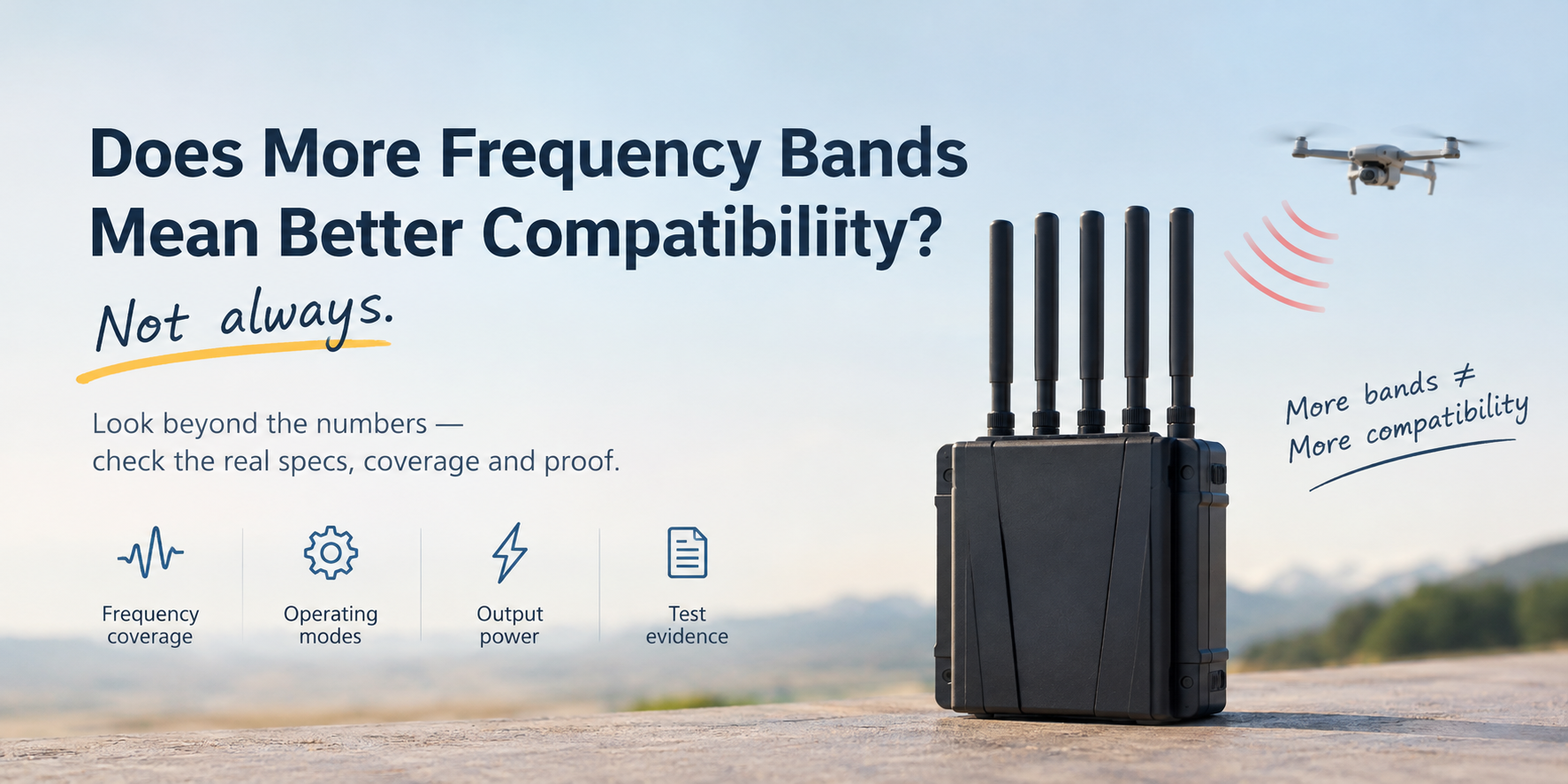
A drone jammer with more frequency bands may cover a wider range of signals. However, the number of advertised bands does not tell you how many drone models it supports, whether those bands operate simultaneously, or how well the device performs under real operating conditions.
The difference becomes clearer when you compare actual product specifications rather than the numbers in product titles.
1. Six Frequency Bands Do Not Mean Compatibility With Six Types of Drone
Consider a buyer looking for a multi-band drone jammer for a facility where different UAV models may be encountered.
Product A advertises six frequency bands. Product B advertises four. At first glance, Product A appears to offer broader compatibility.
Now look beyond the titles. Product A lists its frequency ranges but provides no model-specific compatibility information. Product B lists its supported ranges, explains its operating modes, and provides test documentation for the intended application.
Which product offers more confidence?
Product A has more advertised bands, but that alone does not establish broader compatibility. Product B provides better evidence of what it can support, even though its band count is lower.
There is an important distinction here: a frequency band is a portion of the radio spectrum, not a category of drone. Several drone models may use overlapping frequencies, while systems operating in similar ranges may differ in their communication arrangements.
This is why terms such as six-band drone jammer, multi-frequency UAV radio jammer, and FPV drone jammer should not be treated as interchangeable claims of compatibility.
2. The Number of Bands Can Hide Differences in Frequency Coverage
Not every product counts or describes its supported frequencies in the same way.
One manufacturer may list several separate operating bands. Another may describe a broader continuous frequency range. A third may advertise a total band count without making the exact coverage clear.
For example, imagine two products with four advertised bands. One specifies each supported range individually, while the other gives only a general description of its frequency coverage.
Both products have the same band count, but the available information is not equally useful.
A buyer needs to know whether the listed ranges cover the frequencies relevant to the intended application. The number four, six, or eight cannot answer that question.
There is another detail worth checking: gaps between supported ranges. A product described as covering several bands should not automatically be assumed to cover every frequency between the lowest and highest figures in its specifications.
For anyone comparing a drone jammer frequency range, the exact boundaries matter more than the headline number.
3. Can All Frequency Bands Operate at the Same Time?
This is one of the most useful questions to ask when comparing a multi-band drone jammer.
Some products offer several selectable frequency configurations. Others are designed to operate across multiple bands simultaneously. These arrangements are not equivalent.
Imagine two eight-band products.
Product A lists eight bands but does not clearly state whether all eight can operate at once.
Product B specifies which bands can operate simultaneously and documents the output available in each operating configuration.
Although both products advertise eight bands, their specifications describe different capabilities.
This distinction matters because a list of selectable options does not necessarily describe the device's full simultaneous operating capability. Buyers should check the operating manual or request written clarification (Common Drones and Their Transmission Frequencies) rather than assume that every listed band is active at the same time.
The same issue arises with products advertised as multi-channel or multi-frequency drone blockers. The words band, channel, and operating mode do not always refer to the same thing.
4. More Bands Do Not Automatically Mean More Effective Range
Frequency coverage and operating range are separate questions.
A long-range drone jammer may advertise several frequency bands, but the band count does not establish how far its effects extend. Range depends on the relevant signal characteristics, output at each frequency, antenna configuration, obstructions, and the surrounding radio environment.
Consider two product listings:
| Specification | Product A | Product B |
|---|---|---|
| Advertised frequency bands | 6 | 4 |
| Output by band | Not clearly stated | Individually specified |
| Simultaneous operation | Unclear | Documented operating modes |
| Test conditions | Not provided | Described in the documentation |
| Compatibility evidence | General marketing claim | Application-specific test information |
This comparison does not prove that Product B has a longer range or is more effective. It shows that Product B provides more information with which to evaluate its claimed capabilities.
A manufacturer quoting a long operating distance without explaining the test environment also leaves an important question unanswered: under what conditions was that distance measured?
For technical purchasing, a range figure without a clear test method is difficult to compare with another product's claim.
5. Why Drone Type Matters More Than a Generic Compatibility Claim
A drone is not defined by its radio frequency alone.
Depending on the design, its control link, video transmission, telemetry, and satellite navigation may use different signal arrangements. Some systems also change their communication behavior depending on the model, configuration, or operating environment.
This creates a common problem with generic claims such as "compatible with most drones."
A product may list frequency ranges commonly associated with consumer UAVs or FPV equipment, but that does not establish compatibility with every drone using those ranges. Nor does a broad frequency list prove that the product addresses every relevant communication or navigation function.
For example, someone comparing a multi-band UAV jammer for FPV drones with a product marketed for general drone applications should look for evidence relevant to the intended category. A general frequency list is not a substitute for documented testing.
Firmware revisions and product generations can also complicate comparisons. A compatibility statement for one version of a drone should not automatically be extended to every later version.
The more specific the intended application, the more useful model-specific documentation becomes.
6. What About Output Power Across Multiple Bands?
Another detail often overlooked in drone jammer specifications is how output is described.
Some listings provide a total output figure without clearly explaining how that output is allocated across individual bands. Others specify output separately for each band or operating configuration.
These figures should not be treated as equivalent.
Suppose one product advertises a high total output across several bands, while another provides separate output ratings for each supported range. Without additional information, the first figure does not reveal how much output is available on any particular band.
This does not mean that one specification format automatically indicates a better product. It means the figures must be interpreted correctly.
When evaluating drone jamming device output power and frequency coverage, check whether the ratings refer to total output, individual bands, or a particular operating mode. Also look for the antenna configuration and test conditions associated with the figures.
More frequency bands do not automatically mean more output per band, and a higher total output figure alone does not establish broader compatibility.
7. When Is Paying for More Frequency Bands Worthwhile?
The answer depends on what the additional bands actually contribute.
A buyer whose requirements involve several different signal categories may have a legitimate reason to consider broader frequency coverage. In that situation, additional bands can be valuable if they address relevant requirements and the manufacturer's claims are adequately documented.
But consider a different purchasing scenario: a product offers eight bands, while the buyer has no clear information about the specific frequency coverage, simultaneous operation, or compatibility testing.
The extra bands may sound impressive, but their practical value remains uncertain.
This is where comparing a four-band versus six-band drone jammer becomes more complicated than comparing prices and numbers. The additional bands are worth paying for only if they offer a relevant, verified capability—not simply because the product title contains a larger number.
For commercial or security-related procurement, it is also important to confirm that the equipment is permitted for the intended use. Radio-frequency interference can affect systems beyond the intended target, and applicable restrictions vary by location.
A Practical Checklist for Comparing Multi-Band Drone Jammers
Before making a purchase, check the following:
- Exact frequency ranges: Are the individual ranges clearly listed, rather than represented by a band count alone?
- Operating modes: Are the bands selectable, simultaneous, or available only in certain configurations?
- Output specifications: Is output stated per band, per operating mode, or as a combined figure?
- Compatibility evidence: Does the manufacturer provide relevant test documentation rather than an unrestricted compatibility claim?
- Range claims: Are the test environment and measurement conditions explained?
- Technical documentation: Can the manufacturer clarify any missing details in writing?
These checks help distinguish a product with genuinely useful specifications from one whose main selling point is a high frequency-band count.
The Verdict: Compare Coverage and Evidence, Not Just Numbers
Does a drone jammer with more frequency bands offer better compatibility? Not necessarily.
More bands can expand nominal frequency coverage, but they do not automatically translate into support for more drone models, better performance, or longer operating range.
A six-band drone jammer may be the better fit for one application and an unnecessary expense for another. A four-band model may provide a clearer technical match if its documented capabilities align more closely with the actual requirements.
The key question is not how many bands a drone jammer advertises, but what those bands cover, how they operate, and what evidence supports the compatibility claims.
That is the difference between buying a product with an impressive specification sheet and choosing one whose stated capabilities can actually be evaluated.
