
Why Cell Phone Jammer Performance Is Not Simply About Distance ?
When testing a mobile network jammer, one of the first things people usually look at is distance.
Five meters. Ten meters. Fifteen meters.
It seems logical that the phone should be affected more strongly when it is closer to the jammer and less strongly when it is moved away.
But real-world testing does not always follow such a neat pattern.
You can place a phone five meters away, move it to another position that is still five meters away, and suddenly get a different result. Sometimes moving the phone only a short distance is enough to change what happens on the screen.
So what is going on?
The answer is that distance is only part of the picture. What matters to the phone is the RF environment around it, and that environment can change considerably even over a relatively small area.
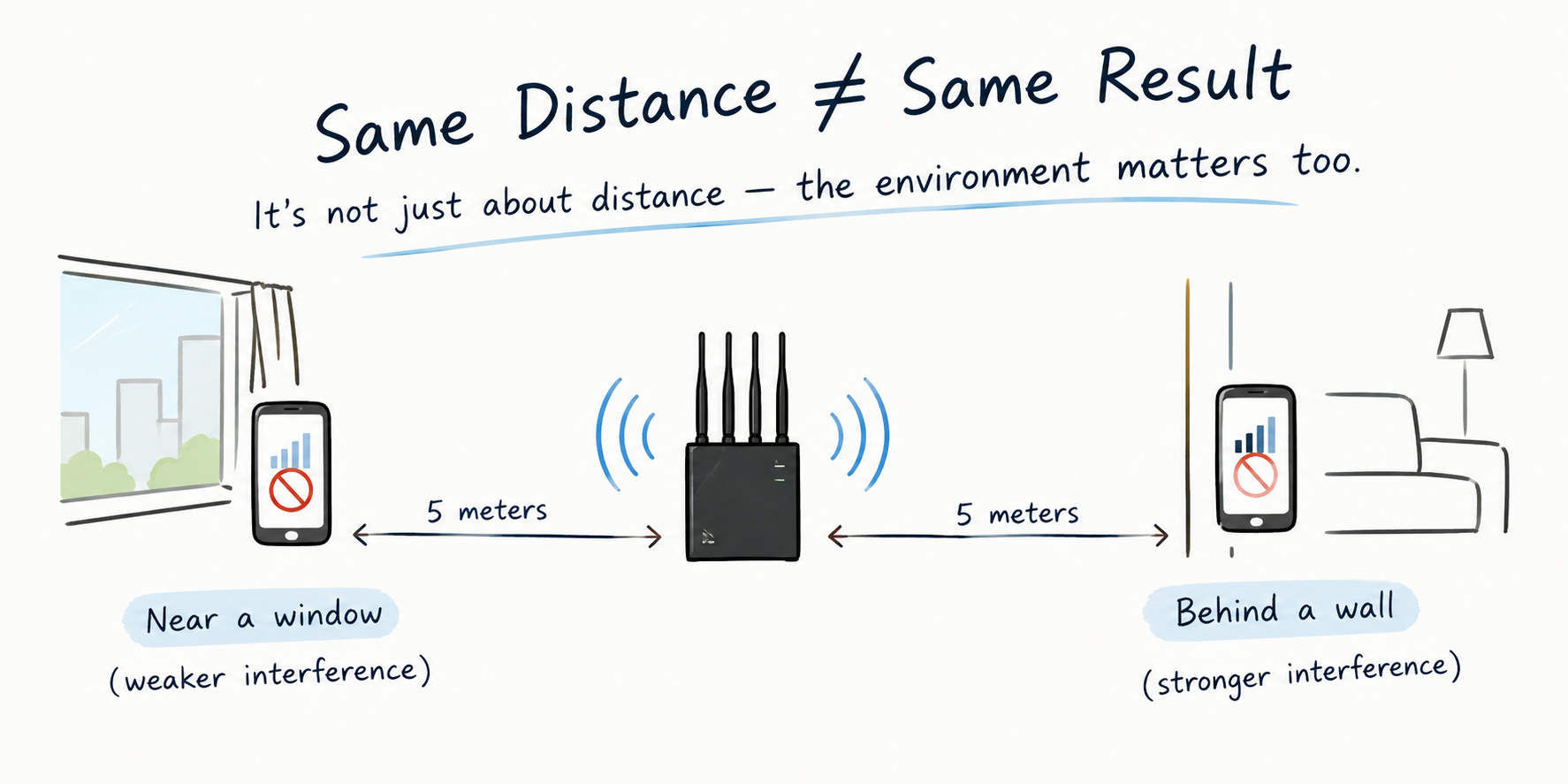
Five Meters Is Not Always the Same Five Meters
Imagine testing a phone in a room.
The first position is near a window. The second is on the other side of the room, behind a wall or a large piece of furniture. Both positions are five meters from the jammer.
On paper, the test conditions look almost identical.
In practice, they may not be.
The phone is not simply responding to the number "5 meters." Its antennas are receiving the radio signals that happen to reach that particular spot. Walls, windows, metal objects and other surfaces can alter how those signals travel through the room.
This is where things get interesting.
A signal can arrive directly, but it can also bounce off walls or other surfaces before reaching the phone. Several versions of the same signal may therefore reach the antenna from different directions.
That is known as multipath propagation, and it is one reason why moving a phone a relatively short distance can sometimes change the RF conditions around it.
The Strongest Signal Isn't Always Coming From the Direction You Expect
Another detail that is easy to overlook is the location of the cellular network itself.
The phone is not communicating with some abstract "mobile network." It is communicating with actual network infrastructure, and the surrounding environment determines how those signals reach the handset.
A window, a concrete wall, a nearby building or even the layout of a room can change the path between the phone and the outside network.
So when a phone is moved from one side of a room to another, its relationship with the surrounding cellular signals changes too.
This is why two phones sitting at roughly the same distance from a mobile phone jammer can sometimes show different behavior.
Then There Is the Phone Itself
The phone's position can also make a difference.
Try placing the same smartphone flat on a table and then holding it upright in another position. The phone hasn't changed, and neither has the jammer. But the antennas are now sitting in a different physical environment.
The same thing can happen when the phone is:
- near a window
- partly covered by clothing or a bag
- close to a metal object
- moved behind furniture
- or simply turned in another direction
None of these factors should be treated as a guaranteed rule for how the phone will respond. They simply illustrate why smartphone position matters when interpreting a jammer test.
Why the Same Room Can Produce Different Results ?
This is where many informal tests become difficult to compare.
Someone might say:
"The phone was five meters from the jammer, so the result should have been the same."
Not necessarily.
If the first test was made beside a window and the second was made behind an interior wall, the phone was exposed to two different RF environments—even though the measured distance was identical.
The same problem appears when testing in different rooms.
A bedroom, office and garage may all be ten meters from the same point, but their walls, windows, furniture and surrounding structures can be completely different.
The distance hasn't changed much.
The radio environment has.
The Network Can Change Between Tests
There is also a factor that has nothing to do with the room: the cellular network itself is not frozen in place.
A smartphone continuously manages its connection. Depending on the conditions, it may evaluate different cells or network resources and change how it maintains the connection.
That means two tests performed at different times may start from slightly different conditions.
For example, the phone might be connected differently during a morning test than during an evening test. Network traffic, available cells and local RF conditions can all change.
The test conditions may have changed in ways that are not immediately visible.
This Is Why "Effective Distance" Can Be Misleading
When people talk about the range of a cell phone jammer, they often imagine a clean circle around the device:
closer = stronger
farther = weaker
That is a useful way to picture the basic idea, but an actual building is not an empty field.
There are walls, windows, furniture, metal structures, reflections and other radio sources. The phone itself is also moving, changing orientation and switching between different network conditions.
As a result, the boundary between "working" and "not working" may not behave like a perfectly measured line.
A phone at 8 meters may not necessarily behave exactly like another phone at 8 meters.
What Should You Look At During a Jammer Test?
Distance is still worth recording. It gives you an important reference point.
But if you want to understand why two tests differ, record more than just the distance.
For example:
- Where exactly was the phone?
- Was it near a window or wall?
- Was it lying flat or being held?
- Was the phone facing the same direction?
- Were doors and windows in the same position?
- Were other wireless devices nearby?
- Was the phone connected to the same type of network?
- Were the tests performed at roughly the same time of day?
These details may seem insignificant when you are standing in the room, but they can make a comparison much more useful afterward.
The Real Question Isn't "How Far?"
A better way to look at a cell phone jammer test is to stop treating distance as the only measurement.
If two phones are both five meters away but one is beside a window and the other is behind a concrete wall, they are not necessarily experiencing the same RF conditions.
Likewise, if the same phone gives different results during two tests, that does not automatically mean that something has gone wrong with the jammer or the phone.
Sometimes the simplest explanation is that the environment was different.
Distance tells you where the phone was.
It doesn't tell you everything the phone was receiving there.
And in a real indoor RF environment, that difference can matter far more than a few extra meters on a tape measure.
