
AI Signal Jammers: Why Voice Control Could Replace Fixed Frequency Settings
Most signal blockers still depend on a familiar control method: select a frequency, choose a preset, and activate the device. It works, but the user has to think like the hardware.
That could change with the next generation of AI signal jammers. In the previous article, we briefly outlined another possible Dynamic Power Allocation Across Multiple RF Bands AI Jammers.
The more interesting development is not simply adding more frequency bands. It is allowing the user to communicate with the device in ordinary language.
Instead of searching through a frequency table, a user could say what kind of operation they need. The AI would interpret the request and connect it with an appropriate, predefined operating profile.
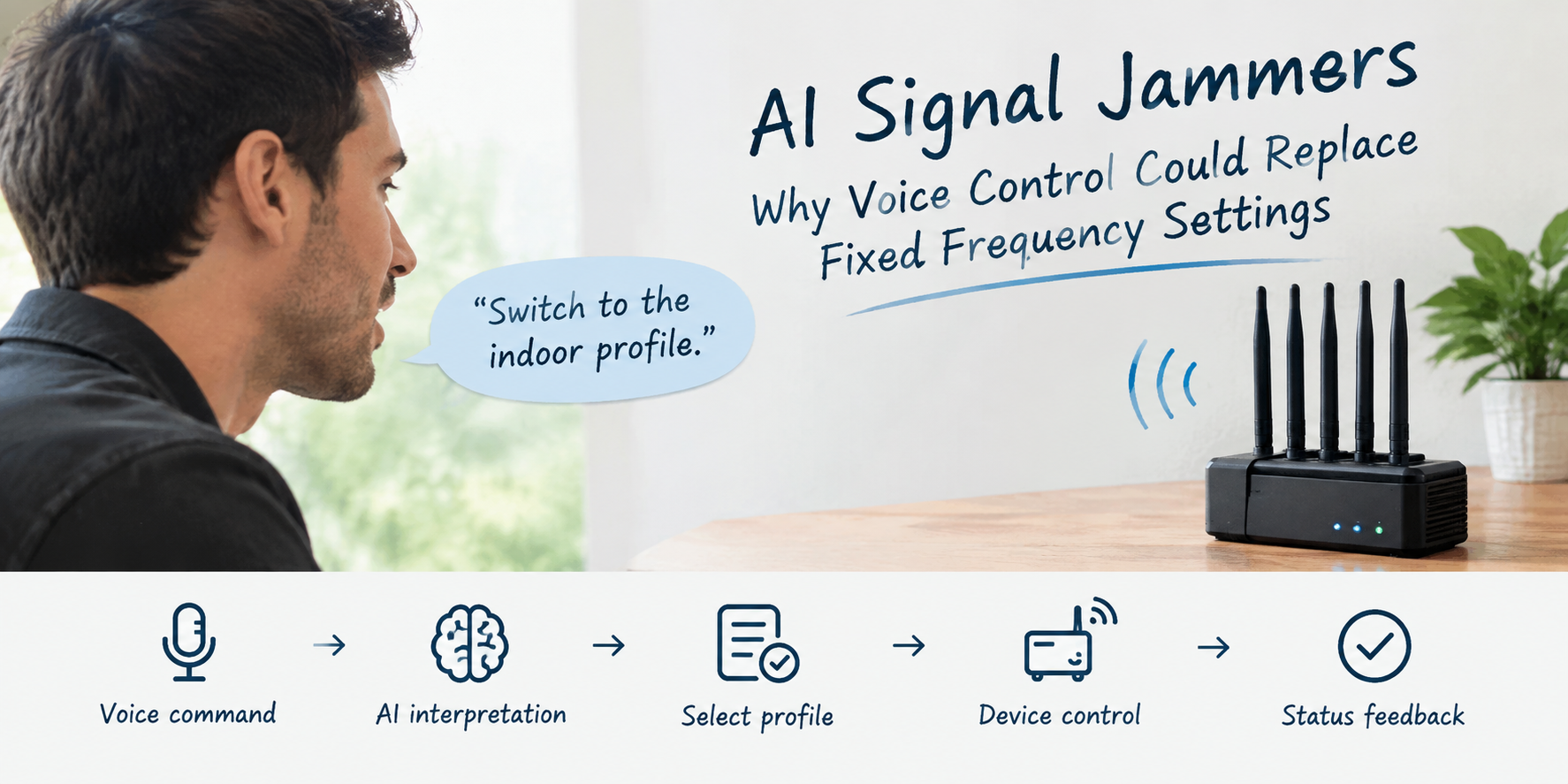
From Frequency Settings to User Intent
Traditional jamming devices control is based on parameters.
Which frequency? Which mode? Which setting?
AI can turn this into a different interaction:
What do you need the device to do?
This is a subtle but important difference. The user no longer needs to know every technical detail behind the operation. The AI becomes an interface between the user's request and the device's available functions.
For example, rather than manually navigating several menus, a future voice-controlled Silencer could recognize a command such as:
"Switch to the configured indoor profile."
The system interprets the request, identifies the corresponding profile and reports the selected operating mode.
The hardware has not necessarily become dramatically more powerful. The interaction has become smarter.
Why Fixed Frequencies May No Longer Be the Main Focus ?
Adding more preset frequencies is relatively straightforward. But a device with 30 predefined settings is still fundamentally a preset-based device.
AI changes the emphasis from selection to interpretation.
This could be particularly useful as wireless environments become more complicated. Cellular networks, Wi-Fi, Bluetooth, GNSS and other wireless technologies do not exist in isolation. A user may care about a particular operating situation rather than knowing the technical details of every signal involved.
That is where natural-language control becomes interesting.
The user describes the requirement. The AI determines which available configuration corresponds to that request.
Voice Control Alone Is Not Enough
There is an important difference between a device with voice commands and a genuinely AI-assisted jammer.
If a device only understands five fixed phrases such as "start," "stop" and "mode two," it is essentially a conventional control panel with a microphone.
A more advanced system would need to understand intent, recognize context and respond appropriately to ambiguous commands.
The architecture could therefore look like:
Voice command → AI interpretation → approved profile → device control → status feedback
The AI is not simply replacing buttons. It is translating human language into controlled machine actions.
The Future May Be About Simplicity, Not More Settings
The strongest advantage of AI in signal-jamming hardware may ultimately be usability.
More frequencies, more switches and more technical parameters do not necessarily make a device easier to operate. In some cases, they make it more complicated.
A genuinely useful AI Jammer would move in the opposite direction: more intelligence behind the interface and less technical complexity in front of the user.
That is why the next step in jammer technology may not be another frequency band or another physical switch.
It may simply be a microphone and an AI system that understands what the user means.
