
What Does "Effective" Really Mean for a Drone Jammer ?
When comparing a drone jammer, most buyers look at three things first: power, frequency bands and range.
But one word can be even more misleading:
Effective.
A product may be described as an effective UAV blocker or advertised with a specific anti-drone jammer effective range. It is easy to read this as a simple promise: switch it on, and the drone immediately reacts.
In practice, "effective" needs context.
The real question is not simply whether a drone jamming device is effective, but what "effective" means under the conditions in which it was tested.
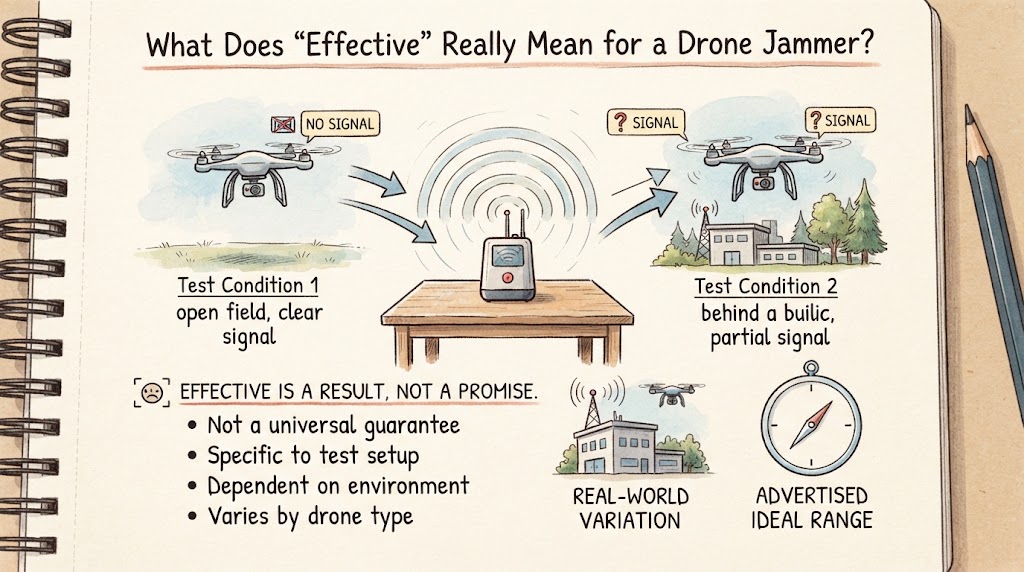
Effective Does Not Mean an Immediate Visible Reaction
A common assumption is that an effective drone radio jammer should cause an obvious change immediately.
That is not necessarily what a product specification means.
A reported result may come from a particular test setup involving specific equipment, distance, environment and signal conditions. Change those conditions, and the observed result may change as well.
So FPV jammer effectiveness is not necessarily a universal result that applies to every drone and every environment.
"Effective" describes a result under particular conditions—not an unlimited guarantee.
Drone Jammer Effective Range Is Not a Fixed Circle
The same issue applies to drone jammer effective range.
If a specification states a certain distance, it is tempting to imagine a perfect circle around the device: inside the circle, the effect is the same; outside it, there is none.
Real radio environments are more complicated.
Buildings, terrain, structures and other radio signals can affect signal propagation. The equipment being tested and its configuration also matter.
That means an advertised uav jammer range should be treated as a reference value tied to a test condition, rather than a perfectly defined boundary.
Distance matters, but distance alone does not define performance.
Frequency Coverage Is Not the Same as Drone Compatibility
Frequency specifications can create another misunderstanding.
A drone jammer frequency band specification tells you which parts of the radio spectrum the equipment is designed to cover. It does not automatically mean that every drone using a related band will respond in exactly the same way.
Frequency coverage is one technical factor.
The actual communication system, signal characteristics and other functions of the drone are separate considerations.
So these two statements should not be treated as equivalent:
"The device supports this frequency band." Click here to learn more Which Radio Frequencies Do Drones and Quadcopters Use?
and
"This particular drone will show this particular response."
The first describes a specification. The second describes real-world behavior.
A Drone’s Behavior Is Only One Part of the Picture
Another common mistake is judging uav jammer effectiveness purely by watching the drone.
A drone may continue flying, change its behavior, switch modes or appear unaffected for a period of time.
But visible flight behavior alone does not necessarily reveal what is happening to the underlying communication or navigation signals.
Different drone systems can also have different control, navigation and safety mechanisms. As a result, two models may not react in the same way under similar radio conditions.
Therefore, "the drone kept flying" does not automatically prove that there was no effect.
Likewise, a visible change in flight behavior does not, by itself, identify exactly which signal or system caused it.
Observation and conclusion are not the same thing.
The Test Conditions Define What "Effective" Means
When reading a drone jammer test, one question is more useful than simply asking for the claimed range:
Under what conditions was the result obtained?
Important details may include:
- test distance;
- test environment;
- equipment configuration;
- frequency bands involved;
- drone or system being tested;
- measurement method;
- and the specific result used to define "effective."
A statement such as "effective up to X meters" provides limited information without the conditions behind it.
A clearly documented test tells you much more.
Why Drone Jammer Tests Can Produce Different Results ?
Two tests of the same device can produce different results even when the equipment itself has not changed.
The surrounding radio environment may be different. The test position may have changed. The drone may be operating under different conditions. Other signals or physical structures may also affect the result.
This is why a uav jammer test is more meaningful when the main conditions remain comparable.
A single observation can show what happened at one moment.
It does not necessarily describe the device's performance in every other situation.
What Should Buyers Look at Instead of "Effective"?
Rather than asking only:
"Does this uav jammer work?"
a more useful question is:
"Does the documented performance match my actual requirements?"
That means checking several things together:
- What frequency bands are specified?
- How is the effective range defined?
- Under what conditions was it tested?
- What equipment was involved?
- How was the result measured or observed?
- Does the stated specification apply to the intended use case?
- Is the intended use permitted under local law?
This approach makes technical specifications easier to compare without turning one marketing phrase into a universal promise.
"Effective" Is a Test Result, Not a Magic Number
The word effective sounds precise, but without context it can mean very little.
A quadcopter jammer may have documented frequency coverage, output specifications and an advertised effective range. Those figures are useful, but they describe different aspects of the product.
What matters is how those specifications come together under defined test conditions.
So instead of asking only:
"How effective is the drone jammer?"
ask:
"Effective under which conditions, measured how, and for what specific requirement?"
That is a much more precise way to read a drone jammer specification—and a better way to understand what an advertised drone jammer effective range actually represents.
