
Where Does a GPS Jammer's Effective Range Actually Start ?
A GPS tracker jammer effective range sounds like a simple number.
50 meters. 100 meters. 500 meters.
But there is a question behind that number that rarely gets asked:
Where does the measurement actually start?
It sounds obvious. Measure from the jammer to the GPS receiver and you have the distance.
Not quite.
When people talk about GPS jammer range, they often mix together three different things: the distance between the equipment, the range printed in a product specification, and the point where a GPS receiver begins to show a noticeable change.
Those are related, but they are not the same measurement.
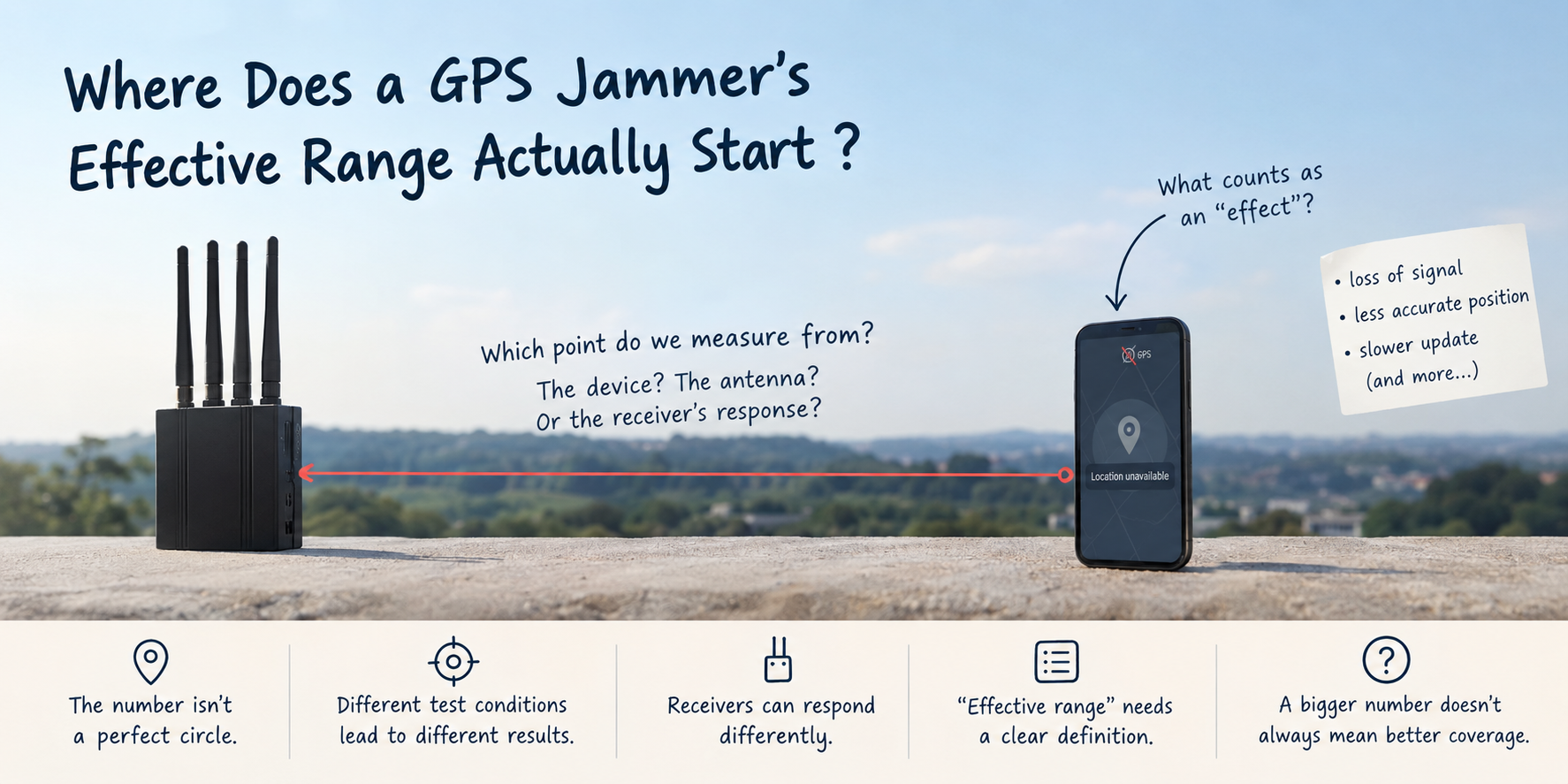
The Number on the Product Page Is Not a Circle
One of the easiest mistakes is to imagine an effective GPS tracker blocker range as a perfect circle.
Put the jammer in the middle, draw a 100-meter circle around it, and everything inside that circle should behave the same way.
That is a convenient way to visualize it.
It is not a very good way to understand what the number actually means.
A stated GPS blocker range is normally a reference value associated with particular test conditions. It does not automatically define a sharp boundary where the effect suddenly begins or disappears.
In other words, "100 meters" does not necessarily mean that 99 meters and 101 meters represent two completely different situations.
Radio systems do not work like a light switch.
So, Where Should the Distance Be Measured From?
This is where product specifications can become surprisingly vague.
Should the distance start from the edge of the enclosure?
From the center of the device?
From the antenna?
Or from the actual point where the receiver begins to show a measurable change?
For a buyer comparing different GPS jammer distance specifications, this distinction matters.
If two manufacturers use different reference points or different test methods, their range figures may look directly comparable when they are not.
That does not necessarily mean that either specification is wrong.
It means that the measurement needs context.
"Effective Range" Needs an Actual Definition
The word effective is doing a lot of work in these specifications.
Effective in what sense?
A receiver might continue operating normally at one point and show a change at another. But what counts as that change?
For one test, it might be a measurable degradation in positioning performance. For another, it might be a loss of usable positioning information.
Without knowing the test threshold, GPS jammer effective range is only a partial description.
This is an important distinction because "maximum range" and "range at which a defined effect was observed" are not necessarily the same thing.
The Receiver Is Part of the Equation
Another detail that is easy to overlook: the Silencer is only one side of the measurement.
The GPS receiver matters too.
Different receivers can have different antennas, sensitivity, processing methods and software behavior. A smartphone, vehicle navigation unit and dedicated GNSS receiver may therefore respond differently under similar radio conditions.
That makes phrases such as "GPS suppressor range for all devices" worth treating carefully.
There is no reason to assume that one measured result automatically describes every GPS-enabled device.
A Better Question Than "How Many Meters?"
Instead of looking only for the largest number, a more useful question is:
"What happened at that distance, and how was the result defined?"
For example, when evaluating a GPS jammer range test, look for:
- the reference point used for the distance;
- the type of GPS or GNSS receiver;
- what the test considers an "effect";
- how the result was observed or measured;
- and whether the stated distance is a maximum, typical value or test-specific reference.
This gives the range number some meaning.
Without those details, a large number can be surprisingly difficult to interpret.
Why Two "100-Meter" Jammers May Not Mean the Same Thing ?
Imagine two product pages.
One says:
Effective range: 100 m
Another says:
Coverage: 100 m
At first glance, they look identical.
But what if the first figure represents the distance at which a particular receiver showed a defined change, while the second is simply a general coverage estimate?
The numbers are the same.
The information is not.
This is one of the less obvious problems with comparing GPS jammer coverage area purely by the headline specification.
The first thing to compare should be the meaning of the measurement, not just the number itself.
Think of Range as a Measurement, Not a Promise
This is perhaps the simplest way to look at it.
A GPS jammer effective distance is useful when you know what was measured.
It becomes much less useful when the number is separated from the test behind it.
The physical distance between two devices is easy to measure. The more interesting question is what happens to the receiver at that location—and what threshold was used to decide that something had changed.
That is why a range figure should be read together with its test conditions.
The Small Detail Most Range Tables Leave Out
When someone asks, "How far does a GPS location blocker reach?", the natural answer is a number.
But a better technical description starts with another question:
"Reach for what, measured from where, and according to which result?"
That small distinction separates GPS jammer range, GPS blocker coverage, and observed receiver effect.
The distance itself is easy to write on a product page.
Understanding what that distance actually represents is the part worth paying attention to.
