
Why Is It So Difficult to Waterproof a High-Power Mobile Phone Jammer?
Making a high-power jammer waterproof sounds simple: keep water out and electronics inside.
The problem is heat.
High-power RF electronics generate substantial heat. A sealed enclosure helps block rain and moisture, but it also makes heat harder to escape. Fans can improve cooling, yet they require airflow—and airflow creates another path for water and dust to enter.
This creates the basic engineering trade-off:
Better sealing can make cooling harder. Better airflow can weaken environmental protection.
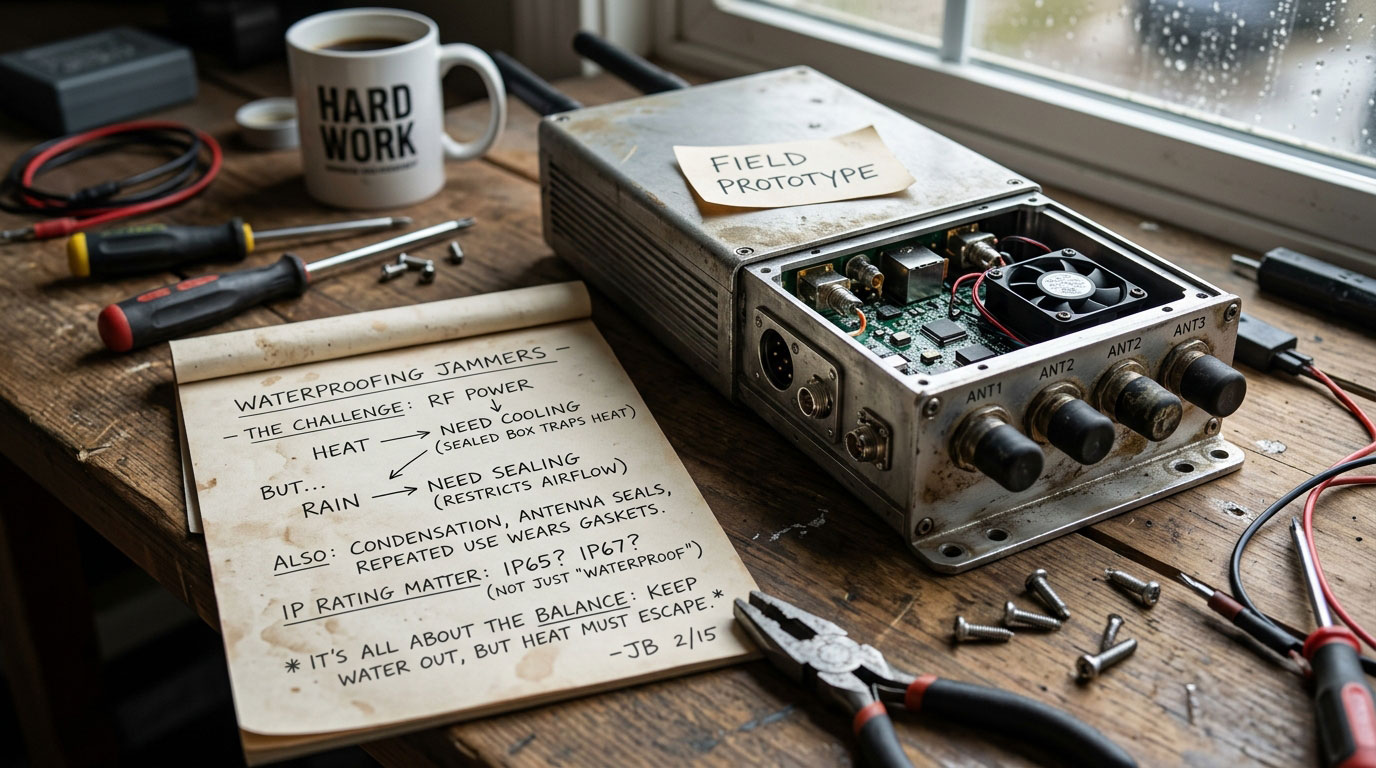
Cooling vs. Water Protection
A completely sealed enclosure can protect the electronics from rain, but trapped heat can raise internal temperatures.
Fan cooling solves part of the thermal problem, but ventilation openings must be carefully designed to prevent direct water entry. For outdoor equipment, thermal management and environmental protection therefore have to be designed together.
External Connections Are Another Weak Point
The enclosure is not the only path that needs protection.
A multi-band RF device may have several antenna connectors, cables, cable glands and removable covers. Each one creates another boundary between the electronics and the outside environment.
Even a well-sealed housing can have problems if its external connection points are poorly protected. Repeatedly connecting and disconnecting cables can also increase mechanical wear on seals and connectors.
"Waterproof" Has Limits
An IP rating is more useful than a general waterproof claim.
IP54, IP64, IP65 and IP67 describe different levels of protection under defined test conditions. They should not automatically be interpreted as permission to leave a device exposed to heavy rain indefinitely.
For an outdoor jamming dvice, the important questions are:
- What is the actual IP rating?
- How is the enclosure cooled?
- How are antenna connectors protected?
- What operating temperature range is specified?
- Is the device intended for occasional outdoor use or continuous outdoor installation?
Condensation Matters Too
Rain is not the only environmental problem.
Repeated heating and cooling can cause moisture and condensation inside equipment, even when there is no obvious water leakage. Long-term outdoor reliability therefore depends on more than simply passing a rain test.
Waterproofing Also Affects Maintenance
The more tightly an enclosure is sealed, the more carefully it must be opened and reassembled.
Gaskets, sealing rings and waterproof connectors have to remain correctly fitted. Frequent maintenance or cable changes can gradually increase the risk of compromising the original seal.
The Real Engineering Challenge
For a high-power phone jammer, waterproofing is ultimately a balance between several competing requirements:
RF power → heat → cooling
and
rain → sealing → restricted airflow
The challenge is not simply keeping water outside.
It is keeping water out while giving heat a reliable way to escape.
