
How to Tell If a 5G Phone Jammer Is Affecting VoNR Calls ?
Your phone still shows 5G. WhatsApp messages arrive. A webpage loads normally. But when you make a phone call, something suddenly changes.
The call takes too long to connect, fails completely, drops after a few seconds, or the phone switches from 5G to 4G.
So, is the 5G phone blocker affecting the voice call?
Not necessarily. The important point is that 5G data and VoNR voice calls are not the same service.
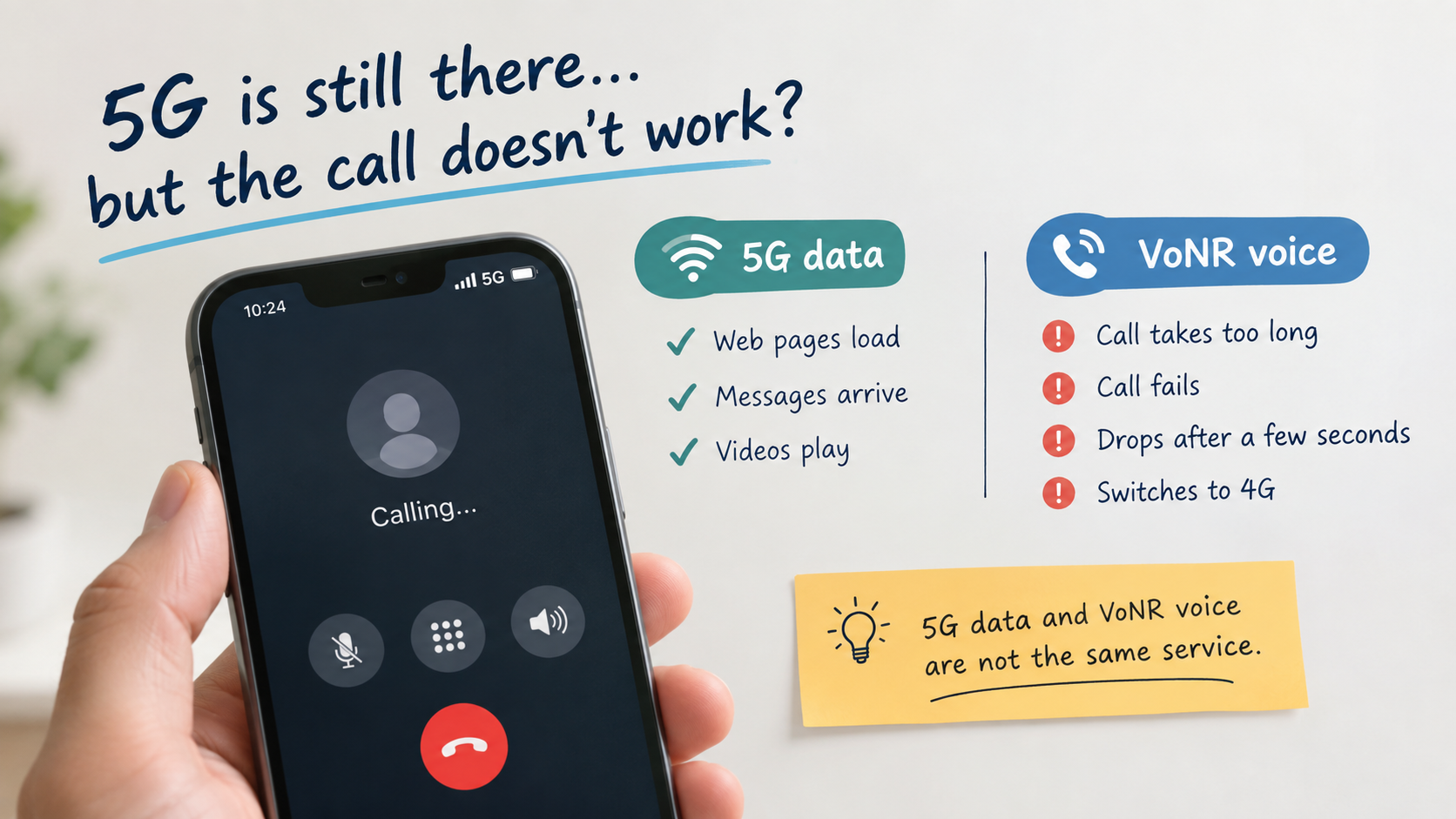
A Real-World Example: 5G Works, but the Call Doesn't
Imagine a phone connected to a 5G Standalone network.
Before making a call, everything looks normal:
- 5G is displayed on the phone.
- You can open websites.
- Videos continue to load.
- Messages arrive without a problem.
Then you press the call button.
The call takes several seconds to connect. Sometimes it fails. On another attempt, the phone changes from 5G to LTE before the call connects.
This is where simply looking at the signal bars can lead to the wrong conclusion.
The phone clearly still has mobile data. What has changed is the voice connection.
Why the 5G Icon Doesn't Tell the Whole Story ?
VoNR means Voice over New Radio. It allows compatible voice calls to run over a 5G network rather than treating voice as just another ordinary data connection.
So there are really two things to watch:
5G data: Can the phone communicate with the network?
VoNR voice: Can the phone establish and maintain the voice session?
They can behave differently.
For example, a phone may continue downloading data while its VoNR call setup becomes unreliable. This is why a 5G jammer cannot be evaluated simply by asking whether the internet still works.
What About the Phone Switching to 4G ?
This is another useful clue, but it needs to be interpreted carefully.
Suppose the phone is on 5G and you start a call. The display changes to 4G or LTE, and the call continues normally.
That does not automatically mean the 5G connection has been completely disrupted.
The network may be using EPS fallback, where the handset moves to LTE for the voice call.
Now consider a different pattern:
5G data works → call starts → voice setup repeatedly fails → no stable call
That is a different situation and deserves closer investigation.
The point is to watch what the phone does when a voice session begins, rather than only watching the network indicator while the phone is idle.
A Simple Test Tells You More Than Signal Bars
Suppose you want to compare normal operation with a test condition.
Start with the phone in its normal environment and make several calls. Note:
- Does the call connect immediately?
- Does the phone stay on 5G?
- Does it switch to LTE?
- Does the call remain stable?
- Do incoming calls work normally?
Then repeat the same type of test under the condition you are investigating.
Imagine the results look like this:
Normal:
5G data works → call connects quickly → stable voice
Test condition:
5G data still works → call takes much longer → VoNR fails or falls back → call becomes unreliable
That pattern is much more useful than saying, "The phone still has five bars, so the jammer cannot be affecting it."
Check IMS Instead of Guessing From Bars
If the handset provides network diagnostics, IMS registration is another useful indicator.
A simplified picture is:
5G connection → IMS registration → VoNR call → stable voice
If the phone has a 5G connection but the IMS or VoNR state changes when conditions change, that gives you a much better clue about where the problem occurs.
You also need to rule out ordinary network issues. A weak indoor signal, overloaded cell, unsupported handset configuration or operator-side problem can create similar symptoms.
The Most Interesting Clue Is the Difference
The strongest clue is often not "5G disappeared."
It is:
"5G data continued working, but voice behavior changed."
That difference is exactly why testing a 5G phone signal jammer through a simple speed test can be misleading.
A speed test tells you about data performance. It does not tell you whether a VoNR call can be established and maintained normally.
Bottom Line
If a phone still has 5G but starts having trouble with voice calls, don't immediately assume that the entire 5G connection has failed.
Compare what happens during data use, IMS registration and an actual VoNR call. Watch for delayed call setup, LTE fallback, dropped calls and changes that consistently appear under the same conditions.
In other words, don't ask only:
"Does the phone still have 5G?"
Ask:
"What happens to the phone when I actually make a 5G voice call?"
That is usually where the difference between a working 5G data connection and a working VoNR connection becomes visible.
