
AI Jammer: Dynamic Power Allocation Across Multiple RF Bands
Traditional jammers usually work with a fixed configuration. Each frequency band is assigned a predefined amount of RF power, and the system continues operating according to those settings.
But real-world RF environments are constantly changing.
A mobile phone jammer may encounter strong or weak cellular activity. A WiFi jammer may operate in an environment where 2.4 GHz and 5 GHz activity changes throughout the day. A GPS jammer may face a completely different RF environment again. The same principle can apply to systems covering UHF, VHF, LoJack and other wireless signals.
So why should every band receive the same fixed allocation all the time?
This is where the idea of an AI frequency blocker becomes interesting.
What Is an AI Jammer?
An AI jammer is an RF interference system designed to respond to changing RF conditions rather than relying entirely on fixed settings.
The basic concept is simple:
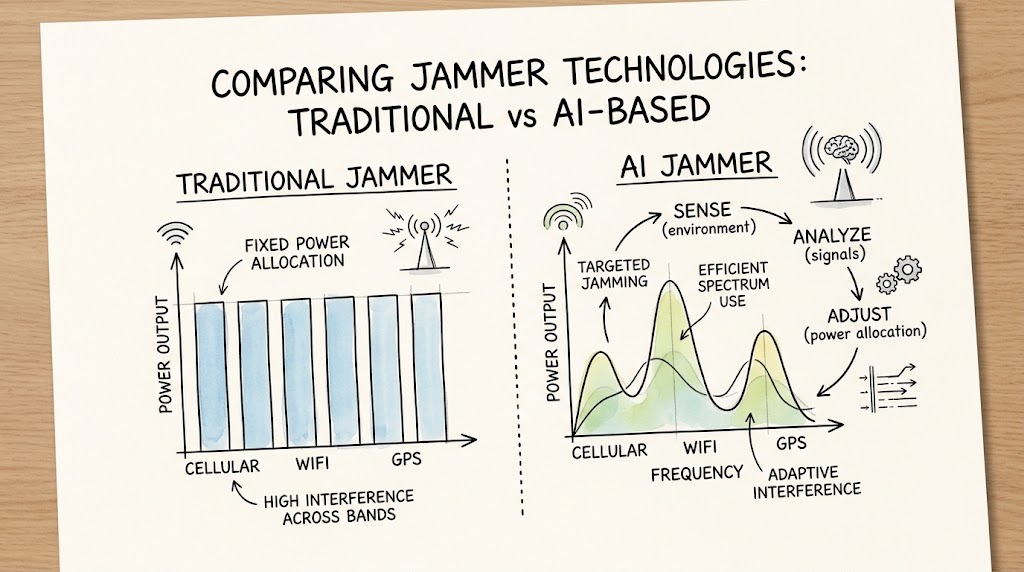
Detect → Analyze → Adjust → Repeat
Instead of giving every supported band a fixed allocation, an intelligent system could evaluate the surrounding RF environment and dynamically manage its available resources.
The goal is not simply to produce more RF power.
It is to use available resources more intelligently.
A Simple Example
Imagine a multi-band system supporting cellular, WiFi, GPS and other RF categories.
At one moment, cellular activity may be much stronger than WiFi activity. An adaptive system could recognize this difference and adjust its resource allocation accordingly.
Later, the RF environment changes. WiFi activity becomes more significant while cellular activity decreases.
The system could reassess the environment and adapt again.
A conventional fixed-power jammer would continue following its original configuration.
An AI-powered blocker is based on a different idea: the RF environment changes, so the system should be able to change with it.
From Cell Phone Jammers to Multi-Band AI Systems
The concept could eventually apply across different types of RF equipment.
A future AI cell phone jammer could dynamically respond to changing cellular activity.
An AI WiFi jammer could monitor changing WiFi activity instead of relying solely on a fixed configuration.
A GPS blocker could be part of a broader adaptive RF platform capable of managing different signal categories.
The same concept could extend to systems involving UHF, VHF, LoJack and other RF technologies.
This is what makes AI-assisted RF technology potentially different from simply adding more frequency bands to an existing device.
Fixed Power vs. Adaptive RF
The difference can be summarized in one sentence:
Traditional jammer: fixed settings.
AI jammer: adaptive settings based on changing RF conditions.
A conventional system might be configured once and then left running.
An intelligent RF system could continuously reassess its environment and adjust its internal resource allocation.
That creates a feedback loop:
RF environment → sensing → analysis → adjustment → new RF conditions
Why Could AI Jammers Become a Trend?
Wireless environments are becoming increasingly crowded and dynamic.
Cellular networks, WiFi devices, GPS receivers, LoJack-related systems, UHF and VHF communications and many other RF sources can coexist in the same general environment.
A fixed configuration does not necessarily reflect these changes.
This creates a potential role for adaptive RF technology.
Instead of asking:
"How much power should each band always receive?"
an intelligent system asks:
"What is happening in the RF environment right now?"
That is the fundamental idea behind the next generation of AI disruptors and intelligent RF systems.
The Future of AI Jamming Technology
The future development of RF interference equipment may therefore be less about simply increasing total output power and more about dynamic resource management.
Whether the system is designed around cellular signals, WiFi, GPS, UHF, VHF, LoJack or multiple RF categories, the underlying concept remains the same:
sense the environment, understand the changes and adapt the system accordingly.
That is why AI jammer technology, adaptive RF jammers and intelligent RF interference systems are becoming interesting concepts in the development of next-generation RF equipment.
