
GSM, 4G LTE and 5G: Why Cell Phone Jammer Range Varies ?
A cell phone jammer does not necessarily have the same effective range on every mobile band.
A multi-band device may affect a GSM 900 signal at a greater distance while its range on a higher-frequency 4G or 5G band is shorter. So a specification such as "50 m jamming range" should not automatically be interpreted as 50 meters for every supported frequency.
The reason is simple: different RF bands do not propagate in exactly the same way, and the phone signal itself may arrive at very different strengths.
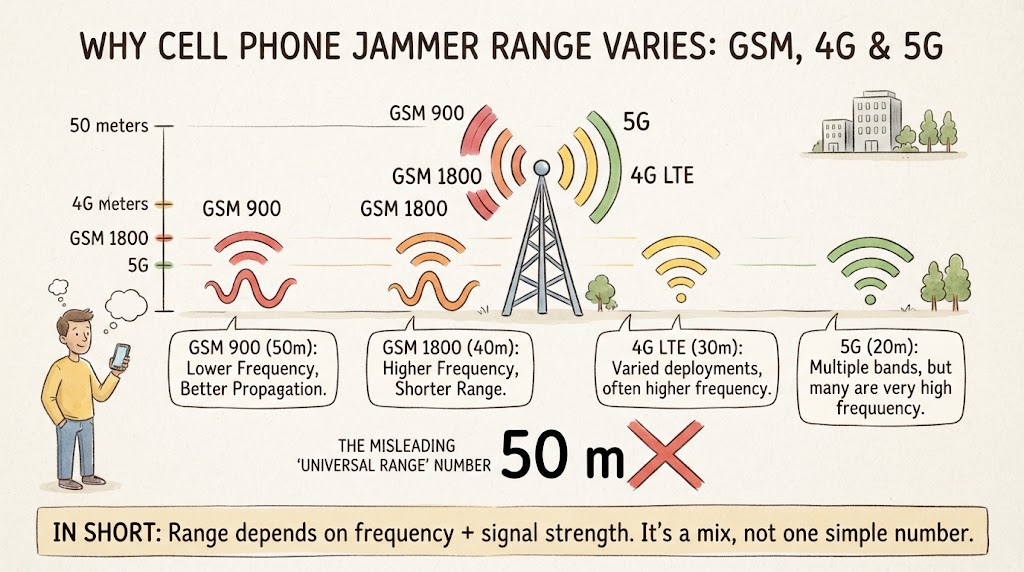
GSM, 4G and 5G Do Not Behave the Same
Consider a hypothetical multi-band mobile network blocker covering GSM 900, GSM 1800, 4G LTE and 5G.
The GSM 900 band operates at a lower frequency than GSM 1800, while many 4G and 5G deployments use higher-frequency spectrum. In general, lower frequencies experience less free-space path loss over the same distance and can have better propagation characteristics.
That does not mean:
Does a Higher Frequency Mean It's Harder to Jam ?
Frequency is only one part of the RF link.
A portable cell phone jammer, high-power cellular phone jammer, or multi-band mobile phone jammer also depends on its RF output, antenna characteristics, surrounding signal level and propagation environment.
This is why two frequency bands from the same 5G Jammer can have noticeably different coverage.
The Strongest Signal Can Be the Hardest One to Disrupt
There is another important point that is often overlooked.
The practical range of a mobile network jammer is not determined by frequency alone. It also depends on how strong the legitimate cellular signal is at the location.
A phone receiving a strong nearby cellular signal has a different RF environment from a phone receiving a weak signal through walls or over a longer path.
This creates an important distinction:
The highest frequency is not automatically the hardest frequency to affect.
A lower-frequency GSM signal can sometimes remain usable farther away because of its propagation characteristics, while a higher-frequency signal may lose strength more rapidly. In another environment, however, antenna configuration, network deployment and local signal strength can change the result.
Why One "Jamming Range" Can Be Misleading ?
Suppose a multi-band phone jammer supports several cellular technologies and the practical coverage differs between them:
GSM 900: 50 m
GSM 1800: 40 m
4G LTE: 30 m
5G: 20 m
It would be misleading to treat "50 m" as the universal range of the device.
The more useful way to describe a long-range cell phone jammer is as a range envelope across its supported bands.
A single range number cannot fully describe the RF behavior of all these bands.
5G Is Not One Frequency
Another common mistake is treating "5G" as a single frequency range.
5G can operate across different portions of the spectrum, including sub-6 GHz bands and much higher-frequency ranges. Therefore, saying that 5G cell phone jammer range is always shorter than GSM range is too broad.
The actual comparison must be between specific frequency bands.
For example, comparing GSM 900 with a 5G band around 3.5 GHz is very different from comparing GSM 900 with a lower-frequency 5G deployment.
The same principle applies to 4G LTE jammer range, GSM jammer range, and 5G signal jammer range.
So Which Band Determines the Overall Range?
For a multi-band device, there is no universal rule that says one particular frequency must always determine the range.
If the requirement is that all supported cellular bands need comparable coverage, the band with the smallest effective coverage becomes the practical limitation.
That is why a manufacturer may quote a conservative overall figure even when individual bands can cover a greater distance.
In other words:
"The overall range of a multi-band cell phone jammer is better understood as the coverage of its weakest-performing band, not the maximum distance of its strongest band."
But even this should not be treated as a fixed law. The limiting band can change with frequency configuration, antenna characteristics, signal conditions and environment.
The Better Way to Read a Cell Phone Jammer Range
Instead of asking only:
"How many meters can this phone jammer block?"
A more useful question is:
"How does its range vary across GSM, 4G LTE and 5G bands?"
That distinction is important when comparing a portable 5G cell phone jammer, high-power GSM jammer, 4G 5G cell phone jammer, or multi-band cellular jammer.
A specification such as "up to 50 meters" describes a maximum or general coverage figure. It does not mean every supported cellular frequency will behave identically at 50 meters.
The key variables are the frequency band, RF output, antenna characteristics, cellular signal strength and propagation environment.
That is why a GSM signal may remain affected at a distance where another 4G or 5G band no longer shows the same coverage.
In Short
A phone jammer range is not a single number independent of frequency.
GSM, 4G LTE and 5G can have different effective ranges because their frequencies propagate differently and because the strength of the cellular signal varies by location.
So if a multi-band cell phone jammer is rated at 50 meters, the right interpretation is not “every band works to 50 meters.”
It is better understood as a band-dependent RF coverage range.
