
Will Future high power mini Cell Phone Jammers Have Built-In Antennas and Batteries?
Some Compact GSM cell phone jammers already feature built-in antennas, but compact designs often involve trade-offs. Certain models have limited output capability, while others are bulky or depend on an AC power supply.
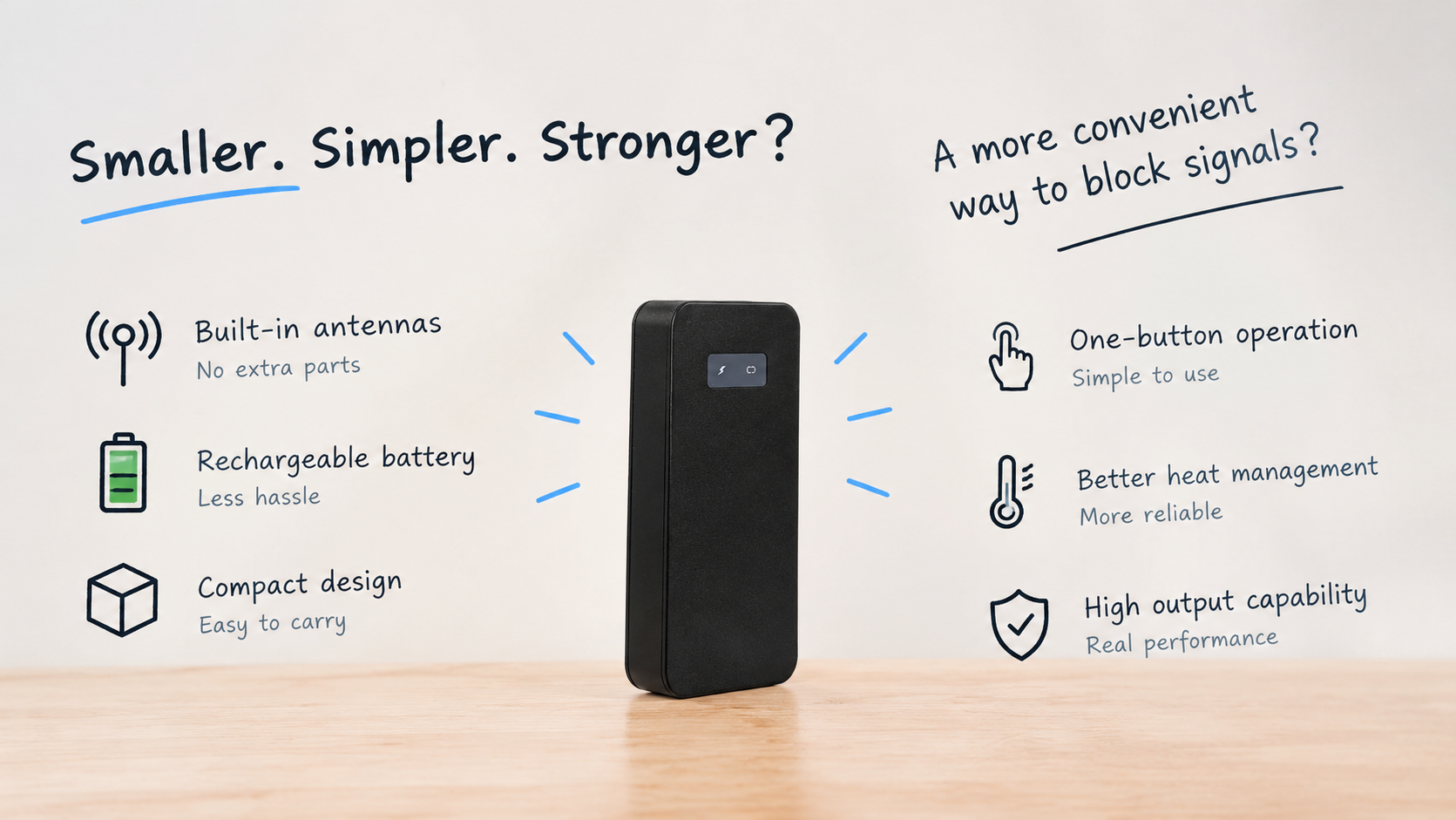
Could future designs combine built-in antennas, a rechargeable battery, a compact enclosure and higher output capability in one device that requires no assembly and is simple to operate?
The idea is technically plausible. The real challenge is fitting everything into a small body without compromising thermal management, battery life or reliability.
Why Is It Difficult to Make a Mini Powerful signal blocker ?
The problem is not simply the size of the antennas. A battery, radio-frequency electronics and thermal management system all compete for limited internal space.
Higher power consumption generally means shorter battery life unless energy efficiency or battery capacity improves. A larger battery adds weight, while a smaller enclosure leaves less room for heat dissipation.
A compact, battery-powered 5G mobile cell Jammer must balance size, power consumption, operating time and heat—not optimize just one specification.
That is why a small enclosure does not automatically mean high performance or long battery life.
Built-In Antennas vs External Antennas
An internal antenna is not necessarily less capable than an external one. Performance depends on the antenna design, operating frequencies, enclosure and surrounding components. Internal vs. External Antennas: Which Signal Jammer Consumes More Power ?
Built-in antennas can eliminate loose accessories, simplify storage and create a cleaner, more portable design. However, fitting multiple antenna elements into a limited space introduces engineering challenges, particularly when different frequency bands are involved.
The key distinction is simple: built-in antennas describe the design, not the performance. The complete system must still meet its intended specifications.
Can a Rechargeable Battery and High Output Capability Coexist?
Potentially, yes. But battery capacity, energy consumption and operating time remain closely connected.
More efficient electronics and better battery integration could improve the balance. Yet heat remains a limiting factor: components generate heat during operation, and a smaller enclosure provides less room to dissipate it.
Consequently, a high-power portable blocker with a built-in battery is not just a miniaturization challenge. It is a matter of balancing energy, thermal limits, size and weight.
The difficult part is not making the device smaller; it is maintaining practical operating time and reliable performance in a smaller enclosure.
Will One-Button Operation Become the Next Design Trend?
For users, the appeal is obvious: unpack the device, switch it on and avoid dealing with separate antennas, cables or complicated controls.
Integrated antennas make this experience easier to achieve, but they do not guarantee it. A genuinely user-friendly design also needs clear indicators, convenient charging and straightforward controls.
Future portable electronics may increasingly prioritize no-assembly setup, integrated components and simpler operation. These improvements can make a product easier to handle without changing the fundamental engineering constraints.
What Will Future Compact Designs Look Like?
The most practical design would combine:
- Built-in antennas to eliminate separate antenna components.
- A rechargeable battery for battery-powered operation.
- A compact enclosure for easier storage and transport.
- Simple controls that reduce unnecessary setup.
- Effective thermal management and realistic operating-time expectations.
These features are individually achievable in portable electronics. Combining them with high output capability in one small device is more demanding, and no single design will suit every requirement.
Is This the Future of Portable mobile Phone Jammers?
A compact device with built-in antennas, an internal battery and simple controls is a plausible engineering direction. Improvements in component efficiency, battery integration and thermal design may help bring these features together.
However, small size, high output capability and long battery life remain competing requirements. Progress in one area does not automatically solve the others.
The real innovation would be a self-contained jammer device that balances portability, usability, reliability and verified performance—not merely one that looks like a smartphone.
The future may bring more integrated designs, but the decisive factor will be how well the entire system works together.
