
Does a Wider 5G Channel Really Make a Phone Harder to Jam ?
A phone can show 5G on the screen without telling you much about the connection behind that symbol.
It doesn't tell you whether the phone is using a 20 MHz, 50 MHz or 100 MHz channel. It doesn't tell you which frequency range is being used either.
And those details can matter when the phone is exposed to RF interference.
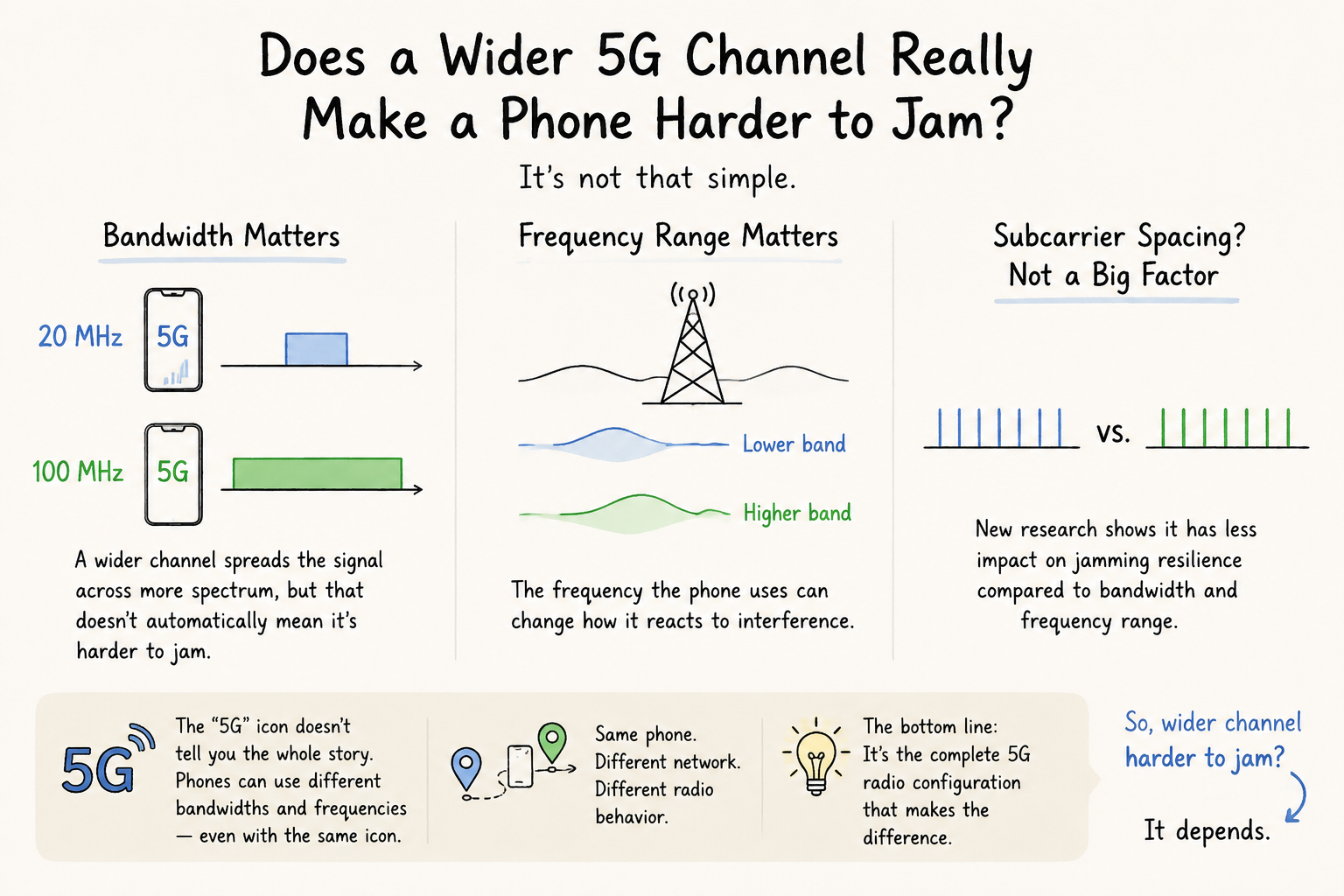
A study published on July 31, 2026, compared several 5G NR configurations under jamming conditions. One result is particularly interesting: channel bandwidth and frequency range had a noticeably greater effect on interference resilience than subcarrier spacing or the choice of cellular technology itself.
That makes the question more interesting than simply asking whether 5G is "harder to jam".
What does channel bandwidth actually change?
Take two 5G connections.
One uses a 20 MHz channel.
The other uses a 100 MHz channel.
The second connection isn't simply five times "stronger". Channel bandwidth describes how much spectrum the connection occupies.
That changes the relationship between the wanted signal and unwanted RF energy.
This is why 5G channel bandwidth and interference should not be treated as completely separate subjects.
A wider channel can respond differently to interference because the communication is spread across a broader portion of the spectrum.
But there is an important point here:
Wider does not automatically mean harder to interfere with.
The effect depends on the complete radio configuration and the conditions under which the connection is operating.
20 MHz and 100 MHz can produce different radio behaviour
Bandwidth is often discussed in terms of network speed.
20 MHz sounds limited.
100 MHz sounds powerful.
For everyday smartphone use, that makes sense.
From an RF perspective, however, the important question is different:
How is the available spectrum being used?
A wider channel changes the occupied bandwidth of the 5G connection. When interference is present, that can affect how the receiver sees the wanted signal.
The recent study found channel bandwidth to be one of the more important variables affecting the simulated resilience of 5G NR against jamming.
So if someone compares 5G interference resistance without considering channel bandwidth, part of the picture is missing.
Frequency range matters too
Bandwidth tells us how wide the channel is.
Frequency tells us where it is.
Those two things should not be mixed together.
The same smartphone can connect to different network configurations depending on location and network deployment. It may still display the same 5G icon even though the underlying radio conditions have changed.
That helps explain why a phone can behave differently in two locations while apparently remaining on the same network technology.
The handset hasn't changed.
The radio link has.
For anyone looking at GSM 3G 4G 5G cellular Jammer performance or cellular interference, this distinction is important.
What about subcarrier spacing?
This is where the recent research becomes especially interesting.
5G NR uses different subcarrier spacings as part of its flexible radio design. It would be easy to assume that this parameter must have a major influence on interference resistance.
The study suggests otherwise.
Under the simulated conditions, subcarrier spacing had a relatively small influence compared with channel bandwidth and frequency range.
That doesn't make subcarrier spacing unimportant.
It simply shows that not every 5G parameter has the same weight when looking specifically at RF interference.
The less talked-about parameter — channel bandwidth — may actually deserve more attention.
Why the "5G" icon isn't enough ?
This is probably the easiest mistake to make.
Two phones can both display:
5G
Yet they may be using different frequency ranges and channel bandwidths.
The user sees one symbol.
The modem sees a much more complicated radio environment.
That's why comparing cell phone jammer behaviour by looking only at signal bars or the 5G icon can lead to very simple conclusions from a very complicated situation.
A phone showing three bars doesn't tell you its complete RF configuration.
Neither does the word 5G.
So, does a wider 5G channel make a phone harder to jam ?
Not automatically.
What the latest research shows is more useful than that simple conclusion.
Channel bandwidth can influence how a 5G NR connection responds to RF interference, and frequency range can have an equally important role. Subcarrier spacing, at least in the scenarios examined, appears to have a smaller effect.
So the better question isn't:
"Is 100 MHz harder to jam than 20 MHz?"
It is:
"How does the entire 5G radio configuration affect the connection when interference is present?"
That is a much more realistic way to look at modern cellular networks.
And it explains why the same phone can sometimes behave differently from one network or location to another, even when the screen simply says 5G.
