
GPS Interference Can Make Your Device Believe It's in Another Time
A GPS receiver can lose its position without losing its sense of time. But under certain GNSS interference conditions, the opposite problem can also occur: the receiver may process incorrect timing information as if it were valid.
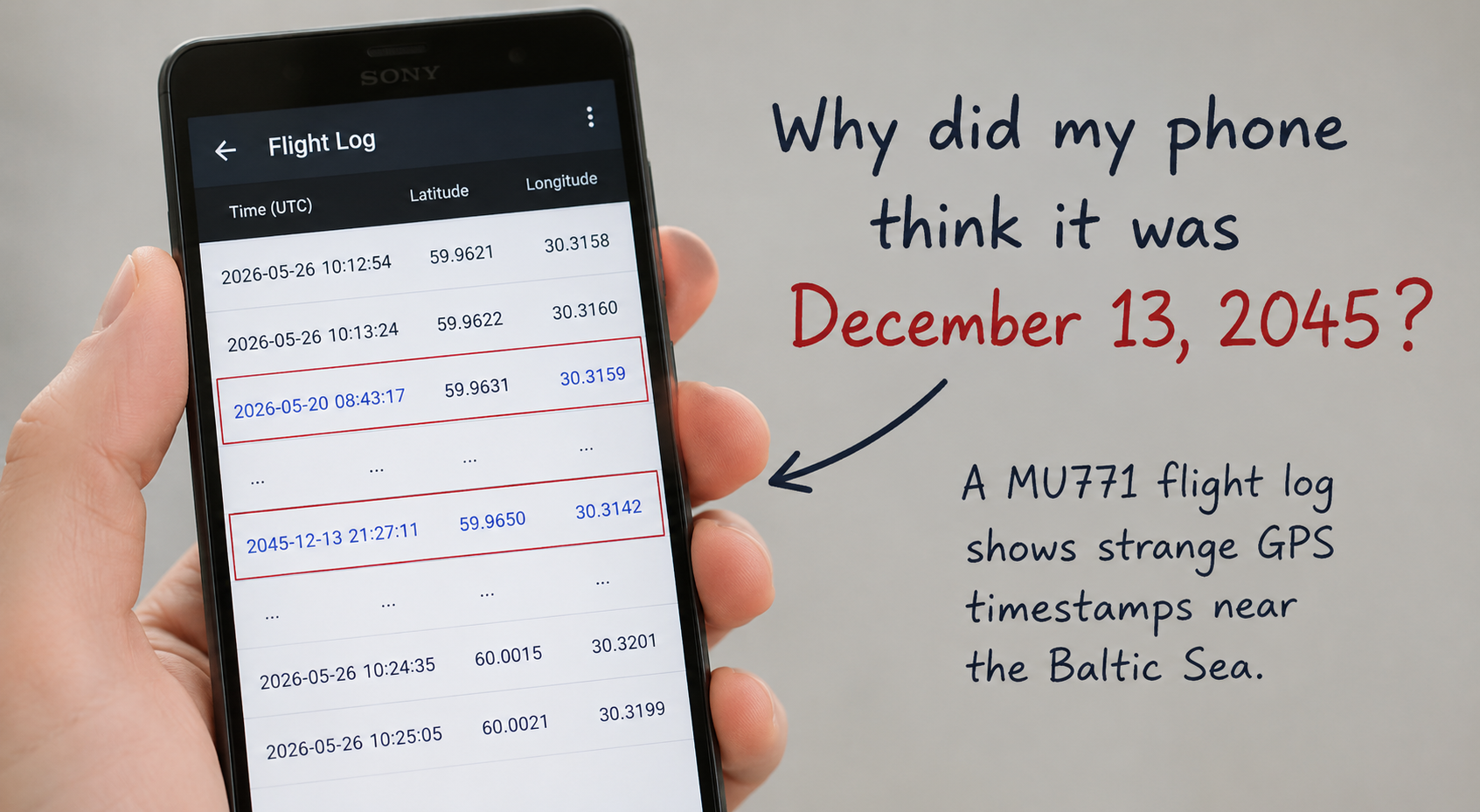
A strange example appeared in a flight-tracking record from China Eastern Airlines flight MU771, traveling from Shanghai to Amsterdam. A Sony Xperia 10 V recorded the flight in a GPX file. When the GNSS data was later examined, some timestamps contained dates that did not match the actual flight.
One sequence was dated May 20, 2026. Another showed December 13, 2045.
The anomalies occurred around the Baltic Sea and northwestern Russia. Increased GPS jamming due to Russian-Ukrainian war. The available record does not prove that a GPS jammer or GPS spoofing system caused the timestamps. It is an individual device log, not a controlled investigation. But it illustrates an important technical point: GNSS interference can affect more than positioning. Timing data can also become unreliable.
GPS Is a Timing System, Not Just a Positioning System
GPS is part of the broader GNSS family and provides more than latitude and longitude.
Every GPS satellite carries highly accurate atomic clocks. A GPS receiver compares the timing of signals from multiple satellites to calculate its position and synchronize its internal clock.
This is why GNSS is widely used for positioning, navigation and timing (PNT).
A GNSS receiver is therefore solving two related problems:
Where am I?
What time does my receiver clock indicate?
When GPS reception is clean, these calculations are highly reliable.
When the GNSS signal is disrupted, the situation changes.
What Does a GPS Jammer Actually Disrupt?
A anti jamming device for gps does not normally “delete” GPS data from a device.
Instead, GPS jamming introduces radio-frequency interference that can overwhelm the extremely weak signals transmitted by GPS satellites.
The result can be:
- loss of GPS lock;
- reduced signal-to-noise ratio;
- failure to acquire satellites;
- degraded positioning accuracy;
- intermittent GNSS fixes;
- complete loss of a navigation solution.
The same principle applies more broadly to GNSS jamming, which can affect GPS, Galileo, GLONASS, BeiDou and other satellite navigation signals depending on the frequencies and systems involved.
A conventional GPS jammer therefore tends to produce a relatively simple outcome:
The receiver cannot reliably use the satellite signal.
But GPS spoofing is different.
GPS Jamming vs. GPS Spoofing
GPS jamming attempts to prevent a receiver from obtaining a usable GNSS signal.
GPS spoofing attempts to make the receiver process false GNSS information.
That distinction is critical.
With GPS jamming, a receiver may effectively report:
No reliable GNSS signal.
With GPS spoofing, the receiver may instead calculate:
I have a valid GNSS signal and this is my position and time.
The second scenario is more subtle because the receiver may continue producing navigation data.
GNSS spoofing can potentially manipulate the calculated position, velocity and time (PVT) solution. That means the problem is not necessarily the absence of data. It can be the presence of incorrect data that appears usable.
How Can GPS Interference Affect Time?
GNSS receivers derive precise timing information from satellite signals.
If a receiver loses GNSS reception because of GPS jamming, it can generally fall back on its internal clock or another available time source. A short GPS outage may therefore have little visible effect on the device's displayed time.
GPS spoofing creates a different risk.
If a receiver accepts manipulated satellite signals, the calculated GNSS time can become incorrect. Depending on the receiver architecture and software, that information may be passed to applications as part of the GNSS data.
This is where an abnormal timestamp can appear.
The device does not necessarily change its normal system clock to 2045.
Instead, a GNSS-derived timestamp or recorded navigation point can contain an incorrect date or time.
That distinction is important when analyzing GPS interference.
Why the MU771 Example Is Interesting ?
The unusual part of the MU771 record is that the abnormal dates were associated with the GNSS tracking data rather than simply showing a phone whose system clock had been manually changed.
The appearance of 2045-12-13 is particularly striking because it is so far outside the actual flight date.
But it would be wrong to conclude:
“A GPS jammer made the phone travel to 2045.”
The evidence does not establish that.
Several technical mechanisms can produce abnormal GNSS data, including:
- GNSS signal interference;
- GPS spoofing;
- receiver reacquisition;
- corrupted navigation data;
- firmware behavior;
- application-level timestamp handling;
- unusual GNSS receiver states.
The case is therefore best treated as an example of GNSS data integrity failure, not as proof of a specific GPS jamming attack.
This is one of the most important distinctions in GNSS technology.
A receiver can have a GPS fix and still be receiving unreliable information.
Under normal conditions, a receiver calculates its position from signals received from multiple satellites. It evaluates those measurements and generates a navigation solution.
During GNSS spoofing, however, false signals can potentially be designed to resemble legitimate satellite signals.
The receiver may continue calculating:
latitude;
longitude;
altitude;
velocity;
time.
The output may look normal even though the underlying information is false.
This is why GPS accuracy and GPS integrity are not the same thing.
A device reporting “5-meter accuracy” does not automatically prove that its calculated position is actually five meters from the truth.
What Happens During GPS Jamming?
The behavior of a GPS receiver during jamming depends on the receiver, antenna, environment and type of interference.
A typical sequence can look like this:
Normal GNSS reception → degraded signal quality → unstable positioning → loss of satellite lock → GNSS outage
A navigation application may then:
- retain the last known position;
- stop updating the location;
- rely on other positioning sources;
- display reduced accuracy;
- report that the location is unavailable.
The visible behavior can therefore vary significantly between smartphones, vehicle navigation systems, marine receivers, drones and professional GNSS equipment.
The same GPS interference does not necessarily produce the same result on every receiver.
What Happens When GPS Is Jammed but the Clock Keeps Running?
A GPS jammer does not automatically stop a device's internal clock.
Modern devices can maintain time using several different sources, including:
- internal oscillators;
- cellular networks;
- internet time synchronization;
- GNSS timing.
When GNSS reception is interrupted, a device can continue using its internal time source.
This is known as holdover.
For a smartphone user, a short GPS outage may therefore be almost invisible. The map may stop updating while the clock continues to show the correct time.
For systems that require highly accurate synchronization, however, GNSS timing loss can be much more significant.
This is why GNSS jamming is considered a PNT resilience issue rather than simply a navigation problem.
GPS Jamming Is Not the Same as GPS Spoofing
The distinction can be summarized simply:
| GPS Jamming | GPS Spoofing |
|---|---|
| Interferes with GNSS reception | Supplies deceptive GNSS signals |
| Can cause loss of GPS lock | Can maintain an apparently valid fix |
| Often produces missing or degraded data | Can produce false position or time |
| Receiver may report an outage | Receiver may not immediately recognize the deception |
| Primary issue: availability | Primary issue: data integrity |
This difference is particularly important when investigating unusual GPS data.
A missing GPS signal is relatively obvious.
A false but believable GPS signal is much harder to detect.
Why GNSS Timing Matters ?
GNSS timing is used far beyond smartphone navigation.
Accurate GNSS time can support:
- telecommunications synchronization;
- financial timestamping;
- scientific measurements;
- power-grid timing;
- network synchronization;
- industrial systems;
- transportation infrastructure.
That makes GPS timing interference a much broader technical issue than a navigation app showing the wrong location.
The MU771 case is interesting precisely because the abnormal data raises this less obvious question:
What happens when a device trusts GNSS time that is no longer trustworthy?
The 2045 Timestamp Is the Real Clue
The most useful way to interpret the MU771 example is not as evidence that a phone literally “traveled into the future.”
It is evidence of something much more technical:
GNSS data can fail in ways that are not immediately visible to the user.
GPS jamming can cause a receiver to lose access to satellite signals.
GPS spoofing can potentially cause a receiver to calculate false navigation information.
And GNSS timing anomalies can expose a third problem: the receiver may have to decide whether the time information it receives is trustworthy.
For everyday users, the first sign of GPS interference may simply be a frozen location.
For a GNSS receiver analyzing raw navigation data, the failure can be much stranger — including timestamps that appear to come from another date entirely.
That is what makes the MU771 record worth examining.
The interesting question is not whether the phone really entered 2045.
It is whether the receiver had a reliable way to know that 2045 was wrong.
