
Your Cell Phone Jammer Detector Says "Over There." What If It's Wrong?
Imagine this.
A company's mobile network suddenly becomes unreliable. Calls drop. Phones show little or no service in one part of the building.
Someone suspects a hidden cell phone jammer.
A technician brings in direction-finding equipment. The result looks clear: the interference is coming from the east side of the building.
They search the offices.
Nothing.
They check the storage room, the ceiling, the electrical cabinets.
Still nothing.
Then they move the detector to another floor.
Now the interference appears to be coming from somewhere slightly different.
At that point, the obvious conclusion would be that the jammer is being moved.
But what if it never moved at all?
A 2026 study from Rice University explored exactly the kind of wireless scenario that could make this possible. The researchers showed that specially engineered curving radio beams can interfere with a receiver while causing its direction-of-arrival system to estimate a false direction. In their experiments, the approach could mislead both direct phase measurements and receive beamforming methods.
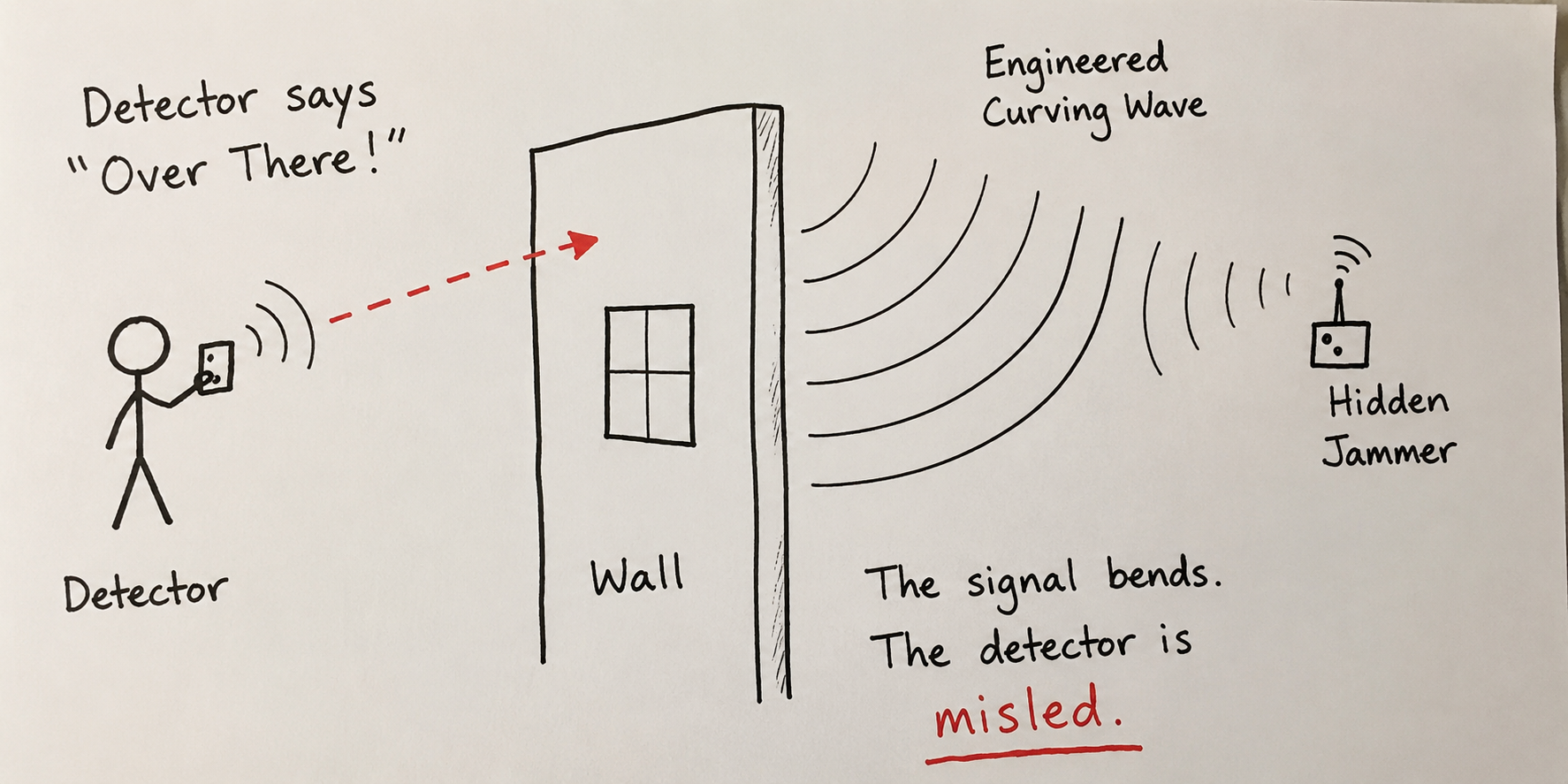
Example 1: The Detector Keeps Sending You to the Wrong Room
Suppose a phone jammer detector indicates that the interference is coming through the wall on your right.
You enter the next room.
Nothing is there.
You move again, take another measurement and get a new direction.
This could easily turn into a frustrating game of chasing the signal.
Normally, you might blame reflections from walls, metal surfaces or other obstacles. Those things already make indoor cell phone jammer detection difficult.
But the Rice research adds another possibility: the receiver may be measuring the direction from which the engineered wavefront arrives, rather than the true physical location of the transmitter. The two do not necessarily have to match.
That creates a useful question for anyone trying to locate interference indoors:
Am I tracking the jammer, or am I tracking the path the signal wants me to see?
Example 2: A Stationary Jammer That Appears to Move
This is probably the most interesting scenario.
Imagine placing several directional measurements on a map.
At 10:00, the suspected source appears to be near the parking area.
At 10:10, the estimated direction shifts toward another side of the building.
At 10:20, it appears to have moved again.
The natural assumption would be that someone is carrying a portable mobile phone blocker.
But the Rice researchers also examined how changing beam parameters could alter the apparent direction of the interference while the transmitter itself remained stationary. The research therefore raises the possibility of a jammer that can create misleading changes in perceived location.
That makes the long-tail question "why does a cell phone jammer detector show different locations?" more interesting than it first appears.
The answer may not always be poor equipment.
Sometimes the signal itself may be producing a misleading spatial picture.
Example 3: The Anti-Jamming System Blocks the Wrong Direction
Now imagine a more automated system.
Instead of sending a technician to search for the interference source, an antenna array automatically detects the direction of the jammer and attempts to suppress signals coming from that angle.
Under normal conditions, that makes sense.
But the Rice study specifically showed how curving beams could falsify direction-of-arrival estimates and undermine array nulling. In the researchers' laboratory evaluation, the interference could still cause severe degradation while conventional directional recovery methods were defeated.
So the problem is no longer simply:
Can the system detect the jammer?
It becomes:
What happens if the system reacts perfectly to the wrong direction?
A Different Way to Think About Finding a Phone disruptor
This research does not mean that every cell phone jammer can suddenly bend radio waves around a building or become impossible to locate. The demonstrated attack involves advanced engineered wavefronts and experimental millimeter-wave systems.
But the idea is worth paying attention to because it exposes a weak point in a very common assumption:
The direction of a signal is not always the direction of its source.
That may eventually change how advanced cell phone Silencer detection systems are designed.
Instead of trusting one directional reading, future systems may need to compare measurements from different locations and ask whether those results describe a physically consistent source.
So perhaps the next generation of hidden phone jammer detection will not begin with:
"Where is the interference coming from?"
It may begin with a more suspicious question:
"Can I trust where my receiver is pointing?"
