
Why Does a Phone Still Show 5G When the Connection Is Already Being Disrupted?
You look at your phone. 5G is still there.
The signal bars have not disappeared either. Yet a webpage refuses to load, a video keeps buffering, or a messaging app suddenly takes much longer to send a file.
So what is going on?
The simple answer is that a 5G connection does not have to disappear before its performance starts falling apart.
That distinction is easy to miss when talking about mobile phone blockers or RF interference.
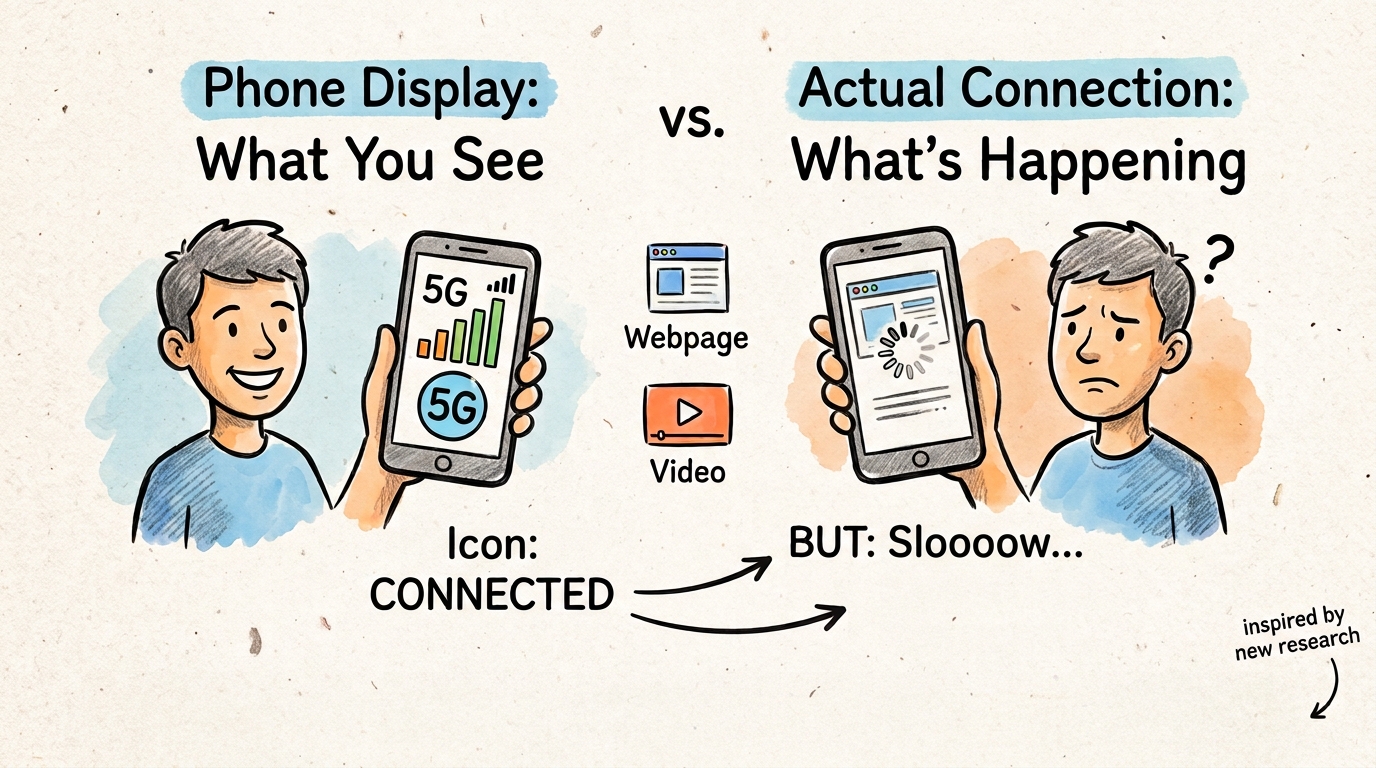
The 5G icon tells you less than you think
The 5G symbol mainly tells you that the phone is connected to a 5G network. It does not tell you how much useful data the connection can still carry.
A phone can remain attached to the network while experiencing:
- increasing packet loss;
- higher latency;
- slower data transfer;
- unstable applications;
- repeated retransmissions.
In other words, “5G connected” and “5G working well” are not the same thing.
This is one reason a simple mobile phone jammer test based only on the signal icon can be misleading.
A new study highlights something easy to overlook
A study published on July 31, 2026, examined how different 5G NR configurations behave under simulated jamming conditions. Instead of treating 5G as one fixed technology, the researchers compared frequency ranges, channel bandwidths and subcarrier spacing.
The interesting part is what they found.
Channel bandwidth and frequency range had a much stronger influence on resilience than subcarrier spacing or simply choosing 5G instead of 4G.
That matters because consumers normally see none of this information.
The phone says 5G.
Behind that small icon, however, the actual radio configuration can be very different.
A 20 MHz channel is not simply a “weaker” 100 MHz channel
This is where the subject becomes more interesting.
A wider channel does not mean that the phone is transmitting five times more power. Channel bandwidth describes how much spectrum the connection occupies.
The study compared configurations including 20 MHz, 50 MHz and much wider channels. Under its simulated conditions, wider channels retained more throughput and experienced less degradation when interference was introduced.
Why?
Part of the explanation is capacity. A wider channel has more room to carry data.
There is another important factor: interference power is distributed across bandwidth. The researchers found that wider channels could reduce the effective interference density when the same total interfering power was spread across a larger frequency range. As we wrote in a previous article: Why More Power Doesn't Always Mean More Range in Signal Jammers ?
That does not mean that a 100 MHz 5G connection is automatically immune to a 5G mobile jammer.
It means that bandwidth is one of the variables that can change how a connection behaves when the RF environment becomes unfavorable.
Frequency matters too
Imagine using exactly the same smartphone in two different locations.
In one location, it connects through a lower-frequency 5G configuration. In another, it uses a higher-frequency configuration.
The display may look almost identical:
5G
But the radio link is not identical.
Frequency affects propagation, attenuation and how signals interact with the surrounding environment. The 2026 study also found better resilience in its simulated FR2 configurations, partly because higher-frequency signals are more spatially confined and experience greater propagation loss.
This is an important point for anyone trying to understand 5G interference:
The frequency being used can matter just as much as the fact that the phone says 5G.
This explains a common “jammer test” mystery
Suppose someone tests a phone in two locations and gets different results.
In Location A, mobile data becomes unusable relatively quickly.
In Location B, the phone continues transferring data even though interference is present.
It is tempting to conclude that the phone, SIM card or mobile phone jammer must be behaving differently.
That may be only part of the story.
The phone could be connected to a different frequency range, using a different channel bandwidth, receiving a different signal level, or operating under different network conditions.
The same handset does not necessarily mean the same radio link.
So, does a 5G jammer have to make the phone show “No Service”?
No.
And this is probably the most useful takeaway.
A visible loss of signal is only one possible symptom of RF interference.
A connection can become inefficient before it disappears completely. The user may notice slow downloads, unstable streaming or connection timeouts while the phone stubbornly continues to display 5G.
That is why terms such as mobile phone jammer, 5G jammer, and cellular signal interference should not be understood only in terms of whether the signal bars reach zero.
The more meaningful question is what happens to the quality of the data connection.
What the new research really changes
The study does not prove that every commercial smartphone will behave in exactly the same way. It is a controlled simulation study, not a test of every phone and every carrier network. The researchers themselves use simulation to make different 5G physical-layer configurations comparable under controlled conditions.
But it does challenge a very common assumption:
5G is not one single radio configuration.
Bandwidth, frequency range and other physical-layer parameters can change the way a connection responds to interference.
So next time your phone still says 5G while everything online seems strangely slow, the icon may not be telling the whole story.
The network connection can be struggling long before the phone admits that it has lost the signal.
