
How to Detect GPS Interference Before the Location Disappears ?
When people think about GPS jamming, they usually imagine one obvious result: the GPS signal disappears.
But that is not necessarily the first sign of GPS interference. As we mentioned in our previous article, "Why Your GPS Signal Disappears for Completely Different Reasons"
A receiver can continue showing a location while the positioning solution is already becoming less reliable. The vehicle remains visible on the map, coordinates continue to update, and the tracking system may appear normal at first glance.
Look closer, however, and the track may begin to behave differently.
Small position jumps appear. The reported accuracy fluctuates. Satellite tracking changes. Signal-quality indicators begin to deteriorate.
The GPS has not disappeared. The confidence in the position has.
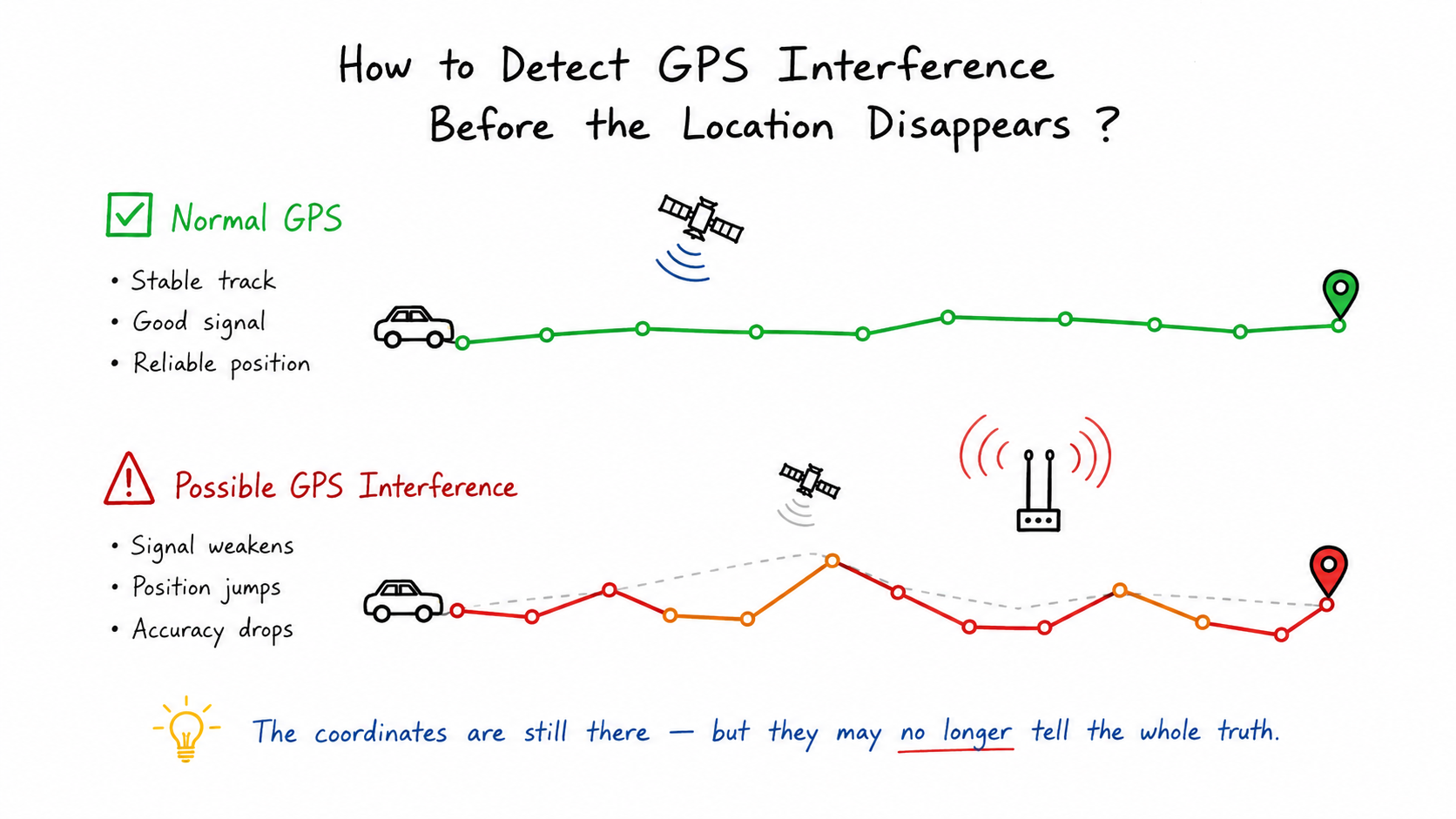
GPS Jamming Does Not Always Start With "No Signal"
Consider a vehicle traveling along a straight highway.
The track is stable at first. Then, without any obvious change in the vehicle's movement, the reported position begins drifting slightly from the actual route.
A few minutes later, more corrections appear.
The receiver is still calculating coordinates, but the positioning solution is becoming less stable.
This is one reason GPS jamming detection should not rely only on whether a receiver has lost its position.
GNSS interference can affect signal quality before complete loss of tracking. Measurements such as C/N₀ may decrease, while positioning errors can increase as the receiver struggles to maintain a reliable solution.
In other words:
"GPS available" does not automatically mean "GPS reliable."
Look for Changes in Positioning Behavior
A single inaccurate GPS point proves very little.
Buildings, reflections, multipath effects, poor satellite geometry, and urban environments can all produce positioning errors.
The more useful clue is a combination of changes.
For example:
- the GPS track becomes noticeably less stable;
- C/N₀ begins to fall;
- AGC behavior changes;
- satellite tracking becomes less consistent;
- signal reacquisition happens more frequently.
None of these is conclusive on its own.
But when several occur together, they may indicate conditions consistent with GPS signal interference.
This is why effective GNSS interference detection focuses on changes in receiver behavior rather than waiting for a complete positioning failure.
The Track Can Be an Early Warning
Imagine a vehicle traveling straight ahead while its recorded position begins moving:
+5 m → -4 m → +7 m → -6 m
The numbers themselves are not proof of GPS jamming.
The pattern is what matters.
If the deviations become more frequent while signal-quality measurements deteriorate and satellite tracking becomes unstable, the situation deserves closer attention.
This approach is particularly useful when investigating the signs of GPS jamming because interference may first appear as degradation rather than complete signal loss.
The receiver is still working.
It is simply having a harder time producing a position you can confidently trust.
Why GPS Jammer Detection Should Look Beyond Signal Loss ?
A simple monitoring system often treats GPS as binary:
working or unavailable.
Real-world GNSS positioning is not that simple.
Between a clean position and a complete loss of tracking, there can be a period of degraded performance.
That is the window worth watching.
For GPS jammer detection, the important question is therefore not only:
"Did the GPS signal disappear?"
It is also:
"Did the behavior of the positioning solution suddenly change?"
That shift in perspective can make interference detection much more meaningful.
Because the most useful warning may come before the map goes blank.
The coordinates are still there — but they may no longer tell the whole truth.
